
Active Packaging Market Size, Share, Trends and Forecast 2026 to 2035
Active Packaging Market (By Technology Type: Oxygen Scavengers, Moisture Absorbers, Antimicrobial Packaging, Ethylene Absorbers, Time-Temperature Indicators, Shelf-Life Sensing and Other Active Systems; By Material Type: Plastics and Polymer Films, Paper & Paperboard, Metal, Glass, Biodegradable and Bio-Based Materials, Others; By Packaging Format: Bags, Pouches & Sachets, Films, Wraps & Laminates, Rigid Containers, Bottles & Jars, Trays, Tubs & Clamshells, Cartons, Boxes & Other Paper Formats, Closures, Labels & Other Formats; By Application: Food & Beverages, Pharmaceuticals, Healthcare & Medical Products, Personal Care & Cosmetics, Electronics & Electrical Products, Agriculture & Fresh Produce, Industrial, Logistics & Other Applications) - Global Industry Analysis, Size, Share, Regional Analysis, Trends and Forecast 2026 - 2035
- Last Updated: 28 Oct 2026
- Report Code: ARC167
- Category: Construction and Manufacturing
Active Packaging Market Size and Forecast 2026 to 2035
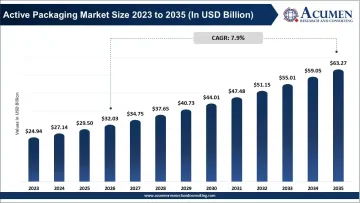
The global active packaging market size was valued at USD 29.50 billion in 2025 and is expected to reach at USD 63.27 billion by 2035, while expanding at a promising CAGR of 7.9% during the forecast period 2026 to 2035. Active packaging adoption is supported by rising demand for longer product shelf life, improved food safety, reduced spoilage, and better product stability during storage and transportation. Innovation in antimicrobial agents, oxygen scavengers, moisture-control systems, and sustainable packaging materials is expanding applications across food, beverages, pharmaceuticals, and other sensitive products.
Active Packaging Market Key Metrics
- Base Year Market Size (2025): $29.50 billion
- Current Year Market Size (2026): $32.03 billion
- Estimated Year Market Size (2035): $63.27 billion
- Forecast Period CAGR (2026-2035): 7.9%
- Leading Region: North America (39% Revenue Share)
Key Takeaways
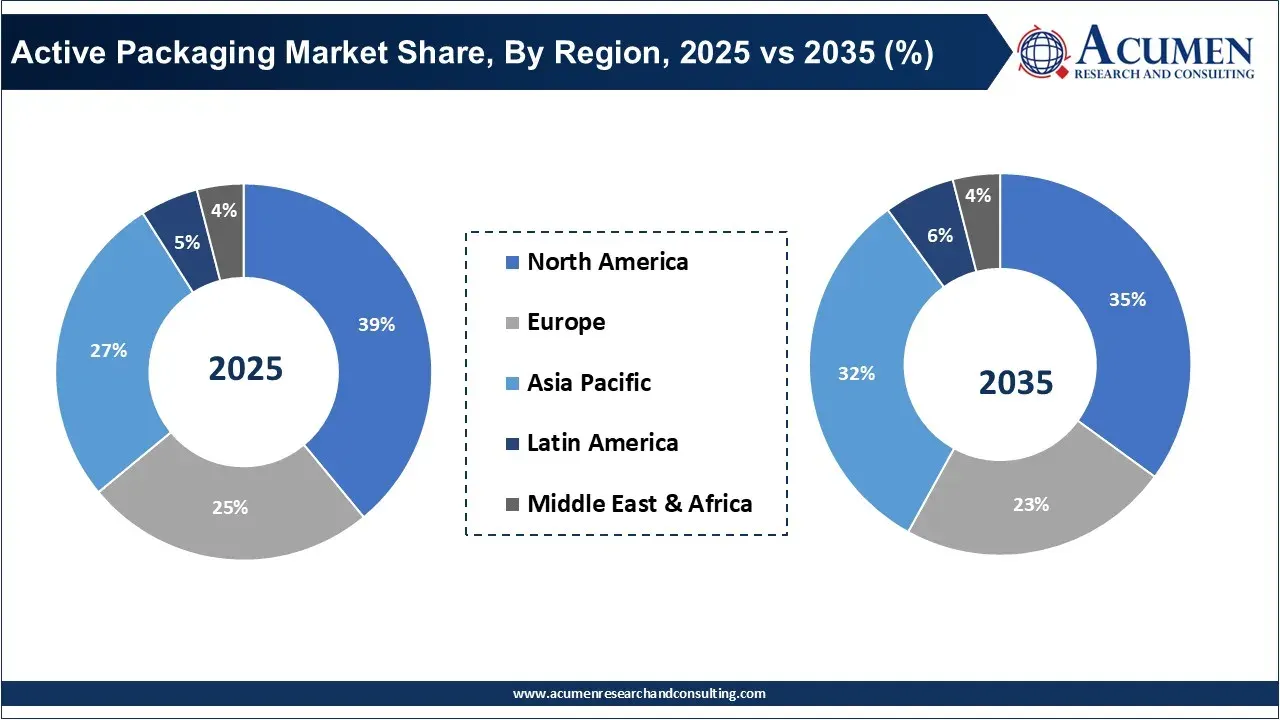
- By Region: North America led the market with a 39% share and USD 11.51 billion in revenue in 2025, supported by established food-processing industries, pharmaceutical packaging demand, and adoption of advanced packaging technologies.
- By Technology: Oxygen scavengers dominated the market in 2025, accounting for 31% of the total share, driven by demand for oxygen control, extended shelf life, and improved product quality across food, beverage, and pharmaceutical packaging.
- By Material: Plastics and polymer films held the leading position with a 45% share in 2025, supported by their flexibility, lightweight properties, sealing performance, and compatibility with active packaging technologies.
- By Packaging Format: Bags, pouches, and sachets accounted for the largest share at 30% in 2025, reflecting their convenience, material efficiency, and suitability for integrating oxygen scavengers and moisture-control systems.
- By Application: Food and beverages represented 55% of the market in 2025, driven by demand for freshness preservation, spoilage reduction, and longer shelf life across packaged foods, meat, seafood, dairy, and fresh produce.
Active Packaging Market Overview
The active packaging market is evolving from conventional product containment toward functional packaging systems that interact with the packaged product or its surrounding environment. Oxygen scavengers, moisture regulators, ethylene absorbers, and antimicrobial materials help manage conditions that contribute to deterioration. Recent innovation is focused on controlled release, natural bioactive ingredients, biodegradable substrates, and multifunctional packaging systems that combine preservation with improved safety and quality management. Commercial adoption depends on demonstrated performance, material compatibility, regulatory compliance, production costs, and end-of-life requirements.
Active Packaging Innovation Trends
- Controlled-Release Active Agents: Research published in 2025–2026 is increasingly focused on packaging that releases antimicrobial, antioxidant, or other functional compounds in controlled quantities rather than releasing them immediately after packaging.
- Natural Antimicrobial Ingredients: Essential oils, plant extracts, polyphenols, and other naturally derived compounds are being investigated to inhibit microbial growth and oxidative deterioration while supporting food-preservation requirements.
- Multifunctional Packaging Systems: Developers are combining oxygen scavenging, carbon dioxide regulation, antimicrobial activity, and moisture control in a single packaging structure to address multiple causes of product deterioration.
- Bio-Based and Biodegradable Materials: Research is expanding into polysaccharide-, protein-, and lipid-based films that incorporate active compounds while targeting reduced dependence on conventional petroleum-derived packaging.
Application-Specific Adoption and Demand Analysis
- Meat and Poultry: A 2026 review of PHBHHx-ZnO active packaging reported potential shelf-life improvements from approximately 3–5 days to 6–10 days for meat under the studied conditions. Antimicrobial activity and reduced pigment oxidation were identified as important preservation mechanisms.
- Seafood and Fish: A 2026 review reported that selected active bio-packaging systems increased the studied fish-storage period from approximately 6–8 days to 12–16 days. The evaluated benefits included lower microbial loads and slower oxidation, although outcomes depend on fish species, temperature, and packaging formulation.
- Dairy Products: Selected studies reviewed in 2026 reported extending the tested dairy products' storage period from approximately 7–10 days to 14–18 days using PHBHHx-ZnO packaging. The systems were evaluated for their ability to reduce light-induced oxidation, microbial instability, and off-flavor formation.
- Bakery Products: Selected PHBHHx-ZnO active packaging studies reported increasing the evaluated bakery-product storage period from approximately 5–7 days to 10–14 days. The primary targets were delayed mold development, moisture migration, and staling.
- Fruits and Vegetables: Selected active bio-packaging studies reported shelf-life ranges increasing from approximately 4–8 days to 8–16 days in evaluated fresh-produce systems. Ethylene scavenging, moisture regulation, antioxidant activity, and suppression of fungal growth were among the investigated mechanisms.
Active Packaging Market Dynamics
Growth Drivers
- Growing Demand for Extended Food Shelf Life: Increasing consumption of packaged, fresh, and ready-to-eat foods is driving demand for active packaging solutions that control oxygen, moisture, and microbial growth. Oxygen scavengers, moisture absorbers, and antimicrobial packaging help preserve product quality, reduce spoilage, and maintain food safety throughout storage and distribution.
- Rising Focus on Food Waste Reduction: Growing concerns about food waste across supply chains are encouraging food manufacturers and retailers to adopt packaging technologies that slow deterioration and extend product usability. Active packaging solutions can help reduce spoilage in meat, seafood, dairy, bakery, and fresh produce applications while improving inventory management and distribution efficiency.
- Increasing Adoption of Advanced Packaging Technologies: Improvements in antimicrobial agents, oxygen scavengers, ethylene absorbers, and moisture-control materials are expanding the commercial applications of active packaging. Food producers are increasingly exploring these technologies to maintain product freshness, protect sensitive ingredients, and meet consumer expectations for quality and convenience.
Restraints
- High Development and Implementation Costs: Active packaging systems often require specialized materials, functional additives, testing, and manufacturing processes that increase costs compared with conventional packaging. These additional expenses can limit adoption among small and medium-sized food manufacturers, particularly in price-sensitive markets and applications with narrow profit margins.
- Regulatory and Food-Contact Safety Requirements: Active packaging materials must comply with applicable food-contact regulations and requirements governing the migration, release, or absorption of specific substances. Demonstrating safety, effectiveness, and suitability for different food categories can increase product development timelines and raise testing and certification costs for manufacturers.
- Limited Consumer Awareness and Acceptance: Some consumers remain unfamiliar with active packaging technologies and may misunderstand sachets, antimicrobial coatings, or oxygen-scavenging components inside food packages. Concerns about chemical additives, food safety, and packaging complexity can discourage adoption, creating a need for clear labeling, consumer education, and transparent communication.
Key Opportunities
- Expansion of Sustainable Active Packaging Solutions: Growing interest in recyclable, compostable, and bio-based packaging creates opportunities for active packaging systems that combine freshness preservation with lower environmental impact. Manufacturers are developing natural antimicrobial agents, plant-derived compounds, and biodegradable functional materials to address sustainability requirements without compromising packaging performance.
- Growth in Fresh Produce and Perishable Food Applications: Active packaging offers opportunities to reduce deterioration in fruits, vegetables, meat, seafood, and dairy products. Ethylene absorbers, moisture regulators, and antimicrobial materials can help manage product-specific spoilage mechanisms, supporting longer distribution distances and improved handling across temperature-sensitive supply chains.
- Integration of Active and Intelligent Packaging Technologies: Combining active packaging with freshness indicators, time-temperature indicators, and connected tracking technologies can provide more comprehensive product protection and quality monitoring. This convergence creates opportunities for food manufacturers, pharmaceutical companies, and packaging suppliers to improve traceability, identify quality risks, and strengthen supply-chain management.
Challenges
- Ensuring Consistent Performance Across Food Categories: Active packaging effectiveness depends on factors such as food composition, moisture levels, oxygen concentration, storage temperature, and packaging design. Manufacturers must develop application-specific solutions that maintain reliable performance under varying conditions without adversely affecting product taste, odor, appearance, or nutritional quality.
- Scaling Laboratory Innovations to Commercial Production: Promising active packaging materials may encounter difficulties during large-scale manufacturing because of challenges involving additive dispersion, material compatibility, processing stability, and production costs. Maintaining consistent functionality at commercial volumes while integrating with existing packaging equipment remains a key industry challenge.
Active Packaging Market Segmentation Insights
Technology Type Insights
Oxygen Scavengers: Oxygen scavengers dominated the technology segment in 2025, accounting for 31.0% of the market and generating an estimated USD 9.15 billion in revenue. Demand is supported by the need to reduce oxidation, preserve flavor and color, and extend the shelf life of packaged foods, beverages, pharmaceuticals, and other oxygen-sensitive products.
Moisture Absorbers: Moisture absorbers represented the second-largest technology segment in 2025, accounting for 22.0% of the market and generating an estimated USD 6.49 billion in revenue. Adoption is supported by moisture-sensitive food products, pharmaceutical formulations, and electronic components that require humidity control during storage and transportation.
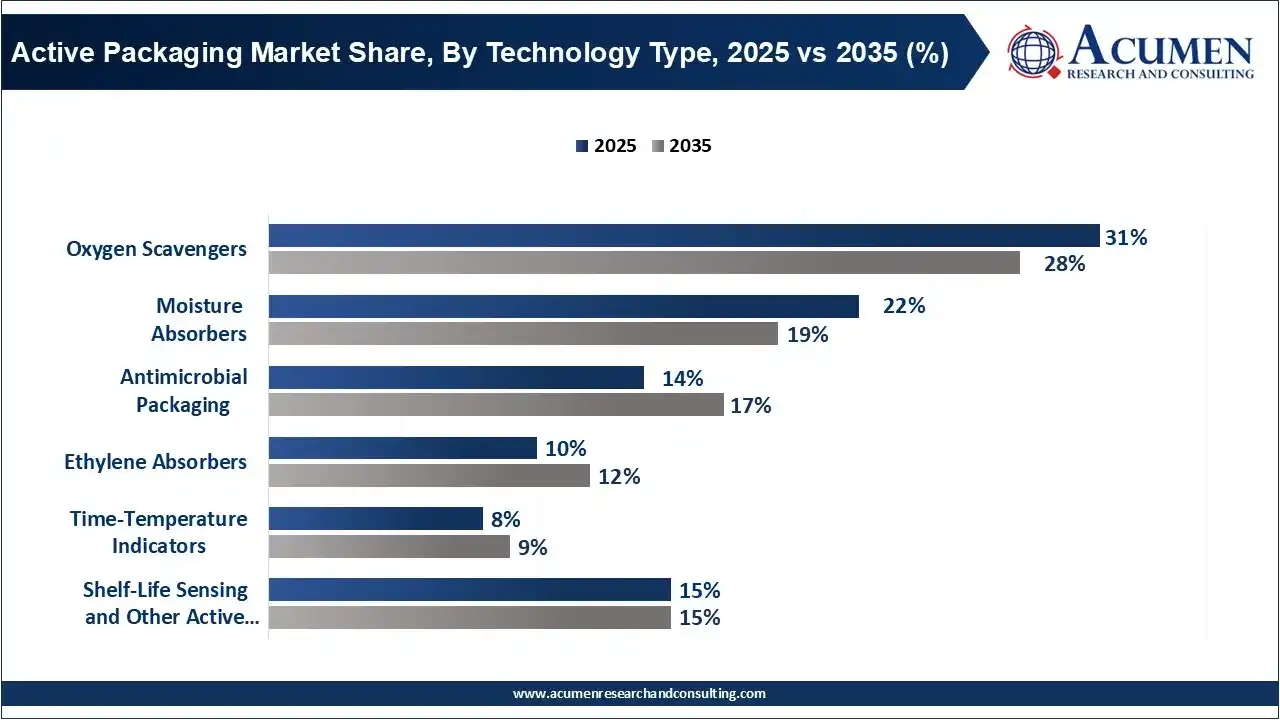
Shelf-Life Sensing and Other Active Systems: Shelf-life sensing and other active systems represented the third-largest technology segment in 2025, accounting for 15.0% of the market and generating an estimated USD 4.43 billion in revenue. Demand is supported by growing interest in product freshness monitoring, quality management, and packaging technologies that help maintain product integrity throughout distribution.
Material Type Insights
Plastics and Polymer Films: Plastics and polymer films dominated the material segment in 2025, accounting for 45.0% of the market and generating an estimated USD 13.28 billion in revenue. Their leadership is supported by flexibility, barrier properties, lightweight construction, and compatibility with active agents used in flexible packaging, pouches, trays, and multilayer structures.
Paper & Paperboard: Paper and paperboard represented the second-largest material segment in 2025, accounting for 22.0% of the market and generating an estimated USD 6.49 billion in revenue. Demand is supported by interest in fiber-based packaging, functional coatings, moisture-control technologies, and packaging solutions that align with recyclable material strategies.
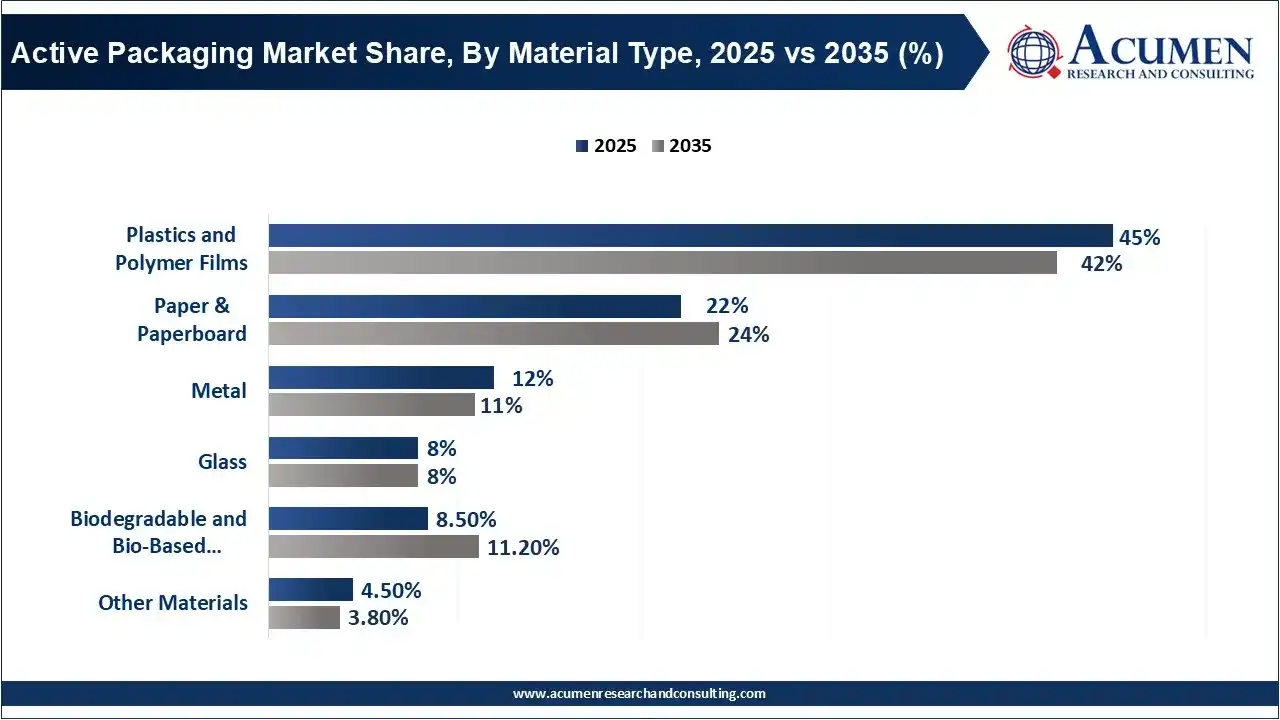
Biodegradable and Bio-Based Materials: Biodegradable and bio-based materials accounted for 8.5% of the market in 2025, generating an estimated USD 2.51 billion in revenue. The segment is projected to be the fastest-growing material category, with a CAGR of 11.2% from 2026 to 2035, supported by research into bio-based films, natural antimicrobial compounds, and active packaging structures designed to reduce dependence on conventional plastics.
Packaging Format Insights
Bags, Pouches & Sachets: Bags, pouches, and sachets dominated the packaging format segment in 2025, accounting for 30.0% of the market and generating an estimated USD 8.86 billion in revenue. Demand is supported by the widespread use of oxygen scavenger sachets, desiccants, antimicrobial inserts, and flexible packaging formats for food, pharmaceutical, and moisture-sensitive products.
Active Packaging Market Share, By Packaging Format, 2025 (%)
| Packaging Format | Revenue Share, 2025 (%) |
|---|---|
| Bags, Pouches & Sachets | 30% |
| Films, Wraps & Laminates | 25% |
| Rigid Containers, Bottles & Jars | 18% |
| Trays, Tubs & Clamshells | 12% |
| Cartons, Boxes & Other Paper Formats | 8% |
| Closures, Labels & Other Formats | 7% |
Films, Wraps & Laminates: Films, wraps, and laminates represented the second-largest packaging format segment in 2025, accounting for 25.0% of the market and generating an estimated USD 7.38 billion in revenue. Adoption is supported by the integration of active agents into packaging layers, improved barrier performance, and the need for preservation solutions across fresh produce, meat, dairy, and processed foods.
Application Insights
Food & Beverages: Food and beverages dominated the application segment in 2025, accounting for 55.0% of the market and generating an estimated USD 16.24 billion in revenue. Demand is supported by the need to control oxidation, microbial growth, moisture migration, and ripening across fresh produce, meat, seafood, dairy, bakery products, and packaged beverages.
Pharmaceuticals: Pharmaceuticals represented the second-largest application segment in 2025, accounting for 14.0% of the market and generating an estimated USD 4.13 billion in revenue. Adoption is supported by requirements for moisture and oxygen protection, product stability, and packaging integrity across sensitive medicines, pharmaceutical formulations, and specialty drug products.
Active Packaging Market Share, By Application, 2025 (%)
| Application | Revenue Share, 2025 (%) |
|---|---|
| Food & Beverages | 55% |
| Pharmaceuticals | 14% |
| Healthcare & Medical Products | 8% |
| Personal Care & Cosmetics | 7.8% |
| Electronics & Electrical Products | 5.2% |
| Agriculture & Fresh Produce | 5.1% |
| Industrial, Logistics & Other Applications | 4.9% |
Healthcare & Medical Products: Healthcare and medical products accounted for 8.0% of the market in 2025, generating an estimated USD 2.36 billion in revenue. Demand is supported by moisture-control packaging, protection of sensitive medical products, and packaging systems designed to maintain product quality during storage, handling, and distribution.
Active Packaging Market Regional Insights
Why Does North America Dominate the Active Packaging Market?
North America accounted for 39.0% of the active packaging market in 2025, generating an estimated USD 11.51 billion revenue.
The region's market growth can be attributed to the growing demand for preservation technologies, availability of functional packaging materials, and advanced manufacturing processes in the region. The regional demand can be attributed to the deep-rooted pharmaceutical and food processing industries, extensive use of convenience foods and packaged food products.
Moreover, increasing need for packaging solutions for shelf-life and product quality enhancement supports the market. The rising demand for absorption packaging and oxygen scavengers, along with the need for antimicrobial active packaging, helps in protecting products during transportation and storage.
Why Is Asia-Pacific the Fastest-Growing Regional Market for Active Packaging?
Asia-Pacific is projected to be the fastest-growing major regional market for active packaging, registering a CAGR of 9.9% from 2026 to 2035. The regional market is expected to increase from USD 8.65 billion in 2026 to USD 20.25 billion by 2035.
Growth is supported by expanding packaged-food consumption, rising pharmaceutical production, and increasing investment in food processing and packaging infrastructure across China, India, Japan, and Southeast Asia. The need to reduce post-harvest losses, preserve perishable products, and improve distribution efficiency is creating opportunities for oxygen scavengers, antimicrobial films, moisture-control systems, and ethylene absorbers. The expansion of modern retail, e-commerce grocery distribution, and export-oriented fresh-produce supply chains is expected to further support adoption.
Top Countries & Their Strategic Opportunities
- United States: Demand is supported by packaged food preservation, pharmaceutical protection, and the need to reduce product losses across distribution networks. Strategic opportunities include antimicrobial films, oxygen scavengers, active packaging for ready-to-eat foods, and moisture-control systems for medicines. Suppliers can also target partnerships with food processors and packaging converters to commercialize functional materials at scale.
- China: Large-scale food processing, e-commerce distribution, pharmaceutical manufacturing, and advanced packaging production create opportunities for active packaging adoption. Growth opportunities include ethylene absorbers for fresh produce, antimicrobial packaging for meat and seafood, and functional films designed for high-volume manufacturing. Domestic suppliers can strengthen their positions through material innovation and integration with packaging production lines.
- Germany: Demand is supported by advanced food processing, pharmaceutical manufacturing, packaging engineering, and sustainability-focused material development. Strategic opportunities include recyclable active packaging, oxygen-scavenging systems, functional coatings, and packaging solutions compatible with circular-material strategies.
Active Packaging Value Chain and Ecosystem Analysis
| Value chain stage | Key participants | Primary activities |
|---|---|---|
| Raw material supply | Polymer, paper, biopolymer, mineral, and chemical suppliers | Supply substrates, active compounds, additives, and functional ingredients |
| Active ingredient development | Oxygen-scavenger, desiccant, antimicrobial, and ethylene-absorber technology providers | Develop agents that regulate oxygen, moisture, microbial growth, and ripening |
| Packaging material manufacturing | Film, resin, coating, laminate, and paperboard manufacturers | Integrate active ingredients into packaging structures |
| Packaging equipment integration | Filling, sealing, coating, and packaging machinery suppliers | Adapt production lines to active packaging formats |
| Testing and regulatory validation | Testing laboratories, food-contact specialists, and quality assurance providers | Evaluate migration, safety, shelf-life performance, and material compliance |
| Distribution and retail | Logistics providers, distributors, retailers, and e-commerce operators | Store, transport, and distribute packaged products |
Competitive Landscape
- Amcor
- Sealed Air
- AptarGroup
- Mitsubishi Gas Chemical Company
- Avient Corporation
- Multisorb Technologies
- Cilicant
- Hazel Technologies
- Microban International
- Sirane
- Mondi
- Huhtamaki
- DuPont
- Desiccare
- Symphony Environmental Technologies
Recent Developments
- October 2026: Symphony Environmental Technologies entered a two-year strategic commercial collaboration with Sirane Central Americana to expand opportunities for its active ethylene-adsorption technology in fresh-produce packaging. The companies plan to explore applications involving berries, tomatoes, and blueberries, with potential extensions to other packaging technologies.
- September 2026: Dow and Amcor announced a strategic collaboration to accelerate the adoption of low-carbon packaging solutions. The initiative combines Dow's materials science and low-carbon polyethylene capabilities with Amcor's packaging development and manufacturing expertise.
Segments Covered
By Technology Type
- Oxygen Scavengers
- Moisture Absorbers
- Antimicrobial Packaging
- Ethylene Absorbers
- Time-Temperature Indicators
- Shelf-Life Sensing and Other Active Systems
By Material Type
- Plastics and Polymer Films
- Paper & Paperboard
- Metal
- Glass
- Biodegradable and Bio-Based Materials
- Other Materials
By Packaging Format
- Bags, Pouches & Sachets
- Films, Wraps & Laminates
- Rigid Containers, Bottles & Jars
- Trays, Tubs & Clamshells
- Cartons, Boxes & Other Paper Formats
- Closures, Labels & Other Formats
By Application
- Food & Beverages
- Pharmaceuticals
- Healthcare & Medical Products
- Personal Care & Cosmetics
- Electronics & Electrical Products
- Agriculture & Fresh Produce
- Industrial, Logistics & Other Applications
By Region
- North America
- Europe
- Asia-Pacific
- Latin America
- Middle East & Africa
Looking for discounts, bulk pricing, or custom solutions? Contact us today at sales@acumenresearchandconsulting.com
Frequently Asked Questions

Related Market Research Reports
February 2023
October 2018
October 2026
October 2026
July 2026
May 2026
December 2025
November 2025