
Advanced Data Center Infrastructure Market Size, Share, Trends and Forecast 2026 To 2035
Advanced Data Center Infrastructure Market (By Component: Software, Services; By Data Center Type: Hyperscale & cloud data centers, Colocation data centers, Enterprise (on-premises) data centers, Edge & micro / modular data centers; By Rack Power Density: Low density (less than 10 kW/rack), Medium density (10–30 kW/rack), High density (30–100 kW/rack), Ultra-high density (more than 100 kW/rack); By Deployment Type: New-build (greenfield) facilities, Retrofit / upgrade (brownfield) facilities; By Organization Size: Large enterprises, Small and Medium Enterprises (SMEs); By Industry Vertical: IT & Telecom; BFSI, Government & defense, Healthcare & life sciences, Retail & e-commerce, Manufacturing, Energy & utilities, Media & entertainment, Others) - Global Industry Analysis, Size, Share, Regional Analysis, Trends and Forecast 2026 - 2035
- Last Updated: 05 Nov 2026
- Report Code: ARC178
- Category: ICT
Advanced Data Center Infrastructure Market Size and Forecast 2026 to 2035
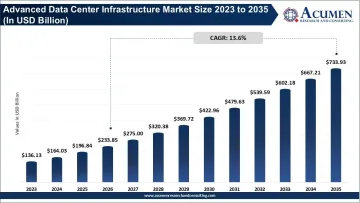
The global advanced data center infrastructure market size was valued at USD 196.84 billion in 2025 and is expected to reach USD 733.93 billion by 2035, while expanding at a CAGR of 13.6% during the forecast period 2026 to 2035. The advanced data center infrastructure market is expanding as artificial intelligence (AI), cloud computing, and high-performance workloads increase demand for scalable computing capacity. Investments in hyperscale facilities, high-density server racks, advanced cooling technologies, and reliable power distribution are further accelerating infrastructure modernization worldwide.
Advanced Data Center Infrastructure Market Statistics
- Base Year Market Size (2025): $196.84 billion
- Current Year Market Size (2026): $233.85 billion
- Estimated Year Market Size (2035): $733.93 billion
- Forecast Period CAGR (2026-2035): 13.6%
Key Takeaways
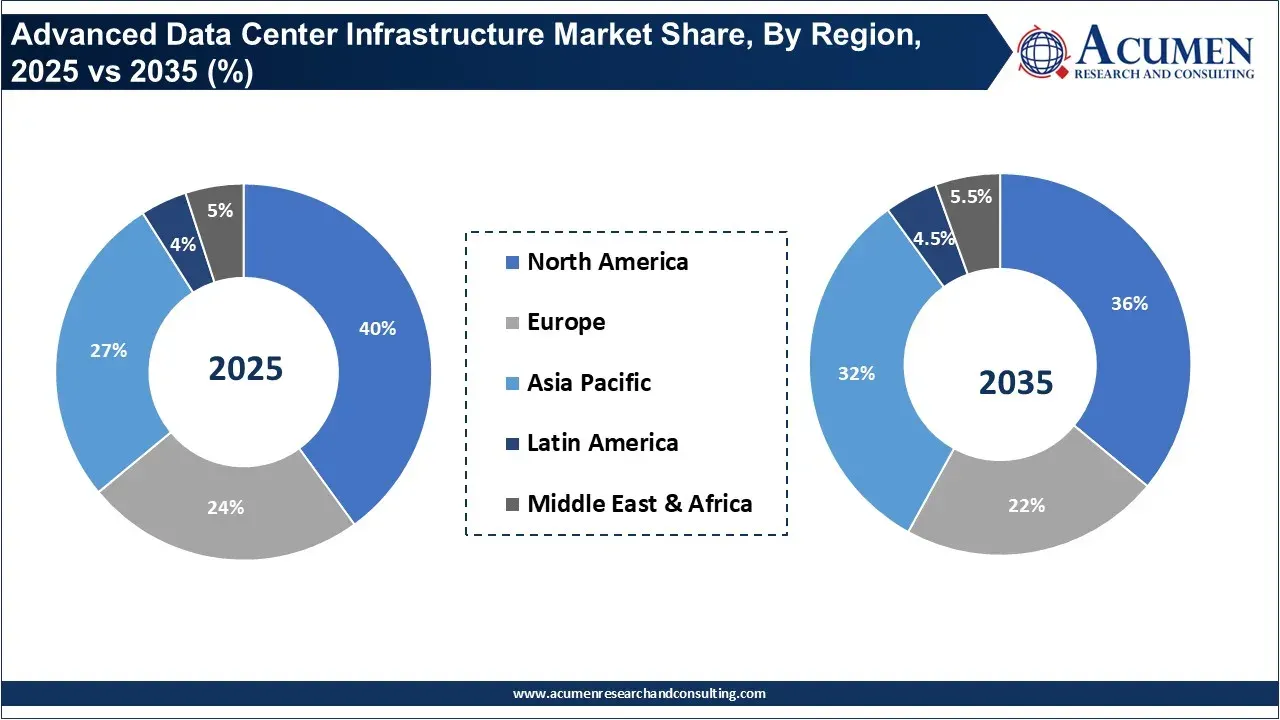
- By region: North America dominated the Advanced Data Center Infrastructure Market with a 40.0% share in 2025, generating USD 78.74 billion in revenue. Asia-Pacific is the fastest-growing region, with a projected CAGR of 15.5% from 2026 to 2035, and is expected to reach USD 234.86 billion by 2035.
- By component: Services dominated the Advanced Data Center Infrastructure Market with a 20.5% share in 2025, generating USD 40.35 billion in revenue. AI / accelerated servers ranked second with an 18.0% share, while cooling infrastructure is the fastest-growing component, with a projected CAGR of 16.2% from 2026 to 2035.
- By data center type: Hyperscale and cloud data centers dominated the market with a 45.0% share in 2025, generating USD 88.58 billion in revenue. Edge and micro / modular data centers are the fastest-growing category, with a projected CAGR of 17.2% from 2026 to 2035.
- By rack power density: Low-density racks dominated the market with a 34.0% share in 2025, generating USD 66.93 billion in revenue. High-density racks ranked second with a 24.0% share, while ultra-high-density racks are the fastest-growing category, with a projected CAGR of 24.7% from 2026 to 2035.
- By deployment type: New-build (greenfield) facilities dominated the market with a 61.0% share in 2025, generating USD 120.07 billion in revenue. Retrofit and upgrade (brownfield) facilities are the faster-growing category, with a projected CAGR of 14.4% from 2026 to 2035.
- By organization size: Large enterprises, including hyperscalers and cloud service providers, dominated the market with a 78.0% share in 2025, generating USD 153.54 billion in revenue. Small and medium enterprises (SMEs) are the faster-growing category, with a projected CAGR of 14.5% from 2026 to 2035.
- By industry vertical: IT and telecom dominated the market with a 41.0% share in 2025, generating USD 80.70 billion in revenue. Banking, financial services and insurance (BFSI) ranked second with a 15.0% share, while healthcare and life sciences is the fastest-growing vertical, with a projected CAGR of 15.1% from 2026 to 2035.
What Is the Advanced Data Center Infrastructure Market?
The data center infrastructure industry can be segmented into hardware, systems, and technologies that are used to manufacture, deploy, and manage high-end data centers. They provide IT equipment, power distribution, and backup systems, cutting-edge cooling units, racks and enclosures, network infrastructure, and monitoring solutions. These infrastructure modules help power cloud service providers, enterprise applications, artificial intelligence, high-speed computing, and enable data centers to operate efficiently and effectively.
Recent Trends
- Increasing rack power density: New data center deployments are moving toward higher-density racks, increasing the need for upgraded power distribution units, advanced cabling, efficient cooling systems, and improved thermal monitoring.
- Expansion of hyperscale and colocation facilities: Cloud providers and colocation operators are expanding infrastructure capacity to serve enterprise cloud migration, AI applications, digital services, and growing data storage requirements.
- Power availability becoming a critical investment factor: Grid connection delays, electricity demand, and capacity constraints are encouraging developers to prioritize power availability and consider on-site generation, battery energy storage, microgrids, and long-term energy procurement.
- Integration of renewable energy and energy storage: Operators are increasingly evaluating renewable electricity, battery storage, and other energy management solutions to improve power resilience, manage electricity costs, and meet sustainability objectives.
- Adoption of modular and prefabricated infrastructure: Modular data center designs can accelerate deployment by integrating power, cooling, and IT systems into standardized units, helping operators scale capacity as demand increases.
Advanced Data Center Infrastructure Market Project Pipeline (2027-2030)
| Company / Project | Country | Announced capacity | Key highlights |
|---|---|---|---|
| Google AI Infrastructure Hub, Andhra Pradesh | India | Approximately 1 GW | AI computing infrastructure, power systems, cooling and hyperscale facilities |
| Digital Realty Dugny Digital Hub | France | 176 MW | Hyperscale capacity, electrical infrastructure and cooling systems |
| Data4 Escaudain Campus | France | Up to 700 MW | AI-ready data center capacity, power infrastructure and thermal management |
| TCS HyperVault AI Data Center Campus | India | Up to 1 GW | AI infrastructure, high-density computing, power and cooling |
| NEXTDC S7 Data Center | Australia | Approximately 612 MW proposed capacity | Hyperscale infrastructure, AI computing and high-capacity power systems |
Investment Outlook
- Global investment in new data center capacity and IT equipment could approach USD 3 trillion between 2026 and 2030, reflecting approximately USD 1.2 trillion in real estate asset value creation and an additional USD 1 trillion to USD 2 trillion in tenant spending on servers, GPUs, and networking equipment.
- The combined capital expenditure of nine major cloud service providers, including Amazon Web Services, Microsoft, Google, Meta, Oracle, ByteDance, Tencent, Alibaba, and Baidu, was projected at approximately USD 830 billion for 2026. Spending is increasingly directed toward AI computing infrastructure, GPU clusters, custom processors, and next-generation data centers.
- Microsoft's 2026 capital expenditure outlook was raised to approximately USD 190 billion, reflecting investments in AI infrastructure, cloud capacity, servers, networking, and supporting data center systems.
- Google's 2026 capital expenditure guidance was revised to approximately USD 180 billion to USD 190 billion. The investment supports expansion of AI computing capacity, cloud infrastructure, data centers, and related technical equipment.
- Amazon's 2026 capital expenditure was projected to exceed USD 230 billion, supported by demand for AI cloud services, computing capacity, and infrastructure expansion across AWS.
- Meta raised its 2026 capital expenditure outlook to approximately USD 125 billion to USD 145 billion. The investment supports AI infrastructure, data center construction, computing systems, and associated power requirements.
Advanced Data Center Infrastructure Market Dynamics
Growth Drivers
- Rising Demand for AI Computing Infrastructure: The expansion of generative AI, large language models, and high-performance computing is increasing demand for advanced data center infrastructure, including high-density server racks, accelerated computing systems, specialized cooling technologies, and high-speed networking equipment.
- Expansion of Hyperscale Data Centers: Cloud service providers and technology companies are investing in large-scale data center facilities to accommodate growing cloud workloads, enterprise applications, and digital services, driving demand for scalable power distribution, advanced server infrastructure, and integrated facility management systems.
Restraints
- High Capital Investment Requirements: Advanced data center infrastructure requires substantial investment in servers, networking equipment, power systems, cooling technologies, and facility upgrades, creating financial barriers for smaller operators and organizations with limited infrastructure budgets.
- Power Availability and Grid Constraints: Increasing electricity requirements from high-density computing facilities are creating challenges related to grid capacity, power connections, and energy availability, potentially delaying new data center projects and limiting expansion in constrained locations.
Opportunities
- Adoption of Liquid Cooling Technologies: Increasing rack power densities associated with AI accelerators create opportunities for direct-to-chip liquid cooling, immersion cooling, and advanced heat rejection systems that support efficient thermal management in high-performance computing environments.
- Development of Modular Data Center Infrastructure: Modular power systems, prefabricated data center components, and scalable cooling solutions offer opportunities to accelerate deployment, simplify capacity expansion, and reduce construction complexity for hyperscale and enterprise operators.
Challenges
- Managing High-Density Thermal Loads: AI and high-performance computing systems generate substantial heat within compact rack configurations. Maintaining safe operating temperatures while controlling energy consumption requires advanced cooling designs and precise thermal management.
- Ensuring Infrastructure Reliability and Resilience: Data centers must maintain continuous operations despite equipment failures, power interruptions, cooling disruptions, and network issues. Designing redundant infrastructure while controlling capital and operating costs remains a significant challenge.
Advanced Data Center Infrastructure Market Segmental Insights
Component Insights
Services: Services represented the largest component category in 2025, accounting for 20.5% of the market with revenue reaching USD 150.46 billion. Demand is supported by the technical complexity of designing, deploying, integrating, maintaining and upgrading modern data centers. As operators expand AI computing capacity and modernize existing facilities, requirements for installation, infrastructure management, consulting, maintenance and optimization services are increasing.
AI / Accelerated Servers: AI and accelerated servers were the second-largest component category in 2025, representing 18.0% of the market and generating USD 35.43 billion in revenue. Their share is projected to increase to 20.0% by 2035, with revenue reaching USD 146.79 billion. This segment is expected to benefit from growing demand for GPU-based computing, generative AI training, inference workloads and high-performance computing.
Software: Software ranked third among component categories in 2025, accounting for 13.5% of the market and generating USD 26.57 billion in revenue. Demand is driven by the need to manage increasingly distributed and resource-intensive computing environments. Infrastructure management platforms, workload orchestration, monitoring, automation and energy optimization software help operators improve resource utilization and operational visibility.
Data Center Type Insights
Hyperscale & Cloud Data Centers: Hyperscale and cloud data centers dominated the market in 2025, accounting for 45.0% of the market and generating USD 88.58 billion in revenue. Growth is supported by cloud migration, AI infrastructure deployment, expanding digital services and the increasing computing requirements of enterprises. Major cloud providers are investing in large-scale facilities equipped with accelerated servers, high-speed networking, advanced cooling and resilient power systems.
Colocation Data Centers: Colocation data centers were the second-largest category in 2025, representing 22.0% of the market and generating USD 43.30 billion in revenue. Colocation providers supply shared data center facilities, power, cooling, connectivity and physical security to enterprises, cloud providers and other customers. Demand is supported by organizations seeking scalable infrastructure without the capital and operational burden of building dedicated facilities.
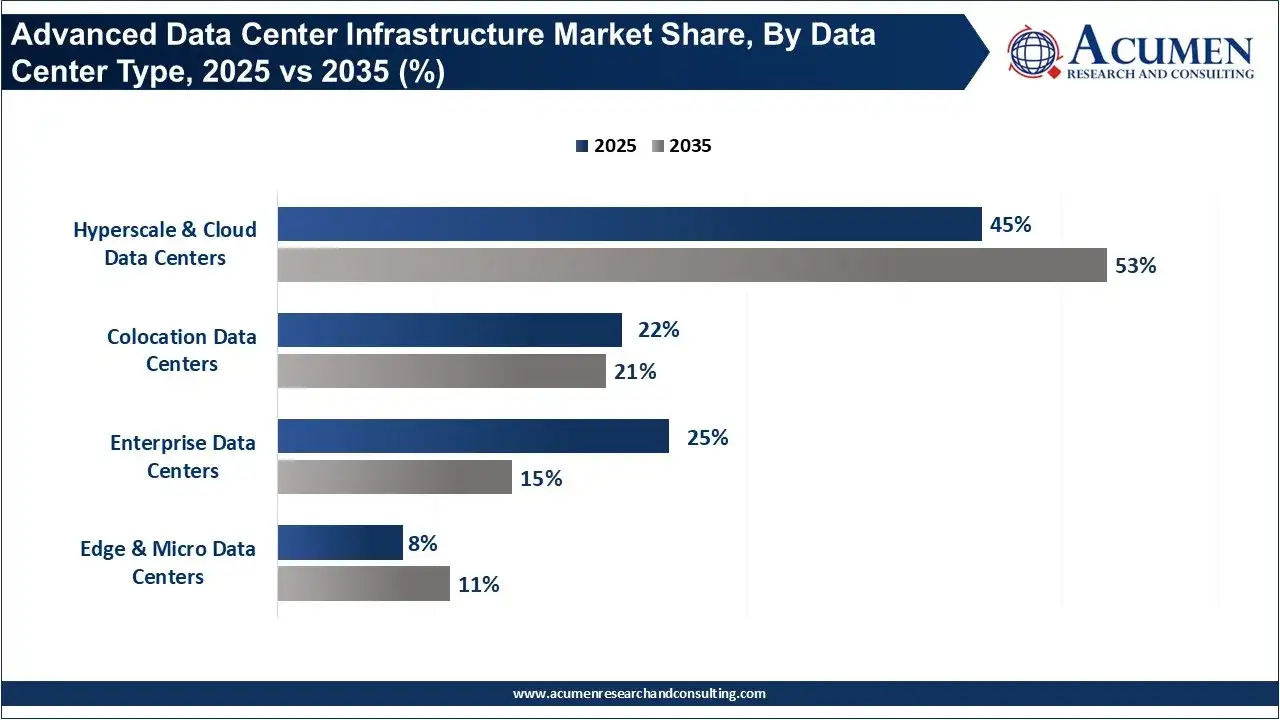
Enterprise On-Premises Data Centers: Enterprise on-premises data centers ranked third in 2025, accounting for 25.0% of the market and generating USD 49.21 billion in revenue. The declining share reflects the growing adoption of public cloud, colocation and hyperscale infrastructure. However, enterprises continue to maintain on-premises environments for applications requiring direct control over data, security, latency and regulatory compliance.
Rack Power Density Insights
Low-Density Racks: Low-density racks dominated the market in 2025, accounting for 34.0% of the market and generating USD 66.93 billion in revenue. Their share is projected to decrease to 14.0% by 2035, with revenue reaching USD 102.75 billion. These racks, operating below 10 kW per rack, remain relevant for conventional enterprise applications, general-purpose computing and workloads that do not require intensive processing. However, their relative importance is expected to decline as AI infrastructure increases average rack power requirements.
High-Density Racks: High-density racks represented the second-largest category in 2025, accounting for 24.0% of the market and generating USD 47.24 billion in revenue. Operating at 30–100 kW per rack, these systems support demanding enterprise computing, accelerated servers and AI workloads. Their expansion is driving investment in advanced cooling, high-capacity power distribution, thermal monitoring and optimized rack layouts.
Deployment Type Insights
New-Build Facilities: New-build, or greenfield, facilities dominated the market in 2025, accounting for 61.0% of the market and generating USD 120.07 billion in revenue. These projects allow operators to design facilities around modern computing requirements, including AI-ready rack layouts, scalable electrical infrastructure, advanced cooling and energy-efficient building systems. Hyperscaler expansion and rising demand for cloud services are supporting new construction. Although greenfield projects retain the largest share, their development depends on land availability, power access, permitting and construction timelines.
Retrofit and Upgrade Facilities: Retrofit and upgrade facilities represented 39.0% of the market in 2025. This segment is expected to grow faster than new-build facilities, registering a projected CAGR of 14.4% from 2026 to 2035. Operators are upgrading existing sites to accommodate higher rack densities, improve power efficiency, integrate liquid cooling and extend facility life. Retrofitting can help organizations expand usable capacity without relying entirely on new construction, although physical space, electrical capacity and cooling-system compatibility can constrain upgrades.
Organization Size Insights
Large Enterprises: Large enterprises, including hyperscalers and cloud service providers, dominated the market in 2025, accounting for 78.0% of the market and generating USD 153.54 billion in revenue. Their share is projected to remain substantial at 76.0% in 2035, with revenue reaching USD 557.79 billion. These organizations invest heavily in data center construction, accelerated computing, high-speed networking and resilient power systems. Their scale enables long-term procurement agreements and large infrastructure deployments, while the expansion of generative AI and cloud platforms continues to increase capacity requirements. The segment's investment decisions strongly influence demand for advanced servers, cooling equipment and integrated infrastructure solutions.
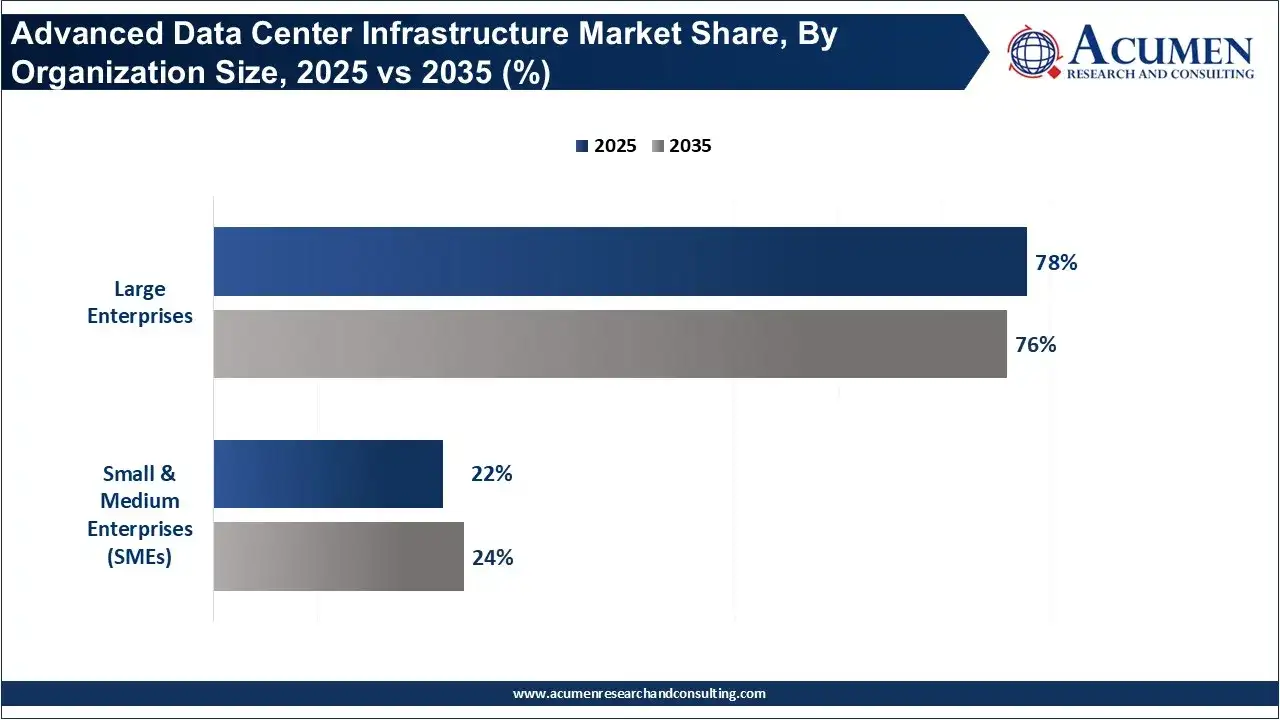
Small and Medium Enterprises: SMEs accounted for 22.0% of the market in 2025, generating USD 43.30 billion in revenue. Their share is projected to increase to 24.0% by 2035, with revenue reaching USD 176.14 billion. SMEs are expected to record a projected CAGR of 14.5% from 2026 to 2035, making them the faster-growing organization-size segment. Adoption of cloud services, managed infrastructure and colocation enables smaller organizations to access computing capacity without building and maintaining dedicated data centers. Demand is also supported by digital transformation, cybersecurity requirements and the growing use of AI-enabled business applications.
Industry Vertical Insights
IT & Telecom: IT and telecom dominated the market in 2025, accounting for 41.0% of the market and generating USD 80.70 billion in revenue. Its share is projected to increase to 44.0% by 2035, with revenue reaching USD 322.93 billion. Cloud providers, telecommunications companies and digital infrastructure operators require extensive computing, storage, networking and power capacity to support growing data traffic and online services. Investments in AI platforms, cloud expansion and network modernization are increasing demand for advanced data center infrastructure.
Banking, Financial Services and Insurance (BFSI): BFSI was the second-largest industry vertical in 2025, representing 15.0% of the market and generating USD 29.53 billion in revenue. Its share is projected to decline to 13.0% by 2035, although revenue is expected to reach USD 95.41 billion. Financial institutions require secure and reliable infrastructure for digital banking, payment processing, fraud detection, risk modelling and financial data management. Investments in cybersecurity, disaster recovery, hybrid cloud and AI-driven analytics continue to support infrastructure spending.
Regional Analysis
Which Region Dominated the Market in 2025?
North America led the market in 2025, holding 40.0% of the global revenue and contributing USD 78.74 billion. The market of North America is estimated to reach USD 264.22 billion by 2035 and the share is expected to decline to 36.0%. The rise of hyperscale cloud companies, dominant colocation operators, AI developers and major enterprise technology organizations is mirrored by the rise in the number of hyperscale data center providers in the region.
Infrastructure builds are aided by investments in accelerated servers, networking hardware, high-capacity electrical distribution and next-generation cooling. The boom is driven also by the nascent AI training and inference centers that need two to four times more IT power than typical deployments.
Which Region Is Expected to Grow the Fastest?
Asia-Pacific is projected to be the fastest-growing regional market, with a CAGR of 15.5% from 2026 to 2035. The region accounted for 27.0% of the global market in 2025, generating USD 53.15 billion, and is projected to reach USD 234.86 billion by 2035. China, India, Japan, Australia and Southeast Asian markets are contributing to data center development through investments in hyperscale campuses, colocation facilities, connectivity and supporting power infrastructure.
Growth is also being driven by rising digital consumption, government-led digitalization and the expansion of regional cloud ecosystems. Increasing deployment of AI workloads is creating opportunities for accelerated servers, high-speed networking, liquid cooling and high-density rack systems. At the same time, electricity availability, land constraints, water management and local permitting requirements remain important considerations for developers.
Government Initiatives
United States
- Federal permitting acceleration: The July 2025 executive order on accelerating federal permitting for data center infrastructure aimed to streamline approvals for qualifying large-scale data center projects and supporting energy infrastructure.
- Federal land and infrastructure: The initiative encouraged the use of suitable federally owned land and resources for data center development.
- Power infrastructure support: Policy measures recognize transmission lines, substations, transformers, switchgear and backup power as essential infrastructure for large AI data centers.
India
- Data Centre Evaluation Framework: In October 2026, NITI Aayog’s Frontier Tech Hub introduced a framework to help states assess data center proposals based on power availability, water and cooling, environmental sustainability, economic value and implementation readiness.
- Investment incentives: Eligible foreign cloud service providers using India-based data center infrastructure can benefit from a tax holiday until 2047, subject to applicable conditions.
- Domestic infrastructure development: Government initiatives promoting digital infrastructure and domestic manufacturing support investment in data centers, power systems, cooling technologies and related equipment.
China
- East Data, West Computing: The national initiative seeks to optimize the geographic distribution of computing resources by connecting data centers in western regions with demand centers in eastern China.
- Green data center development: Policy priorities include improving energy efficiency, increasing the use of renewable energy and reducing the environmental impact of data center operations.
- Integrated computing infrastructure: Investment in cloud computing, AI computing capacity and data infrastructure supports the development of large-scale and specialized data centers.
Singapore
- Green Data Centre Roadmap: The government has outlined measures to expand data center capacity while improving energy efficiency and supporting sustainability objectives.
- Green Data Centre Energy Efficiency Grant: Support for eligible energy-efficient equipment and upgrades helps qualifying operators improve infrastructure performance.
- Sustainable capacity expansion: Singapore's approach emphasizes efficient power and cooling, green energy access, and resource-conscious development as it balances digital infrastructure demand with land and energy constraints.
Competitive Landscape
- Schneider Electric (France)
- Vertiv Holdings (United States)
- Eaton Corporation (Ireland)
- ABB (Switzerland)
- Siemens (Germany)
- Huawei Technologies (China)
- Dell Technologies (United States)
- Hewlett Packard Enterprise (United States)
- Cisco Systems (United States)
- Lenovo (China)
- Mitsubishi Electric (Japan)
- Johnson Controls (Ireland)
- Trane Technologies (Ireland)
- Legrand (France)
- Delta Electronics (Taiwan)
Recent Breakthroughs
- October 2026: Vertiv delivered high-density liquid cooling infrastructure in India. Vertiv announced the delivery of a direct-to-chip liquid cooling deployment at CapitaLand India Trust's CLDC Mumbai 01 data center, supporting 30 MW of AI workloads. The deployment highlights growing demand for liquid cooling systems designed for high-density AI computing.
- September 2026: ABB launched its Infinitus direct-current portfolio. ABB introduced a portfolio of DC power solutions designed for AI data centers, including solid-state transformer technology, DC power distribution and protection systems. The offering targets the growing need for efficient, scalable power delivery in high-density computing environments.
- October 2026: Adani Enterprises and Jabil announced a proposed data center hardware joint venture. The companies signed a non-binding memorandum of understanding for a proposed 50:50 joint venture to manufacture and assemble AI and data center equipment in India. The planned scope includes AI racks, servers, networking equipment, power systems and cooling infrastructure.
Segments Covered
By Component
- Hardware: AI / accelerated servers
- Hardware: General-purpose servers
- Hardware: Storage systems
- Hardware: Networking equipment
- Hardware: Power infrastructure
- Hardware: Cooling infrastructure
- Hardware: Racks, enclosures, cabling & physical security
- Software
- Services
By Data Center Type
- Hyperscale & cloud data centers
- Colocation data centers
- Enterprise (on-premises) data centers
- Edge & micro / modular data centers
By Rack Power Density
- Low density (less than 10 kW/rack)
- Medium density (10–30 kW/rack)
- High density (30–100 kW/rack)
- Ultra-high density (more than 100 kW/rack)
By Deployment Type
- New-build (greenfield) facilities
- Retrofit / upgrade (brownfield) facilities
By Organization Size
- Large enterprises
- Small and Medium Enterprises (SMEs)
By Industry Vertical
- IT & Telecom
- Banking, Financial Services and Insurance (BFSI)
- Government & defense
- Healthcare & life sciences
- Retail & e-commerce
- Manufacturing
- Energy & utilities
- Media & entertainment
- Others
By Region
- North America
- Europe
- Asia-Pacific
- Latin America
- Middle East & Africa
Looking for discounts, bulk pricing, or custom solutions? Contact us today at sales@acumenresearchandconsulting.com
Frequently Asked Questions

Related Market Research Reports
July 2024
February 2023
October 2026
September 2026
September 2026
September 2026
July 2026
June 2026