August 2020

Artificial Intelligence Market (By Component: Software, Hardware, Services; By Technology: Machine Learning Platforms, NLP Software, Computer Vision Software, Generative AI Platforms, RPA with AI, AI Decision Intelligence Platforms; By Deployment Mode: Cloud-Based AI, On-Premise AI, Hybrid AI; By Enterprise Size: Large Enterprises, SMEs; By AI Model Type: Predictive AI, Generative AI, Conversational AI, Prescriptive AI, By Application: Customer Service & Virtual Assistance, Predictive Analytics & Forecasting, Process Automation, Cybersecurity & Threat Detection, Supply Chain & Logistics Optimization, Others; By End User: BFSI, Healthcare & Life Sciences, Retail & E-commerce, Manufacturing, Others) - Global Industry Analysis, Size, Share, Regional Analysis, Trends and Forecast 2026 - 2035
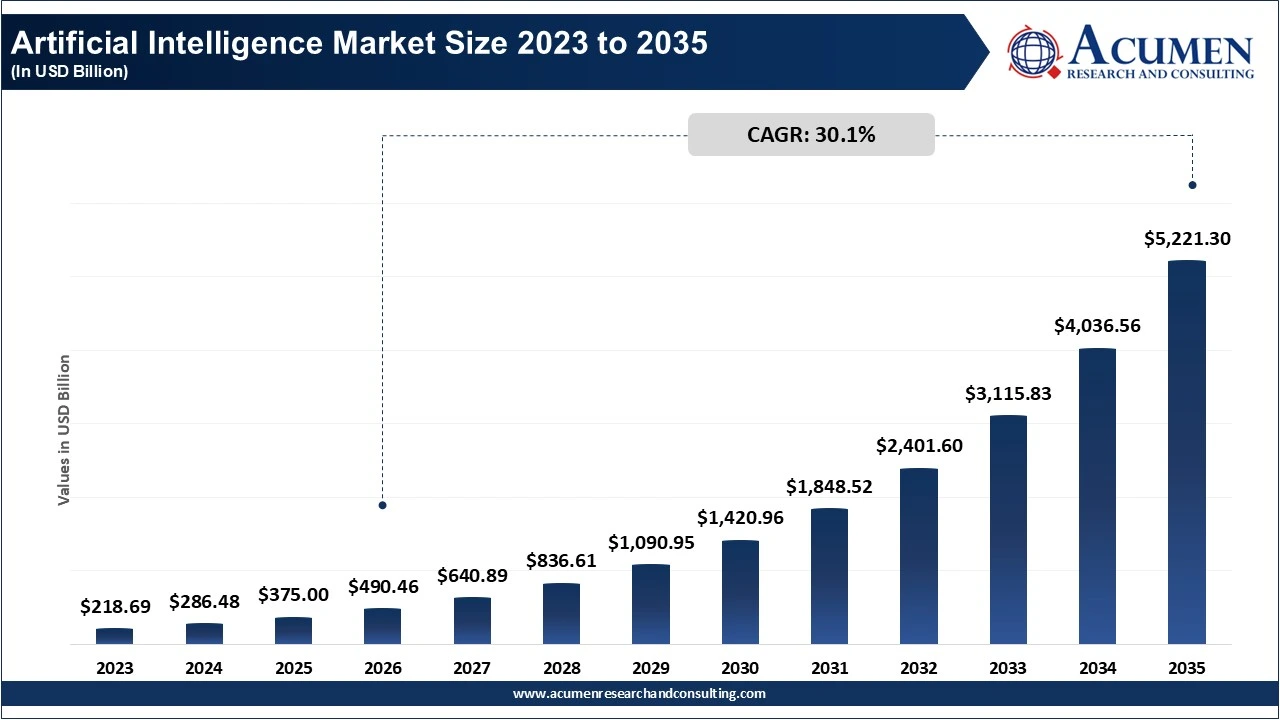
The global artificial intelligence market size was valued at USD 375 billion in 2025 and is projected to exceed around USD 5,221.30 billion by 2035, expanding at a CAGR of 30.1% during the forecast period 2026 to 2035. The artificial intelligence market is seeing exponential growth as various enterprises across the industry sector are implementing and embedding artificial intelligence into their services, products and decision making mechanisms. AI includes a diverse set of techniques and algorithms like machine learning, natural language processing (NLP), computer vision, generative AI, predictive analytics, intelligent automation that allow machines to execute various tasks that conventionally required human intelligence.
Rapid implementation of AI is being propelled by the availability of large quantities of digital data, advancements in cloud computing, improved access to high performance hardware and government and private investments in the domain.
Rapid Adoption of Gen AI & Enterprise Automation
Growing implementation of generative AI and intelligent automation solutions represents a key driver for the growth of the AI market. It is observed that companies are effectively using AI to automate routine tasks, enhance productivity, optimize work processes, and improve customer interaction. Extensive applications of virtual assistants, content creation platforms, software development, predictive analytics, and intelligent enterprise applications, to name a few, have accelerated the pace of AI implementation. Furthermore, companies are increasingly spending significant amounts of money on AI technologies for business efficiency, and strategic business benefits. Thus, expanding industry use of AI technologies is estimated to accelerate market expansion significantly for the duration of the forecast period.
Data Privacy & Security Concerns
Though the AI market is witnessing healthy growth, it encounters challenges regarding data privacy, cybersecurity threats, ethic and regulatory landscape. AI systems require massive amounts of sensitive personal, financial, health and operational data, thereby raising concerns over data security and data misuse. Globally various governments have implemented stricter laws for AI development, transparency, accountability, and responsible deployment, which would add cost and complication for organization for implementing the same. However issues concerning algorithmic bias, misinformation, intellectual property and workforce impact are still present.
Growth of AI in emerging economies and sector-specific uses
Growing adoption of AI in all industries and in developing economies is expected to provide massive business opportunities. Countries in Asia-Pacific, Latin America, Middle East and Africa are rapidly increasing their investments in AI infrastructure, smart cities, cloud technology and digital innovation programs. Sector-specific uses of AI, in medical diagnostics, precise medicine, financial services, cyber security, manufacturing automation, supply chain management and automated transportation have a tremendous potential to open new revenue channels for AI vendors. Widely available cloud-based AI platforms and AI-as-a-Service will help smaller and medium sized businesses around the world to adopt AI technologies.
North America was the largest share in artificial intelligence market in the year 2025 owing to significant number of AI technology players, sophisticated digital infrastructure, substantial VC funding, and early adoption of novel technology. The U.S. Continues to hold leadership in the global innovation of AI, it contributes a lot to the AI technology advancement through its investments in AI research, cloud computing, semiconductor technology, and generative AI platforms. The large technology companies contribute billions of U.S. Dollars to the AI model development and AI ready data centers every year; this fuels the market growth in the region. Furthermore, the U.S. Has a well-developed community of startups, research bodies, and enterprise adopters for the development of AI technology commercialization across various industries.
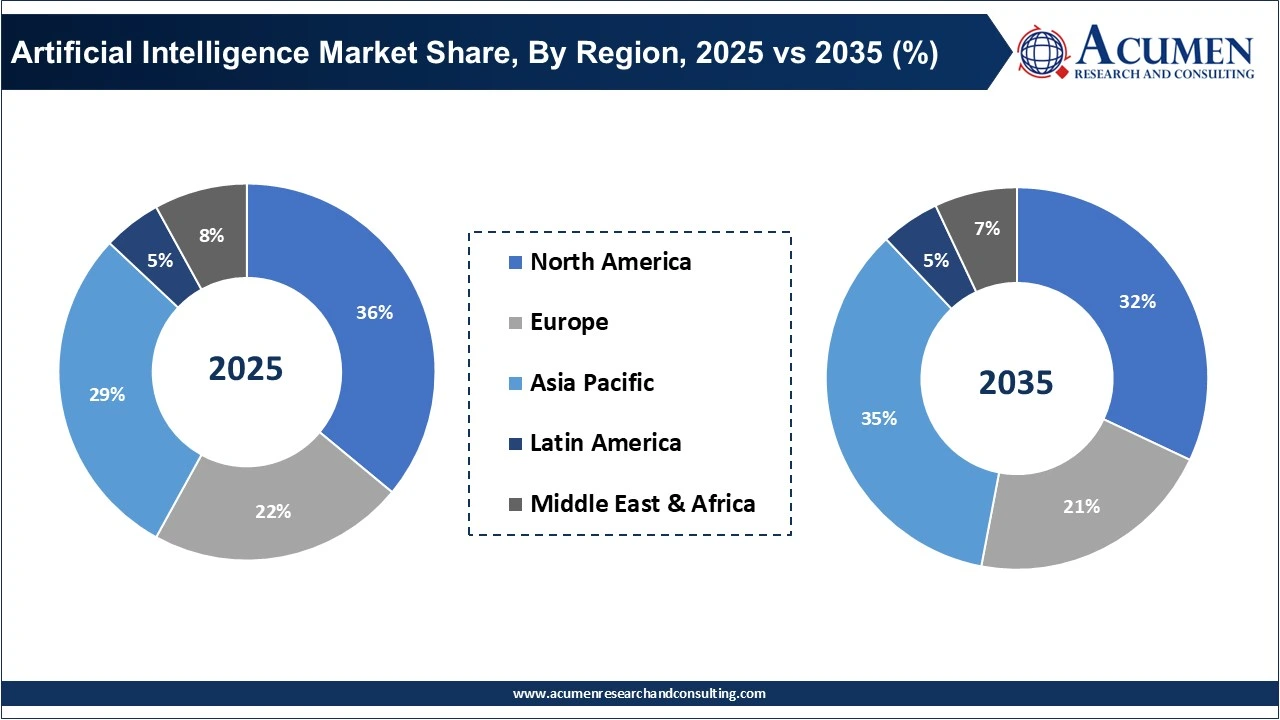
The second largest market share 29% in 2025 was accounted for by Asia Pacific, and is predicted to witness the highest CAGR of 32.8% over the forecast period. The rapid pace of digital transformation across the region, increasing proliferation of cloud infrastructure, government driven efforts on AI and rising adoption of AI by enterprises is fueling its growth across the Asia Pacific region. Countries such as China, India, Japan, South Korea and Singapore are pouring in substantial investment in research and development in the field of AI, talent pool creation, semiconductor production and the use of AI based applications in manufacturing industries. The ever increasing internet penetration and developing digital economy of its large population is a potential driver for adoption of AI across diverse sectors like healthcare, manufacturing, retail, finance, and the government itself.
The software segment accounted for a large chunk of artificial intelligence market share, holding 52.0% of the total market in 2025. This is owing to increased demand of AI platforms, machine learning frameworks, generative AI tools, and enterprise AI solutions in several sectors. Enterprises continue to increase their investments in AI software for business automation, efficient decision making, better customer experiences and insights for business strategies by analyzing structured and unstructured data.
The AI software market share is attributed to various factors including AI solutions like AI analytics, conversational AI tools, recommendation engine, fraud detection software, and intelligent automation. Demand for such tools along with increased access to low-code AI development tools and SaaS-based AI platforms will further fuel the adoption of AI solutions in enterprises.
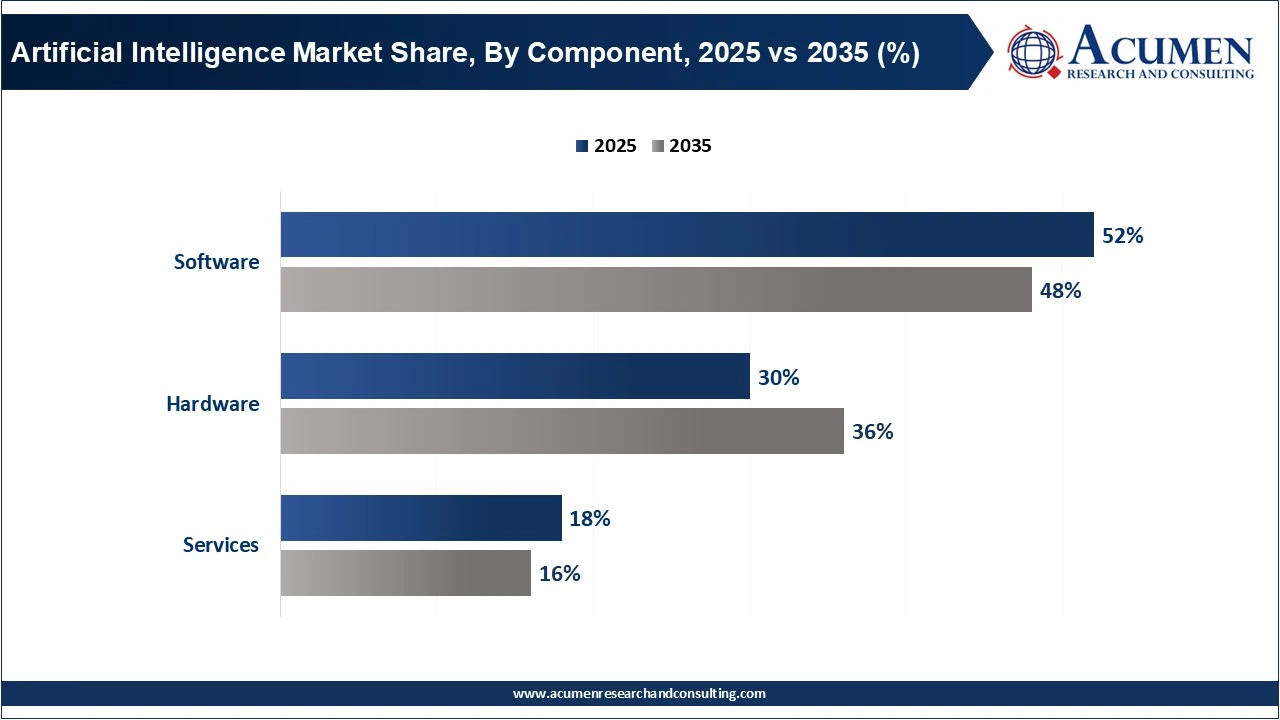
The hardware segment held a substantial market share of 30% in 2025 and is projected to exhibit the fastest growth rate in the coming forecast years. The high growth in this segment can be seen as a result of the rapidly increasing demand for high-powered AI infrastructure as a result of the massive adoption of generative AI, LLMs, machine learning training, and edge AI.
Key AI hardware elements including GPUs, TPUs and NPUs play a pivotal role in training AI models and executing inference operations. Significant investment by hyperscale cloud providers and large corporations for AI servers, AI networking infrastructure and storage systems has increased market demand. It is estimated that AI-related data center investment has risen by substantial percentage in the past three years to support increasingly complex AI models.
Machine learning platforms captured a major market share of 30% in 2025. These platforms have enabled predictive analytics, automation, pattern recognition and intelligent decision making in all sectors. Machine learning technologies have been extensively used in industries like banking, healthcare, manufacturing, retail and telecom to optimize their operations.
With increasing availability of cloud based ML platforms and autoML solutions, enterprise adoption is also high. ML continues to gain focus and investment from enterprises to drive a measure of business value, through improvement in forecasting and operational efficiency, and enhanced customer experience.
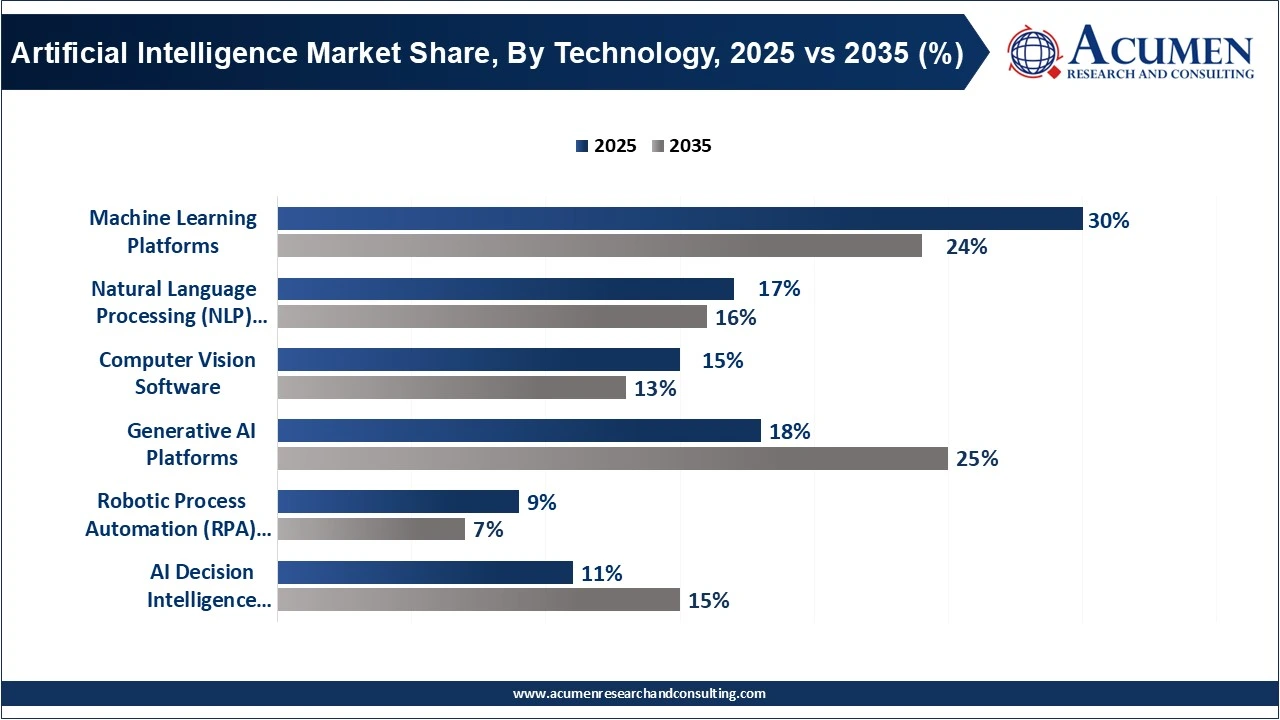
Generative AI platforms secured the second largest market share at 18% in 2025 and are predicted to grow at the fastest pace. Generative AI tools have changed the market dynamics by being rapidly adopted for content creation, software development, customer service, healthcare research and enterprise productivity applications.
Investment has boomed across every sector for advanced large language models, multimodal AI systems and enterprise ready generative AI solutions. Leading technology organizations are already investing billion dollars each year on the infrastructure and models for generative AI solutions.
Cloud-based AI segment held 58% share in 2025 and is expected to hold major share in market considering their flexibility, scalability, low infrastructure cost, easy availability and usability of this technology. Enterprises are continuously choosing cloud deployment model due to easy availability and fast availability and faster deployment of AI. They require no initial investment for setting up the whole AI environment and provide access to high performance computers, pre-trained AI models, machine learning tools and data analysis capabilities.
AI Market Revenue Share, By Deployment Mode, 2025 VS 2035 (%)
| Deployment Mode | Revenue Share, 2025 (%) | Revenue Share, 2035 (%) |
| Cloud-Based AI | 58% | 62% |
| On-Premise AI | 18% | 10% |
| Hybrid AI | 24% | 28% |
Hybrid AI held the second-largest market share, 24%, in 2025 and is projected to grow at the highest CAGR of 32.3% during the forecast period. Enterprises are increasingly leveraging the advantages of hybrid deployment models due to increasing needs to balance security, compliance, performance and scalability. Enterprises can effectively keep sensitive data and critical applications on-premises while employing the cloud infrastructure to run advanced AI workloads. This deployment model is also a growing choice among highly regulated industries like healthcare, BFSI, government and defense industries where data security and compliance have highest priority.
Large enterprises dominated the artificial intelligence market by capturing a revenue share of 74% in 2025 as they possess higher capital budgets, advanced technology infrastructure, and significant ability to invest in AI driven business transformation initiatives. AI is being adopted across multiple business functions by large enterprises in customer service, operations, cyber security, supply chain management and strategic planning processes. Access to large volumes of data and compute power helps them achieve greater ROI from AI investments. Being early adopters of advanced AI technologies has been a driving factor for large enterprises to significantly contribute to overall AI market revenues.
AI Market Revenue Share, By Enterprise Size, 2025 (%)
| Enterprise Size | Revenue Share, 2025 (%) |
| Large Enterprises | 74% |
| Small & Medium Enterprises (SMEs) | 26% |
Small & medium enterprises accounted for 26% of the market in 2025 due to increased availability of cloud based AI platforms and affordability. These enterprises increasingly use AI for engaging with customers, marketing automation, sales forecasting, optimizing operations and business processes. The growing trend of AI as a Service subscriptions and low-code development platforms makes sophisticated AI functionality accessible to SMEs without demanding any major technology or infrastructure investments.
Predictive AI constituted 38% of market share in 2025, driven by high adoption within forecasting, risk management, fraud detection, predictive maintenance, business intelligence and various other applications. The predictive AI models are widely implemented across different sectors in order to predict business outcomes, potential failures and to assist in decision-making. The models help to transform historical data into future predictions, thus making it a central part of enterprise digital transformation endeavors.
Generative AI shared the second largest market segment of 24% in 2025, and is expected to showcase the highest growth rate throughout the forecast period. Enterprises are steadily adopting generative AI across customer service, software development, marketing and advertisements, content creation, product design, knowledge management and the other similar segments. Growing demand for AI powered assistance and productivity tools will significantly boost its adoption. Continued investment by enterprises in large language models and multi-modal AI technologies is anticipated to drive rapid growth.
AI Market Revenue Share, By AI Model Type, 2025 (%)
| AI Model Type | Revenue Share, 2025 (%) |
| Predictive AI | 38% |
| Generative AI | 24% |
| Conversational AI | 12% |
| Prescriptive AI | 16% |
Predictive analytics & forecasting led the market with a 20% share in 2025 owing to the burgeoning demand for data-driven decision making across industries. Companies employ predictive analytics for accurate demand forecasting, optimized inventory management, risk mitigation, customer behavior prediction, and for improving operational efficiencies. The exponential rise in the volume of enterprise data coupled with the evolution of machine learning algorithms has greatly improved the accuracy and capabilities of predictive models and made them essential for the operation of modern enterprises.
Process automation stood at the second place with a share of 16% in 2025 as organizations attempt to cut down on operating costs and augment their operational efficiencies with intelligent automation. AI driven automation tools allows enterprises to streamline tasks that are repetitive in nature, increase productivity and improve the overall work efficiency, along with reduced chances of human error. Manufacturing, banking, healthcare and telecommunications sectors are the leading consumers of the AI powered automation technologies to enhance their operational efficiencies.
BFSI sector held the major share of 18% revenue in 2025 because of significant deployment of AI across fraud detection, credit scoring, risk assessment, algorithmic trading, regulatory compliance, customer service, among others. Banks are increasingly relying on AI based technologies for increasing their efficiency in day-to-day operations, enhancing their customer services, and strengthening their cyber security protocols. The escalating amount of complex financial transactions and stringent regulatory frameworks are continuously pushing the BFSI sector toward further integration of AI technologies.
AI Market Revenue Share, By End User, 2025 (%)
| End User | Revenue Share, 2025 (%) |
| BFSI | 18% |
| Healthcare & Life Sciences | 12% |
| Retail & E-commerce | 14% |
| Manufacturing | 13% |
| IT & Telecommunications | 12% |
| Automotive & Transportation | 8% |
| Government & Defense | 7.90% |
| Media & Entertainment | 6% |
| Energy & Utilities | 5% |
| Education | 2.10% |
| Others | 2% |
Retail and e-commerce segment registered a share of 14% in 2025 as they are extensively using AI for their personal recommendation engines, customer engagement, inventory optimization, demand forecasting and for creating highly personalized customer experiences. They use AI for analyzing purchasing trends, tailoring marketing strategies, managing supply chains and so on. The significant growth of online commerce along with the adoption of omnichannel retail strategies is significantly fueling the AI penetration into this sector.
By Component
By Technology
By Deployment Mode
By Enterprise Size
By AI Model Type
By Application
By End User
By Region
Looking for discounts, bulk pricing, or custom solutions? Contact us today at sales@acumenresearchandconsulting.com

August 2020
December 2020
December 2020
May 2025
Trusted Market Intelligence | 2026–2035 Insights | Designed to Support Faster, Smarter Decisions
Thank you! Our team will reach out to you soon.