June 2023

Data Center Networking Market (By Component: Hardware, Software, Services; By Deployment: On-premise Data Centers, Cloud Data Centers, Colocation Data Centers, Hybrid Data Centers; By End Use: Cloud Service Providers, Enterprises, Telecom Operators, Government & Defense, Others; By Industry Vertical: BFSI, IT & Telecom, Healthcare, Retail, Government & Defense, Media & Entertainment, Manufacturing, Others) - Global Industry Analysis, Size, Share, Regional Analysis, Trends and Forecast 2026 - 2035
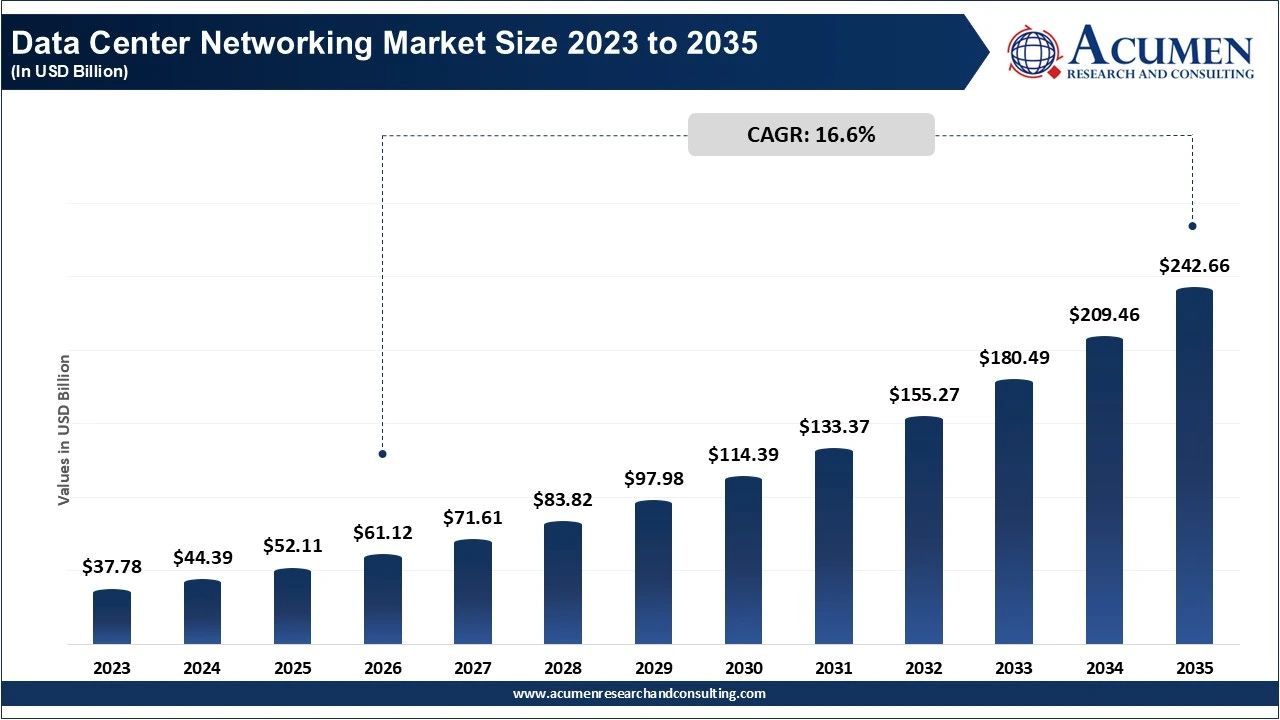
The global data center networking market size was valued at USD 52.11 billion in 2025 and is estimated to surpass around USD 242.66 billion by 2035 growing at a CAGR of 16.6% from 2026 to 2035. The rising emphasis over modern IT infrastructure especially for businesses that depend on cloud applications and real-time data brings a sustained potential for the growth of data center networking market.
What is Data Center Networking & How Does the Industry Works?
Data center networking is the overall set of hardware, software and services, that enables communication, data transport, storage accessibility and application deployment between and within data centers. The backbone of all modern digital services, data center networking physically connects all servers, storage systems, applications, and end-users through low-latency, high-speed and extremely secure networks.
From an industry and business perspective, the data center networking market is defined as the worldwide ecosystem ofvendors, service providers, hyperscalers, Telco’s and enterprises that design, implement, and manage data center networks that underpin digital services. Driven by the ongoing demand for faster networking technologies, smart automation and highly secure networking architectures, in response to increasing levels of data traffic, AI loads and interactive applications, the data center networking sector keeps on innovating toward a digital future.
| Country | Key Government Initiative | Impact on Data Center Networking |
| United States | CHIPS Act + Federal Cloud First policies | Massive AI and cloud expansion is accelerating hyperscale data center builds. |
| India | Data Center Policy & Digital India Incentives | Started incentives for hyperscale parks, data localization and colocation. |
| China | Eastern Data, Western Computing Initiative | Initiated nationwide interconnection of data centers and routing infrastructure. |
| Singapore | Green Data Center Roadmap | Started focusing on sustainable hyperscale builds that drive adoption of energy-efficient networking hardware. |
| Germany | GAIA-X & European Cloud Federation | Started efforts for sovereign cloud infrastructure for secure networking. |
Explosion of Cloud, AI, and Hyperscale Data Center Deployments
Key growth areas of the data center networking market includes rapidly expanding cloud computing, artificial intelligence and high-performance computing. Enterprises across various verticals are shifting their workload to hybrid and multi-cloud architecture, thus the worldwide data traffic continues to grow. Specifically, the need for the latency free, high bandwidth and scalable network fabric for the GPU clusters to serve the data-hungry AI and generative AI workloads are tremendous. Meanwhile, the hyperscale cloud providers continue to grow and deploy huge data center campus all over the world, where the network infrastructure requires thousands of high capacity switches, routers and SDN technologies.
For example, the exponential increasing workloads of the AI model training and inference has been prompting the cloud vendors to rapidly upgrade to the 400G and 800G Ethernet switching architecture, and on-going deployment of 5G network worldwide is escalating the development of the edge data center.
High Capital Costs
While prospects for growth remain excellent, capital intensive requirements and the complexity of managing today's networks provide limitations to market adoption. Capital investment to implement new networking hardware, improve old systems, and implement software-defined networking can be incredibly high. Budgets are typically tight for most SMB companies which puts the adoption of next-generation networking technology on the back burner.
Management of today's networks have been made more complex by hybrid and multi-cloud environments which need very sophisticated tools and skills to properly manage the complex networks and have the capability of integrating and avoiding vendor lock-in and lack of personnel skilled in networking technology. For example, the transition from traditional networking to software-defined infrastructure will require extensive training and consulting resources which will elevate the cost and duration of the project.
Rise of Edge Computing and 5G Infrastructure
Rising deployment of edge computing creates the new opportunity in the data center networking market. More industries are increasingly depends on the real-time applications, for example autonomous vehicles, smart city, industrial IOT and augmented reality. The compute will need to be move closer to the user to respond fast, thus is leading to the deployment of the edge data centers which requires smallest footprint, highest performing networks and delivering the ultra-low latency and highest reliability.
In addition, the deployment of the 5G network across the globe provides the accelerated support to boost the trend by providing the speed connectivity and new use cases which require on-premise computation power. Telco carriers and enterprises are making the large investments for the distributed edge infrastructure which brings the new high demand on the smart routers, switches and network automation platform.
North America held the largest share of 39.50% in 2025 while it is seen growing at a CAGR of 15.9% during the forecast period. The largest cloud and technology service providers are located in this region and are consistently expanding and upgrading data centers for enabling AI, high-performance computing and multi-cloud environments. The increasing demands driven by generative AI, big data analytics and real-time applications are rapidly scaling up the usage of high capacity networking such as 400G/800G Ethernet switching, Software defined networking (SDN) and network automation. The increasing trend in edge computing and development of 5G network are also propelling the expansion of data center facilities across the country.
Key Growth Indicators in North America Data Center Networking Market:
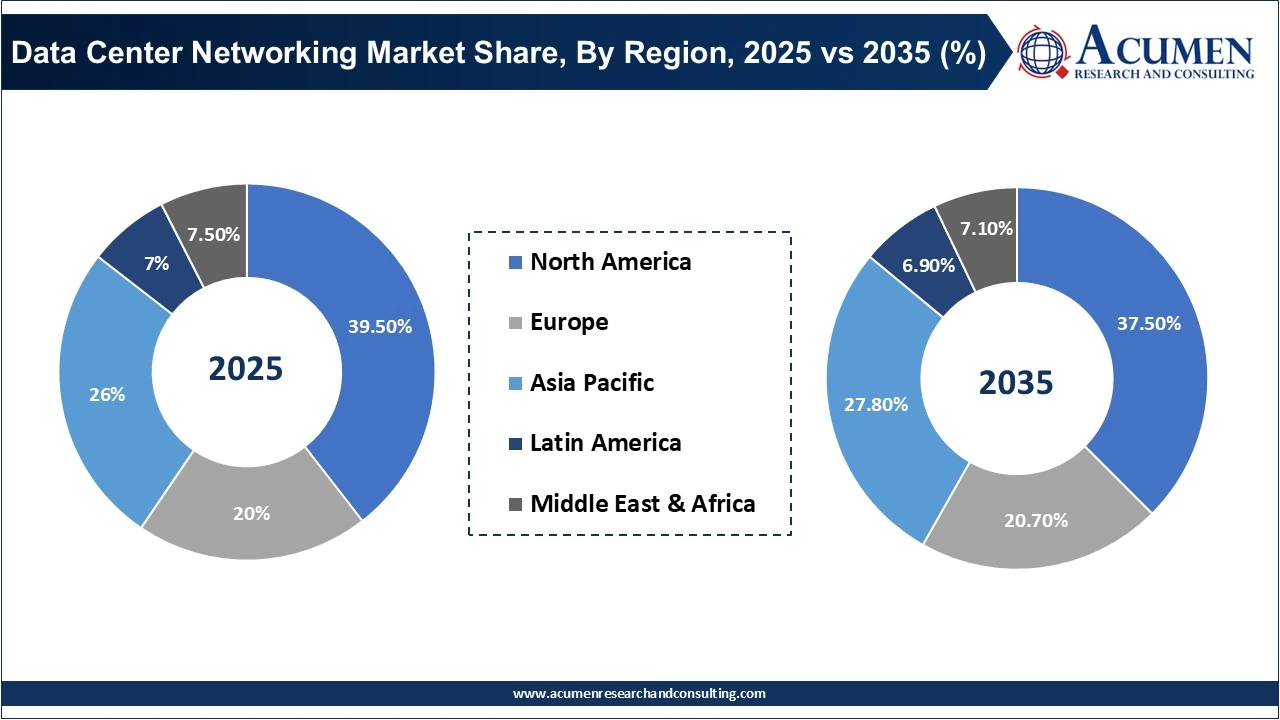
Asia Pacific is seen to grow at the highest CAGR of 17.4% in the global data center networking market because of fast digitalization, increasing internet penetration, and cloud service adoptions by the developing countries. Countries like India, China, Singapore, Indonesia and Vietnam are seeing a strong growth in their data consumption due to increase of internet and mobile usage and E-commerce, streaming media and digital payments, increasing popularity of mobile based transactions.
The local governments across the region are strongly focusing on their digital economy plan, smart city plan and local data center investments thereby enhancing the need for modern networking infrastructure. The region is becoming a center for data center deployments due to increase in the investments by global cloud providers and collocation data center providers in expanding their capacity across Asia Pacific countries.
Key Growth Indicators in Asia Pacific Data Center Networking Market:
The hardware segment accounted for the biggest share of 49% in the market for year 2025. Growing demand for high performance networking hardware to handle the rising global data traffic has driven the growth of this segment. Ethernet switches dominated as sub-segment of hardware owing to the vital role in the high speed data center interconnections. Rise of leaf-spine architecture, increased installation of 400G and 800G Ethernet devices across hyperscale data centers, growth of AI workloads demanding lowest latency and high bandwidth interconnect for GPU based computing clusters to process the massive data and expanding use of routers across edge computing and 5G network deployment, and increase of storage area network with AI training and High-Performance Computing(HPC) applications demanding fast as well as scalable storage connections have propelled switch installations at an accelerated rate.
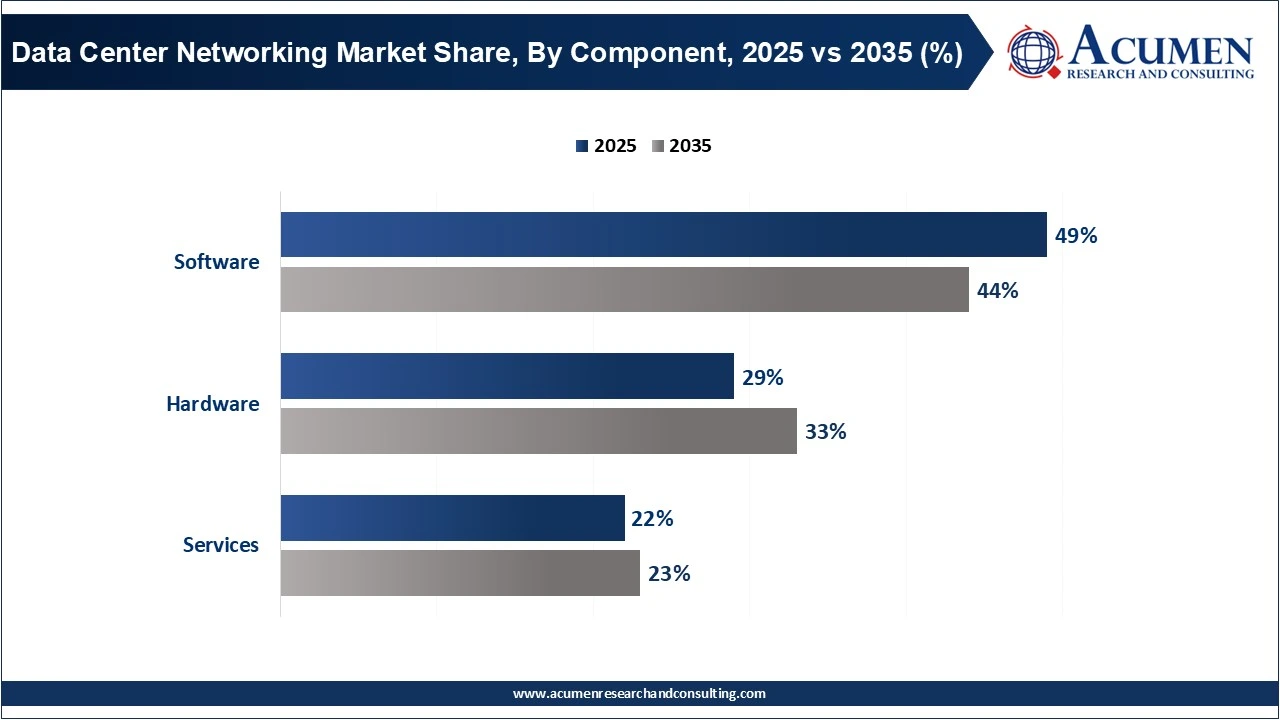
The software segment held the second largest share of 29% in 2025 and is expected to grow at the fastest rate during the forecast period owing to rise in the complexity in hybrid and multi cloud infrastructure. Growing use of network automation, orchestration and AI based analytics to minimize operational cost and enhance network visibility. With increasing adoption of artificial intelligence for IT operations (AIOps), the network is able to have preventive maintenance and proactive network management, thereby pushing the adoption of management platforms.
With 42% share in 2025, cloud data center has the largest share in the market in terms of deployments. The rapidly growing adoption of hyperscale infrastructure by hyperscale companies boosted the growth of the segment. The growing trends like AI workloads, machine learning, big data analytics, cloud native deployment significantly raised the data center network traffic. Hyperscale players have demanding requirements for network hardware like 400 G/800 G Ethernet switch, SDN, optical interconnects to support their large scale compute environments. The increasing demand for public cloud services and AI training clusters still drive the demand for cloud data center networking.
Data Center Networking Market Revenue Share, By Deployment, 2025 (%)
| Deployment | Revenue Share, 2025 (%) |
| On-premise Data Centers | 31% |
| Cloud Data Centers (hyperscale) | 42% |
| Colocation Data Centers | 17% |
| Hybrid Data Centers | 10% |
With 31% share in 2025 on-premise data center still has large demand especially in organizations dealing with confidential data and critical applications. Banks, Healthcare, Government and Defense industries are highly concerned about data sovereignty, security, compliance and operational control which boost the demand in private networking infrastructure. Modernization on virtualization of network, high speed switches and integrated cybersecurity also drive the growth of the segment.
Cloud service providers were the largest market segment in the market in 2025 with 38% share due to ongoing hyperscale facility expansion and increase in demand for cloud computing services. With AI infrastructure deployment, GPU clusters, high density servers the network requirement for very high bandwidth, very low latency increased. The investments in new generation Ethernet, optical networking, automated network management continue to boost segment growth.
Data Center Networking Market Revenue Share, By End User, 2025 (%)
| End User | Revenue Share, 2025 (%) |
| Cloud Service Providers (CSPs) | 38% |
| Enterprises (BFSI, IT, Telecom, Healthcare, Retail) | 32% |
| Telecom Operators | 16% |
| Government & Defense | 9% |
| Others | 5% |
Enterprises also remained important market segment in the market in 2025 with 32% value share, as enterprises organizations are one of the largest adopter of data center networking technologies as digitally transformation is driven in various industries. The increasing volume of data, network security, demand of real time business operation prompt the Enterprise organization to invests in advanced networking infrastructure. Enterprises organization is deploying more hybrid cloud environment, SD-WAN, automated networking platform and the needs will continue to boost.
The IT & telecom segment captured the largest market share of 29% in the market owing to its critical role in accelerating digital transformation and globalization. Cloud computing adoption and hyperscale data center deployment coupled with the evolution of 5G services have augmented the need for cutting edge network infrastructure. Telcos are upgrading their network to cater to the needs of real time/ ultra low latency services, cloud service providers are extending their network of global data centers to accommodate increasing demand for internet services, video streaming and adoption of cloud by organizations.
Data Center Networking Market Revenue Share, By Industry Vertical, 2025 (%)
| Industry Vertical | Revenue Share, 2025 (%) |
| IT & Telecom | 29% |
| Healthcare | 9% |
| Retail | 8% |
| Manufacturing | 13% |
| BFSI | 19% |
| Government & Defense | 11% |
| Media & Entertainment | 6% |
| Others (Energy, Education) | 5% |
BFSI sector held a prominent share of 19% in the market, and expected to grow rapidly; propelled by digital banking services and fintech platforms along with the adoption of real time payment services. It demands for high security and low latency network services to keep transactions flowing smoothly and adhere to stringent regulatory norms. The manufacturing segment is also observing an exponential growth due to the advent of industry 4.0 and smart factory initiatives. Industrial IoT (IIoT) and automated systems being integrated into factory settings has pushed for enhanced network infrastructure.
By Component
By Deployment
By End Use
By Industry Vertical
By Region
Looking for discounts, bulk pricing, or custom solutions? Contact us today at sales@acumenresearchandconsulting.com

June 2023
January 2023
March 2023
August 2020
Trusted Market Intelligence | 2026–2035 Insights | Designed to Support Faster, Smarter Decisions
Thank you! Our team will reach out to you soon.