April 2025

EV Semiconductor Market (By Material Technology: Silicon (Si), Silicon Carbide (SiC), Gallium Nitride (GaN), Other Wide-Bandgap Materials: By Vehicle Type: BEV, PHEV, HEV, FCEV; By Product Type: Power ICs & Modules, Microcontrollers & Processors, Sensors, Memory Components, Analog Components, Others, By Vehicle Class: Passenger Cars, LCV, HCV, Electric Buses, Two-Wheelers & Three-Wheelers) - Global Industry Analysis, Size, Share, Regional Analysis, Trends and Forecast 2026 - 2035
The global EV semiconductor market size was accounted for USD 25.80 billion in 2025 and is estimated to surpass around USD 67.71 billion by 2035 growing at a CAGR of 10.1% from 2026 to 2035. The global EV semiconductor market is expected to grow at a rapid pace owing to the rising demand for emerging autonomous electric vehicles; coupled with consistent spending on R&D. Countries especially in Asia are witnessing rapid expansion of EV assembly plants, battery gigafactories, and semiconductor fabrication facilities supported by government-backed clean energy and semiconductor initiatives.
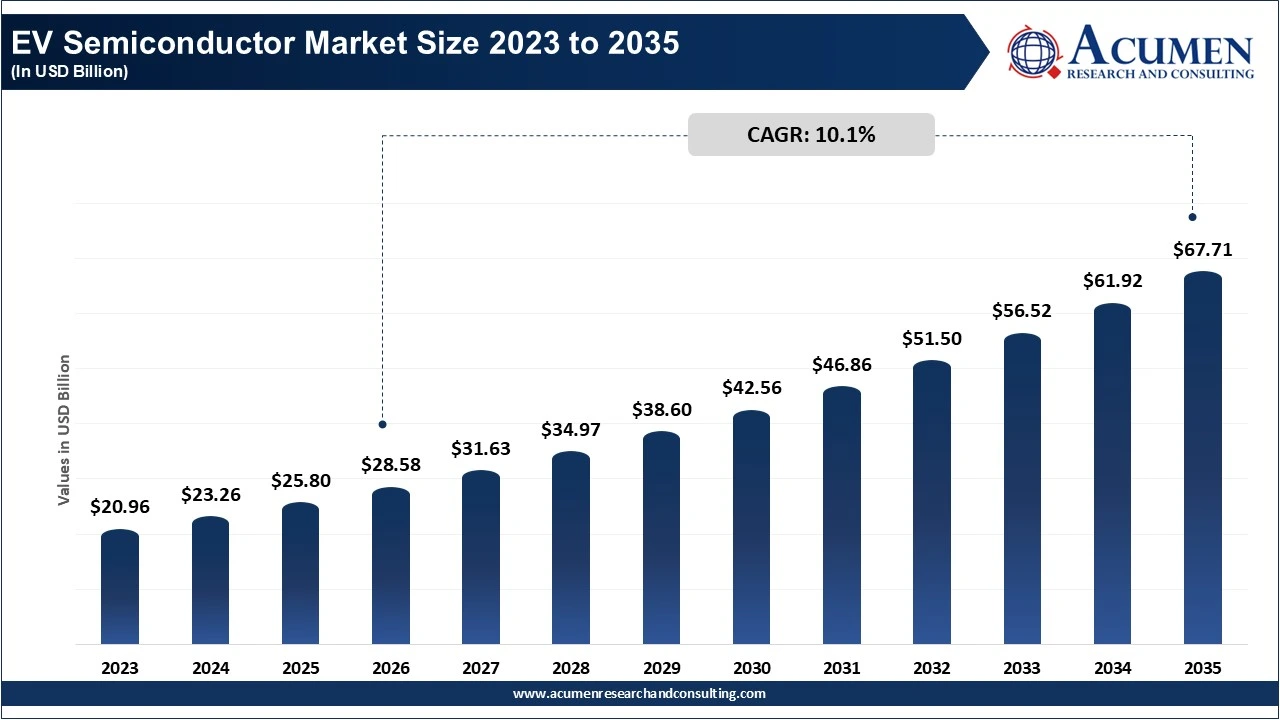
EV semiconductor refer to semiconductors utilized by electric vehicles and it is one of the world industry dealing with designing, manufacturing, supplying, and applying these semiconductors in the EVs. These semiconductors help to manage and control the energy power converting and batteries performances, motor control, charging stations, vehicle's communication, and its infotainment, safety system and automated drive.
The market is expanding rapidly, driven by worldwide electrification trends for vehicles, increased investments into autonomous mobility, and wider adoption of connected transport systems. It's estimated that semiconductors content in premium EVs may exceed US $1,000 per vehicle, thanks to integrated features such as advanced driver assistance systems (ADAS), battery management systems (BMS), artificial intelligence (AI)-powered processing units, and high-voltage power electronics. Demand for automotive semiconductors across the world is further boosted by the spread of rapid charging networks, smart mobility systems, and next-generation battery technologies.
Rising Electric Vehicle Production and Electrification Trends
One of the key factors enabling growth of the EV semiconductor market is the fast pace at which global production of electric vehicles is expanding. An EV uses a considerably larger quantity of semiconductor content as compared to an internal combustion engine vehicle because the EV system relies heavily on an electronic control system, battery management technology, a power electronics powertrain, and a smart connectivity system.
The IEA stated that over 20 million global EVs will be sold in 2025. Such a large number of electric vehicle sales worldwide has increased global automotive semiconductor consumption such as battery systems, inverters, onboard chargers, sensors, and microcontrollers. An increasing integration of new semiconductor technologies for enhanced battery system efficiency and increased vehicle travel range, driving speed, and safety continues to drive global semiconductor consumption.
Semiconductor Supply Chain Disruptions and High Manufacturing Complexity
The EV semiconductor market is hampered by problems such as semiconductor supply shortages, geopolitical concerns and manufacturing complexity issues associated with automotive-grade chip production. It requires heavy investment in capitol facilities and skilled production sites and has long manufacturing processes; all of which can result in shortages during periods of strong demand from automotive companies.
Many of the global automotive manufacturers faced delays to their production in the recent chip shortages which primarily affected microcontroller, power IC and automotive processor supplies. Furthermore, the industry-wide shift to next-gen semiconductor technologies such as SiC and GaN will face challenges with manufacturing costs and lack of capacity that will perhaps limit growth in the shorter term.
Growing Adoption of Silicon Carbide and Autonomous Vehicle Technologies
The proliferation of silicon carbide (SiC) semiconductors and the growing adoption of autonomous driving technologies offer ample opportunities for expansion of the EV semiconductor market. SiC devices have better thermal efficiency, switching performance, power consumption, and power loss in comparison to silicon semiconductors, and are used in future electric vehicles and ultra-fast charging systems.
Simultaneously, the acceleration of autonomous driving, intelligent transportation systems and AI powered driving assistant services is driving an enormous demand for processors, radar, imaging sensors and AI accelerators. Automakers are increasingly looking toward software-defined automobiles and smart transit systems, which is estimated to drive demand in all passenger, commercial, and autonomous EV segment semiconductor.
| Attribute | Details |
| EV Semiconductor Market Size in 2026 | USD 28.58 Billion |
| EV Semiconductor Market Size in 2035 | USD 67.71 Billion |
| EV Semiconductor Market CAGR | 10.1% |
| Analysis Period | 2022 - 2035 |
| Base Year | 2025 |
| Forecast Data | 2026 - 2035 |
| Segments Covered | By Material Technology, By Vehicle Type, By Product Type, By Vehicle Class, By Region |
| Regional Scope | North America, Europe, Asia Pacific, Latin America, and Middle East & Africa |
| Key Companies Profiled | Infineon Technologies, NXP Semiconductors, STMicroelectronics, Texas Instruments, Renesas Electronics, ON Semiconductor, Qualcomm, NVIDIA, ROHM Semiconductor, Mitsubishi Electric |
| Report Coverage | Market Trends, Drivers, Restraints, Competitive Analysis, Player Profiling, Covid-19 Analysis, Regulation Analysis |
The silicon-based semiconductor segment dominated the EV semiconductor market with 55% market share in 2025 driven by the extensive use of power electronics, control systems, infotainment systems, and battery management applications. The automotive sector’s continued reliance on silicon semiconductors stems from the maturity of their production ecosystem, reduced cost of manufacturing, high scalability and compatibility with existing automotive electronic systems. The use of components such as Insulated Gate Bipolar Transistors (IGBTs), Silicon MOSFETs, microcontrollers and analog ICs are prevalent in electric vehicles owing to their functionality in energy conversion, motor control, charging systems, and safety systems.
“The widespread adoption of electric vehicles contributes to the silicon semiconductors' dominance in the market. International Energy Agency reported more than 20 million units of electric vehicles sold in 2025 leading to a spike in demand for automotive grade semiconductor chips.”
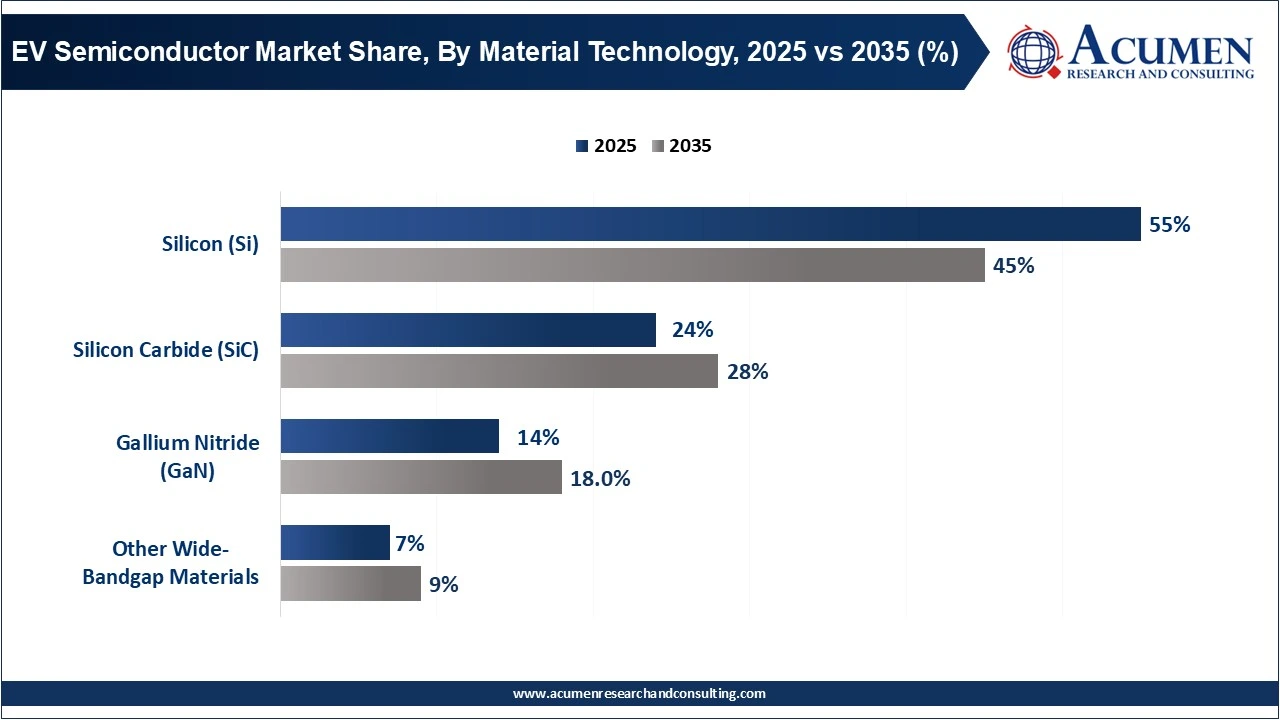
During the forecast period the segment Silicon Carbide (SiC)) semiconductors are expected to witness a notable growth as it also held 24% of market share in 2025 on account of increasing demand for electric vehicles which have high efficiency and fast-charging capabilities and the need for advanced performance.
These semiconductors deliver better power conversion efficiency, have low power losses, better heat conduction and higher switching frequency than the existing silicon semiconductors. Ultra-fast charging infrastructures are becoming more popular with the widespread demand for long range electric vehicles contributing to the widespread adoption of silicon carbide based power electronics.
The battery electric vehicle segment led the market of semiconductors for electric vehicles in 2025 as advanced semiconductor components are heavily integrated in every aspect of the vehicle; powertrain, battery management systems, advanced driver-assistance systems, infotainment systems, and connectivity. The quantity of semiconductors in BEVs is far larger than for internal combustion engine vehicles as all the critical functions of a vehicle rely on the electronic controls and power electronics. The fast growth of global BEV production is driving demand worldwide for semiconductors.
The fuel cell electric vehicle segment is predicted to grow at a notable CAGR of 10.1% in the forecast period with greater attention to emission-free transport technologies around the globe, increase in number of refueling stations for hydrogen fuel, and surge in investment on green mobility. For smooth functioning of an FCEV, integrated semiconductor components are indispensable for effective management of power, control system for fuel cell, energy management for battery, and thermal management, and operation of electric motor. Growing need for longer driving range for electric vehicles along with fast refueling time compared to battery electric vehicles is strongly aiding the development of FCEV. This trend is particularly notable for commercial as well as heavy-duty vehicles.
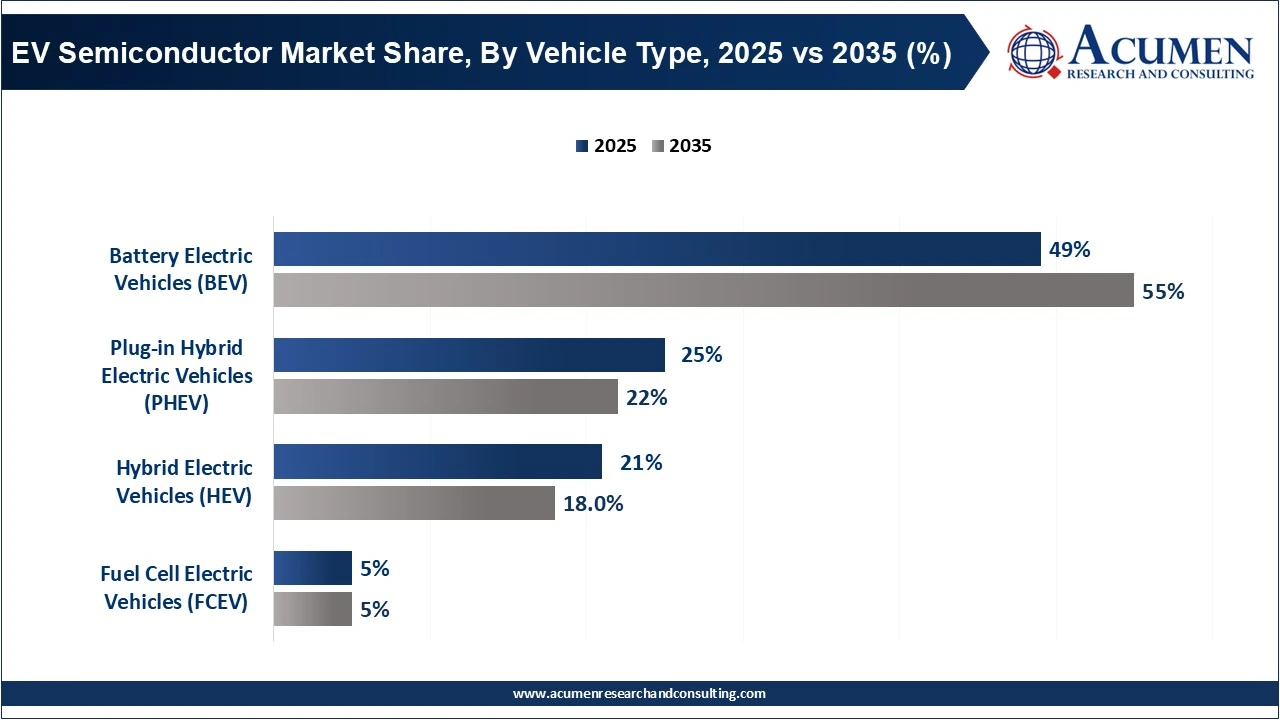
The plug-in hybrid electric vehicle segment held the second largest share of 25% in 2025. Increased consumer adoption of transitional electrification technology that combine the use of both electric power and conventional engine for auxiliary power or prolonged vehicle range, and the wide adoption of PHEVs in markets with relatively poor charging infrastructure or high concerns of electric range, are among the major drivers of PHEV market growth.
PHEVs necessitate complex semiconductor systems in managing their dual-propulsion systems, regenerating braking systems, energy management systems, battery charge systems and engine synchronized operations. This contributes to a higher semiconductor demand in terms of automotive microcontrollers, power management ICs, battery control semiconductors and communication semiconductors.
The power ICs & modules segment led the market with 36% of market share in 2025 because of increased electrification of EV architectures and increasing requirement of energy conversion systems. Power ICs include voltage regulators, battery chargers, motors drivers, thermal management & power distribution. Moreover, fast charging technology & high voltage EV architectures are forcing tremendous upswing in demand for advanced power semiconductor module with high power density with minimal power loss. Silicon carbide based power modules are replacing conventional silicon based components owing to enhanced thermal performance & switching.
EV Semiconductor Market Revenue Share, By Product Type, 2025 (%)
| Product Type | Revenue Share, 2025 (%) |
| Power ICs & Modules | 36% |
| Microcontrollers & Processors | 24% |
| Sensors | 14% |
| Memory Components | 10% |
| Analog Components | 9% |
| Others (Communication ICs, etc.) | 7% |
The microcontrollers & processors held the second largest share of 24% in 2025 with their wide usage, as they control battery management, motor, entertainment system, vehicle communication, ADAS functions, thermal management & distribution power management system. Numerous ECUs are integrated in the EV cars and require high end microcontrollers and processing chips for functioning of the EV.
In 2025 the passenger car segment held a market share of 51% due to high rate of adoption of electric passenger cars in developing and developed economies. Higher adoption of eco-friendly electric passenger cars and availability of subsidies for electric cars along with strict emission reduction rules in developing and developed countries such as China and North America have propelled significant demand of semiconductors for passenger EVs. The advanced electric passenger car segment utilizes large number of semiconductor components such as power IC, MC, Sensors, Memory IC and SiC power devices, which play a significant role in managing the battery system, infotainment, ADAS, electric powertrain, autonomy etc.
EV Semiconductor Market Revenue Share, By Vehicle Class, 2025 (%)
| Vehicle Class | Revenue Share, 2025 (%) |
| Passenger Cars | 51% |
| Light Commercial Vehicles (LCV) | 15% |
| Heavy Commercial Vehicles (HCV) | 13% |
| Electric Buses | 11% |
| Two-Wheelers & Three-Wheelers | 10% |
The light commercial vehicle segment held the second largest market share of 15% in 2025 due to high rate of adoption of electric delivery van, logistic fleet and urban light commercial vehicles for transporting goods. Growing e-commerce trends and demand for last-mile delivery solutions and services have been the major driver in demand for light commercial EVs with the latest semiconductor technologies. These semiconductor devices are utilized for better power management in electric light commercial vehicles.
Asia Pacific remained the leading market in the EV semiconductor market during 2025 with market share of 35% and is expected to grow rapidly at the highest CAGR of 11.4% owing to unparalleled EV manufacturing setup, robust semiconductor fabricating capacity, predominant battery supply chain and rapid government’s push to electric mobility. The region has emerged as the nucleus of the global EV uprising with countries such as China, Japan, South Korea and now even India paving way for mass manufacturing of EVs, automobile chips, batteries, intelligent vehicle technologies. The shift towards software-defined vehicles, self-driving vehicles and higher power density battery structures has boosted the need for semiconductors across the region.
Strong vertical integration in the supply chain was also one of the major contributing factor among semiconductor firms, battery providers, and EV manufacturers. The likes of BYD, CATL, Samsung Electronics, Renesas Electronics, Toyota Motor Corporations and others were investing massively on future automotive chip technology as well as intelligent electric vehicle electronics in this region. It has one of the largest Semiconductor and Electronic Manufacturing facilities in the world which helps in reducing the overall cost and high volume of automobile chip production.
Government Initiatives Supporting the EV Semiconductors Market in Asia Pacific
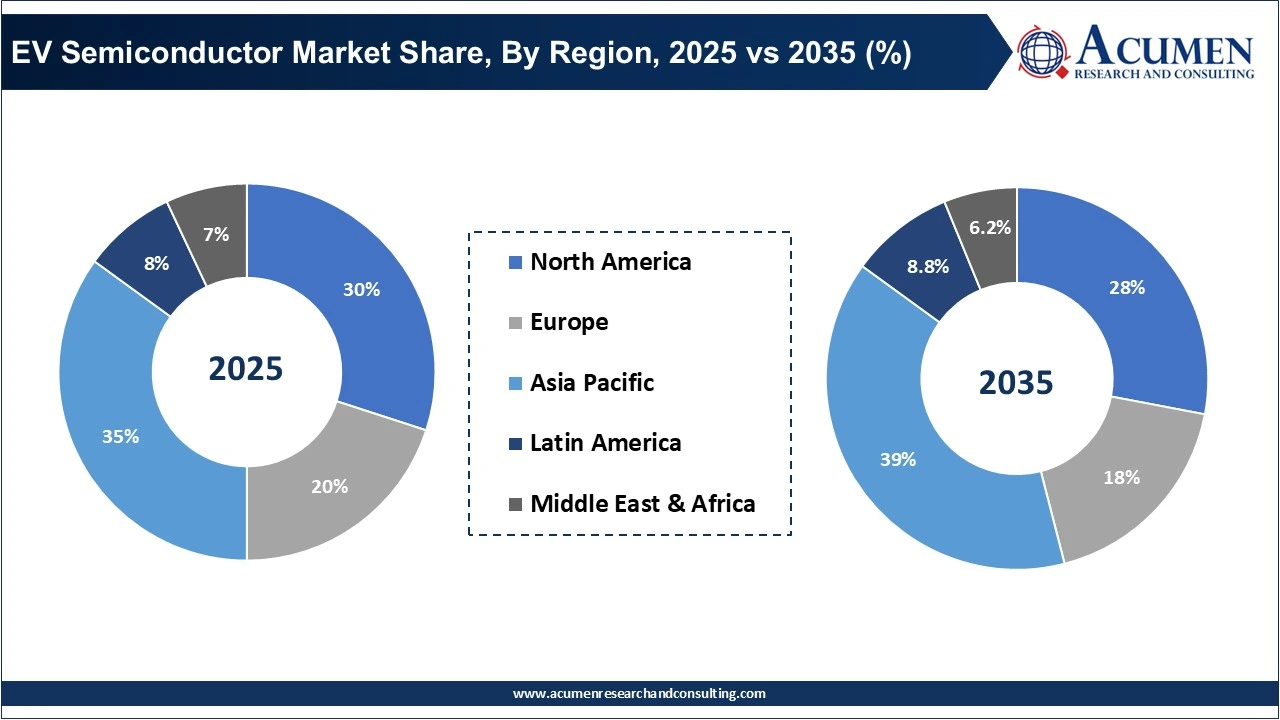
The North American market held second largest share in 2025 of 30% and will grow quickly at 9.2% CAGR in the upcoming timeframein the EV semiconductor market over the forecast period, owing to increasing investments in domestic semiconductor production, increased capabilities in EV production facilities, and an increased demand for the most advanced automotive technologies. The region's automotive semiconductor supply chains, and related infrastructure, are rapidly building themselves up, driven by widespread concerns regarding supply chain disruption, geopolitical risks and reliance on Asian semiconductor imports.
A key driver is the passing of the CHIPS and Science Act. This legislation is stimulating investments amounting to billions of dollars into semiconductor fabrication facilities, as well as automotive chip R&D and high-tech electronics production in the U.S. Intel, Micron Technology and Texas Instruments are among several companies already expanding chip manufacturing capabilities focused on automotive grade semiconductors.
During the forecast period, the Latin America EV semiconductors market is likely to grow at an increasing CAGR of 11.2% driven by the escalating adoption of electric vehicles, expanding automotive production, and growth of various government initiatives towards clean mobility across the Latin America. The growing investment across infrastructure development, battery manufacturing, and charging networks by countries like Brazil, Mexico, Chile, among others, is driving the development of EVs across the region.
As the adoption of Battery Electric Vehicles (BEVs) and Hybrid Electric Vehicles (HEVs) increase, the demand for power ICs, sensors, microcontrollers, and Silicon Carbide (SiC)-based power devices is likely to witness a significant growth rate. Rising fuel costs, increasing awareness on environment and tightening emission norms by automobile manufacturers will further fuel the demand for energy efficient semiconductor devices for developing next generation of electric vehicles.
By Material Technology
By Vehicle Type
By Product Type
By Vehicle Class
By Region
Looking for discounts, bulk pricing, or custom solutions? Contact us today at sales@acumenresearchandconsulting.com

April 2025
July 2024
November 2020
April 2020
Trusted Market Intelligence | 2026–2035 Insights | Designed to Support Faster, Smarter Decisions
Thank you! Our team will reach out to you soon.