August 2018

Industrial Vehicles Market (By Vehicle: Forklifts, Tow Tractors, Container Handlers, Aisle Trucks, AGVs, Others; By Propulsion: Internal Combustion Engine, Electric Vehicles, Hybrid Vehicles; By Automation Level: Manual Vehicles, Semi-Autonomous, Fully Autonomous; By Application: Material Handling, Warehousing & Logistics, Manufacturing Operations, Construction & Infrastructure, Mining Operations, Port & Container Handling, Waste Management, Others; By End-user: Manufacturing, Logistics & Warehousing, Retail & E-commerce, Automotive, Chemicals, Pharmaceuticals, Construction, Mining, Others) - Global Industry Analysis, Size, Share, Regional Analysis, Trends and Forecast 2026 - 2035
The global industrial vehicles market size was valued at USD 47.20 billion in 2025 and is estimated to surpass around USD 85.56 billion by 2035 growing at a CAGR of 6.1% from 2026 to 2035. Rapid industrialization, infrastructure development and expansion of e-commerce; especially in major Asian countries create sustaining opportunity for the market to grow. Additionally, the industrial vehicles market is driven by the integration of flexible leasing/rental services that make such vehicles easily available for fleet operators.
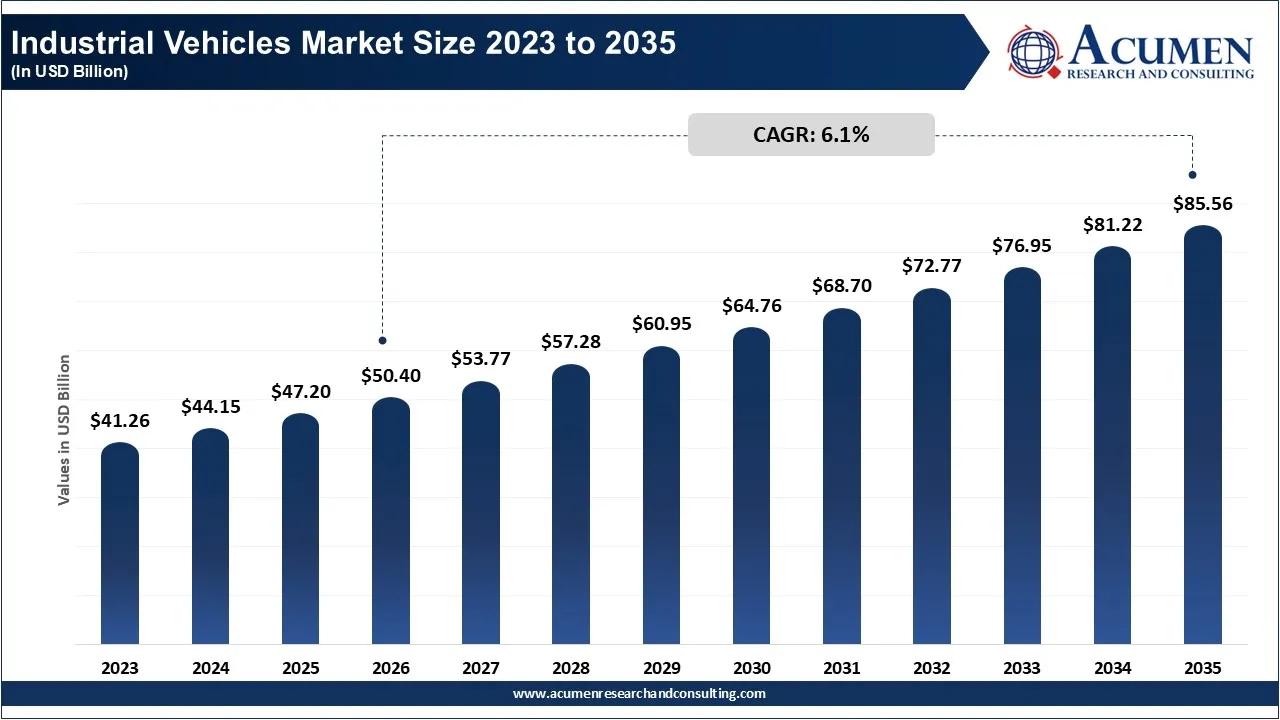
The industrial vehicles market encompasses the global supply-demand market for specialized material handling and transportation vehicles employed in various industrial applications such as manufacturing plants, warehouses, distribution centers, port operations, mines, construction sites, agricultural facilities, and other similar environments. The market growing considerably due to an increased emphasis on operational efficiency and automation in supply chain operations, along with a substantial increase in warehousing and distribution infrastructure development across both developed and emerging economies.
Rapid Growth of Warehouse Automation and E-commerce Logistics Accelerating Industrial Vehicle Demand
Increasing pace of growth in global e-commerce, growth in warehouse automation and smart logistics infrastructure development are among some of the significant factors driving industrial vehicles market growth globally. Due to growing consumer expectations regarding speedy delivery and same-day shipping, efficient management of inventory, companies engaged in logistics and warehouse management sector are heavily investing in new age material handling equipment including forklifts, automated guided vehicles (AGVs), aisle trucks, and tow tractors.
Deployment of mega fulfillment centers at a large scale by firms such as Amazon, Walmart, and Alibaba Group, have spurred the adoption of automated industrial vehicles globally. Logistics sector data indicates that the investment in warehouse automation continues to witness significant growth owing to burgeoning digital transformation across logistics and manufacturing industries. Furthermore, growing organized retail, cold chain logistics and industrial manufacturing in emerging economies, have generated significant long-term demand for electric forklifts and autonomous industrial vehicles. Also the ever increasing focus of industries toward industrial safety, operational efficiency and labor optimization is fueling market growth on global scale.
High Initial Investment and Infrastructure Costs
The steep capital investment required for cutting-edge industrial vehicles and automated systems remains a key barrier to the growth of the industrial vehicle market. AGVs, autonomous forklifts, li-ion powered fleets and HFC industrial vehicles involve a steep capital outlay in terms of system integration, charging stations, batteries, navigation systems, facility redesign.
Financial constraints to investing in the highest automated industrial vehicle systems could especially become a hindrance for SMEs, more so for those in developing economies. Further, maintenance and employee training costs are also a constraint.
Electrification and Smart Manufacturing Trends
The accelerating trend toward industrial electrification and smart manufacturing provides huge development potential for the industrial vehicles market. Governments and industries are striving to promote green manufacturing and develop a manufacturing industry that relies on smart technologies, low-carbon industrial practices, and clean energy sources worldwide. As a result, the market demand for electric industrial vehicles, AGVs, and hydrogen-powered material handling equipment is increasing.
Moreover, the increasing application of Industry 4.0 technology like AI, IoT, machine learning, robotics and predictive analytics is allowing businesses to develop smart and highly automatic transportation systems for industrial operations. Developing markets like India, Vietnam, Indonesia, Brazil and Mexico are experiencing rapid industrial growth, improvement of infrastructure, development of logistics systems. There is enormous potential for industrial vehicle manufacturers in developing countries. With the trend toward automatic warehouses, intelligent ports and AI driven supply chains, high-tech industrial vehicles would likely experience a strong growth in long-run over the forecast period.
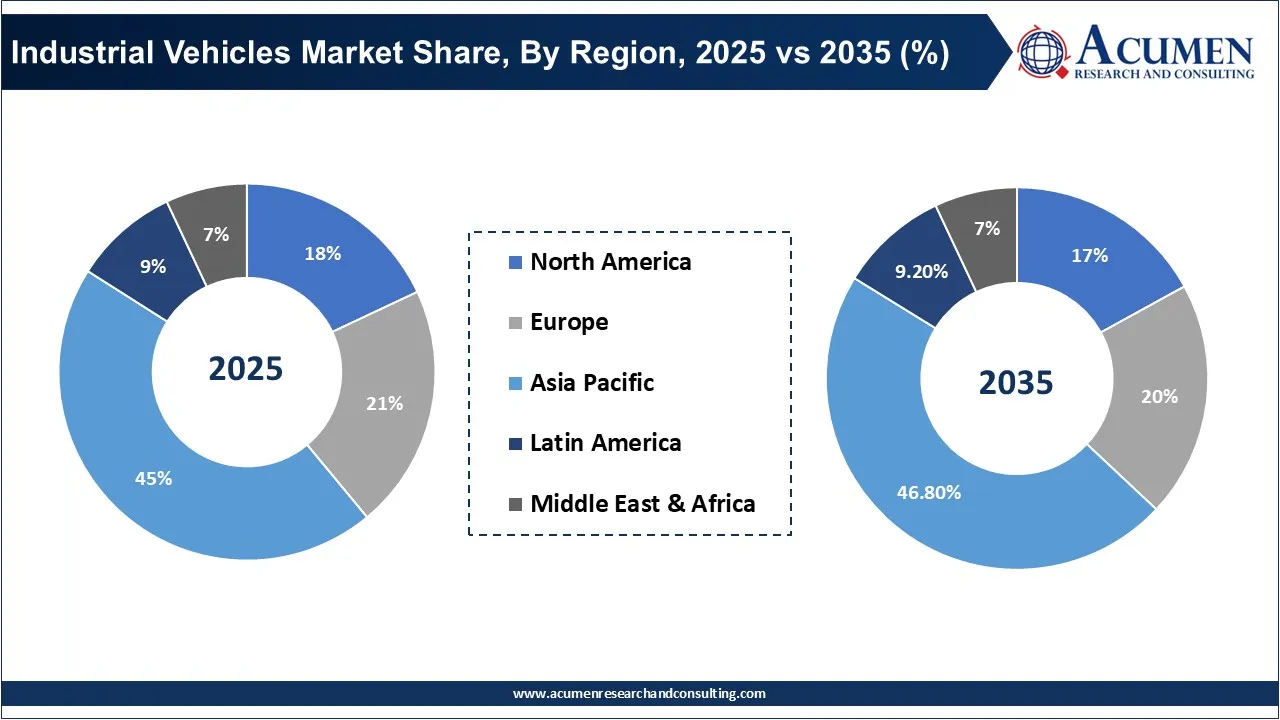
Asia Pacific led the industrial vehicles market in 2025 with 45% market share and is expected to grow at the fastest rate of CAGR of 6.5% as industrialization, strong manufacturing output, surging e-commerce activities and the rise of warehouse automation investments spur demand. The strong growth in industrial production, logistics, smart factories and ports across China, Japan, India and South Korea is rapidly expanding the demand for forklifts, AGVs, aisle trucks, tow tractors and electric industrial vehicles.
Increasing use of electric industrial vehicles is another factor that contributed to the dominance of the Asia Pacific. China alone has become responsible for majority of electric forklift production volume owing to government incentives, electric forklifts production plans and its dominance in battery manufacturing. High market demand for lithium-ion powered industrial vehicles is witnessed across the Asia Pacific market because of stringent environmental regulations and rising industrial sustainability programs.
Indian Government Initiatives Supporting Industrial Vehicles Market Growth
Latin America industrial vehicles market is predicted to expand drastically at a CAGR of 6.3% throughout the forecast period attributed to growing warehouse automation, increasing labor shortage, growing e-commerce sector and mounting investment on smart manufacturing infrastructure in the region. This region is steadily increasing adoption of latest industrial vehicles embedded with robotics, AI, IoT, autonomous navigation in warehouse and manufacturing industries to enhance operational productivity and logistics costs reduction.
Growing labor shortage in warehousing and logistics industries is also another major driver of growth of automation investments in North America. According to market reports, warehouse operators throughout the region. Are heavily investing in the adoption of robotic industrial vehicles and AGVs, boosting productivity and operational efficiency in the logistics and warehousing industry, which will spur growth of Latin America industrial vehicles market throughout the forecast period.
Brazil Industrial Vehicles Market Overview:
Brazil holds the largest share in the Latin American industrial vehicles market attributed to highly established logistics sector, advanced manufacturing infrastructure and enormous warehouse infrastructure in the country. The country is continuing to witness enormous investment in automated fulfillment and distribution centers. Ever-growing need of expedited order delivery and same day delivery, which is exponentially driving adoption of forklifts, AGVs, AMRs, automated aisle trucks across Brazil.
Forklifts Held the Largest Share in 2025
The industrial vehicle market was led by the forklifts segment at the share of 44% in 2025 owing to widespread application across warehouses, manufacturing plants, ports, distribution centers, logistics centers and shipping industries worldwide. These are being extensively used in all aspects of material handling tasks including loading, carrying, stacking and movement of heavy materials within confined industrial premises due to increased efficiency and ease of operation. Growing e-commerce and retail warehousing & 3PL industries are increasing the global demand for automated and electric forklifts.
Prominent companies such as KION Group AG, Toyota Industries Corporation and Jungheinrich AG are heavily investing in developing and launching advanced forklifts with latest features of lithium ion batteries, telematics, artificial intelligence based fleet management systems and autonomous navigation systems. Forklifts contribute to over 55% of the overall global demand for industrial vehicles owing to cost efficiency in operations over industrial heavy vehicles and operational flexibility according to the estimates of global material handling industry.
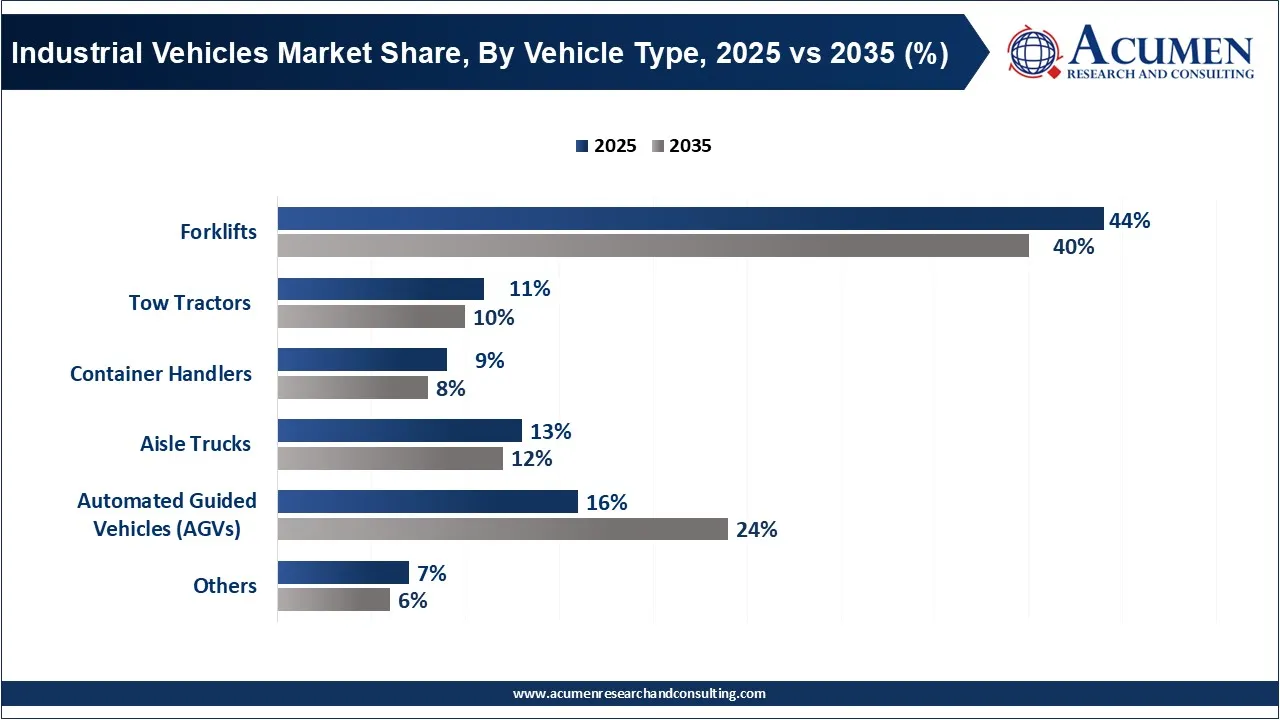
The Automated Guided Vehicles (AGVs) segment was the second largest shareholder at 16% market share in 2025 and is expected to grow with the fastest rate during the forecast period owing to growing trend of automation in industries, the growth of smart warehousing concepts, and widespread adoption of Industry 4.0. These vehicles are gaining a lot of traction and replacing the forklifts, robots etc in modern industrial warehouses and plants. The AGVs are known for minimal human interaction during their operations, better operational safety, fewer operational mistakes, increased supply chain efficiency etc. The growth of automated warehouses being implemented by companies such as Amazon, Alibaba Group and Walmart is boosting the demand for AGVs on a global scale for transporting palletized goods, fetching products, material handling, AS/RS and other operations.
Internal Combustion Engine (ICE) Vehicles Dominated the Market in 2025
The internal combustion engines (ICE) segment dominated the industrial vehicles market with 60% share in 2025, owing to the continued utilization of diesel, LPG/CNG, and gasoline-powered industrial vehicles within the high-intensity industrial activities. ICE-powered industrial vehicles maintain high popularity among mining, construction, ports and shipping, and heavy manufacturing segments, where the factors of higher load carrying capacity, longer operational times, and outdoor performance are paramount. The demand for diesel powered forklifts and container handlers has continued to be high across emerging countries due to their lower initial costs, already established fueling infrastructure, and higher endurance for heavy-duty applications. The ports and shipping locations in countries such as China, India, U.S., and Germany continue to use diesel powered heavy industrial vehicles for the container transportation and handling operations.
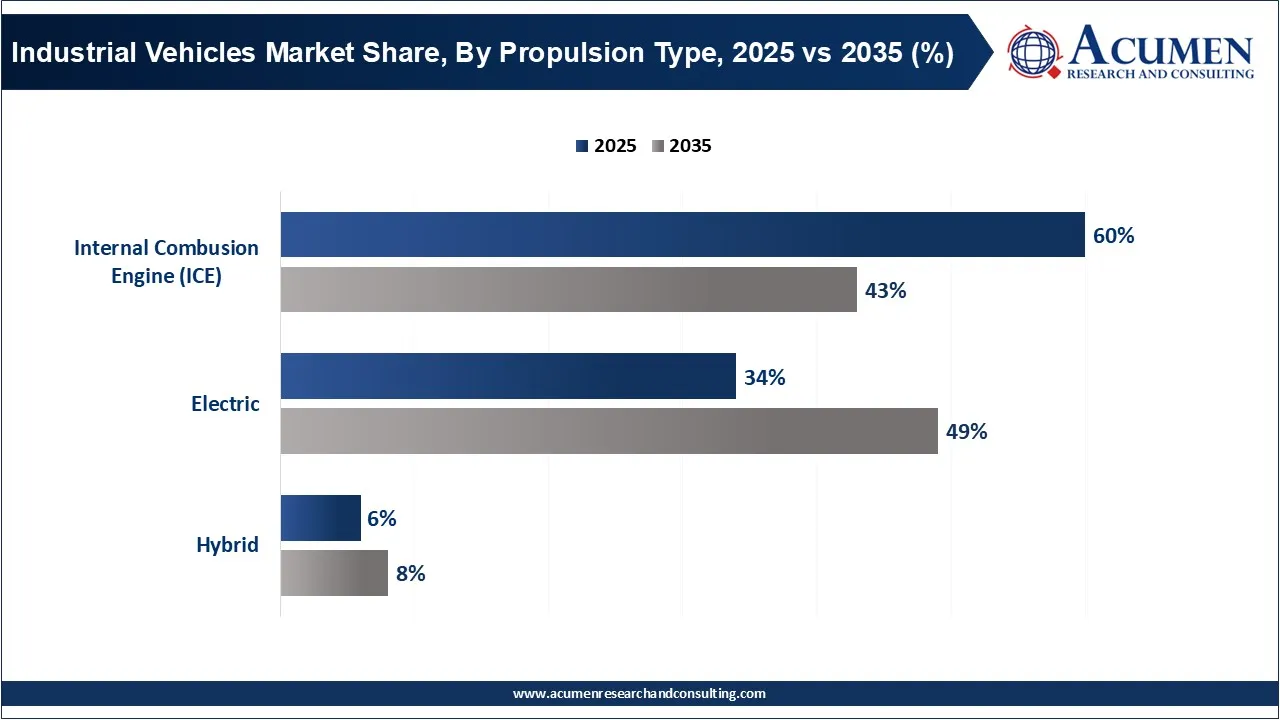
The electric vehicles segment held 34% of market share in 2025 and is rapidly gaining prominence at a CAGR of 10.2% across the industrial vehicles market, attributable to the increased industrial electrification, stringent environment rules and regulations, and the demand for energy efficient material handling equipment. The electric industrial vehicles such as electric forklifts, aisle trucks, AGVs and tow tractors are increasingly being deployed in warehouses, manufacturing plants, retail distribution centers and logistics hubs due to zero emissions, reduced operating costs, noise reduction and lower maintenance requirement over the ICE industrial vehicles.
The hydrogen fuel cell vehicles segment held a notable share of 6% in 2025 due to increasing decarbonization goals, cleaner energy adoption and mounting investments in green industrial transportation solutions. The hydrogen fuel cell powered vehicles provides the benefit of emission-free operation, rapid refueling times, extended operating hours and greater efficiency in high intensity industrial applications.
“Top companies like Plug Power Inc., Toyota Industries Corporation and Hyundai Motor Company are investing highly in hydrogen fuel cell forklifts and material handling industrial equipment. Hydrogen fuel cell forklifts are widely being implemented in the large distribution centers and warehouses that require continuous operation and quick refueling.”
Manual Vehicles Dominated the Market in 2025
Manual vehicles segment held the biggest share in the industrial vehicles market as it takes up 64% in 2025. The market share of the manual vehicles is high due to its lower purchase price, easy maintenance and convenience of operating manually controlled industrial vehicles. Small and medium scale industries are using manually operated industrial vehicle, loaders, transport vehicles, pallet trucks, and forklifts with a large market share in the industrial vehicles market. This is due to the convenience and lower cost that manually operated vehicles carry with them which do not need advanced technological support. Industries like manufacturing, warehouse, mining, and construction industries are using manual industrial vehicle to carry material and load/unload goods to/from transportation and moving inventory goods in their manufacturing unit and warehouses. Manual vehicles are also preferred more in developing countries where the cost of labor is low and industries are still working on automation technologies for their manufacturing unit.
Market Share, By Automation Level, 2025 (%)
| Automation Level | Revenue Share, 2025 (%) |
| Manual Vehicles | 64% |
| Semi-Autonomous Vehicles | 26% |
| Fully Autonomous Vehicles | 10% |
The second biggest share in the market in the year 2025 is of semi-autonomous industrial vehicles, with market share of 26%. This segment is highly valued in the industrial vehicles market as a large portion of industrial tasks is now assisted with the implementation of automation technology. Semi-autonomous industrial vehicles are becoming popular for better efficiency, lower errors, better workplace safety. They feature technologies like sensors, anti-collision, telematics, GPS tracker and automated navigation systems and facilitate higher productivity, whereas still permit manual control of operators.
Material handling segment dominated the industrial vehicles market share by holding a 24% of market share in the year 2025 due to the rising need for movement, storage and transportation of goods within the industrial premises. The vehicles under this segment used for transporting or moving materials within and around the premises like forklifts, pallet trucks, tow tractors and automated guided vehicles play a vital role in efficient material handling and warehouse management and factory automation. High rates of industrialization and growth in manufacturing sector along with growing automation of warehouses are contributing to the growth of material handling segment. Growth in e-commerce, retail, food & beverage and automobile sectors have driven the need for material handling vehicles that can be used to carry and transport material and reduce operational delays.
Market Share, By Application, 2025 (%)
| Application | Revenue Share, 2025 (%) |
| Material Handling | 24% |
| Warehousing & Logistics | 20% |
| Manufacturing Operations | 16% |
| Construction & Infrastructure | 13% |
| Mining Operations | 9% |
| Port & Container Handling | 7% |
| Waste Management | 6% |
| Others (Airport Ground Support, Agriculture & Forestry, Oil & Gas Operations, etc.) | 5% |
The warehousing & logistics segment stood second in the market share in the year 2025 by holding 20% of market share due to expansion of global supply chain and growth of e-commerce sector. Vehicles under this segment such as forklifts, reach trucks, autonomous guided vehicles, and electric industrial vehicles are used in warehouses and logistics for transporting, lifting and shifting goods, inventory management and shipping along with picking up orders. Growing establishment of large sized distribution centers and smart warehouses have boosted the demand of forklifts, reach trucks, automated guided vehicles and electric industrial vehicles. Major growth in demand for these vehicles is also driven by the investment of e-commerce players on advanced automation techniques in warehouse for reducing delivery time and improve overall efficiency of the system.
In 2025, Logistics & Warehousing Segment Dominated the Market
The logistics and warehousing segment held the largest share of 24% in the industrial vehicles market in 2025, attributed to the exponential growth of the global supply chain network, e-commerce fulfillment centers, omnichannel retail operations and warehouse automation infrastructure. With growing need of speedy delivery of packages and real time inventory tracking, usage of forklifts, automated guided vehicles, aisle trucks, tow trucks in the distribution centers and warehouses has been significantly high.
Growth in global e-commerce with giants such as Amazon, JD.com and Flipkart is significantly driving investment towards sophisticated warehouse automation systems. Warehousing firms are adopting industrial vehicles that run on AI for better work efficiency and reduce labor expenses, coupled with increase in the inventory precision.
Market Share, By End User, 2025 (%)
| End User | Revenue Share, 2025 (%) |
| Manufacturing | 19% |
| Logistics & Transportation | 24% |
| Retail & E-commerce | 11% |
| Construction | 12% |
| Mining | 8% |
| Automotive | 7% |
| Food & Beverage | 6% |
| Chemicals | 5% |
| Pharmaceuticals | 4% |
| Others | 4% |
Manufacturing sector, which held 19% share in 2025, is projected to have a high growth during the forecast period owing to the rise in automated manufacturing activity, rise in infrastructure spending. manufacturing requires high capacity and strong durability industrial vehicles operating under severe conditions and managing industry standards. With increase in the large scale manufacturing operations in countries such as Australia, Canada, Chile, China and Africa, there has been rise in the deployment of heavy-duty forklifts, tow trucks, container handlers, automated mining transport systems in these projects.
By Vehicle
By Propulsion
By Automation Level
By Application
By End-user
By Region
Looking for discounts, bulk pricing, or custom solutions? Contact us today at sales@acumenresearchandconsulting.com

August 2018
August 2021
March 2023
July 2020
Trusted Market Intelligence | 2026–2035 Insights | Designed to Support Faster, Smarter Decisions
Thank you! Our team will reach out to you soon.