
Pharmacy Management Systems Market Size, Share, Trends and Forecast 2026 to 2035
Pharmacy Management Systems Market (By Component: Solutions, Services; By Deployment: Cloud-Based, On-Premise; By Organization Size: Small and Medium-Sized Pharmacies, Large Pharmacies) - Global Industry Analysis, Size, Share, Regional Analysis, Trends and Forecast 2026 - 2035
- Last Updated: 26 Oct 2026
- Report Code: ARC2533
- Category: Healthcare and Pharmaceuticals
Pharmacy Management Systems Market Size and Forecast 2026 to 2035
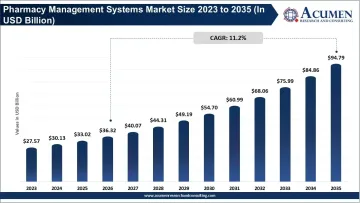
The global pharmacy management systems market size was valued at USD 33.02 billion in 2025 and is expected to reach at USD 94.79 billion by 2035, while expanding at a promising CAGR of 1.2% during the forecast period 2026 to 2035. The pharmacy management systems market is expanding as pharmacies digitize dispensing workflows, automate inventory control, improve prescription accuracy, and integrate electronic health records. Rising prescription volumes, medication safety requirements, labor shortages, and demand for real-time operational visibility are encouraging adoption across hospital, retail, and specialty pharmacies.
- Base Year Market Size (2025): $33.02 billion
- Current Year Market Size (2026): $36.32 billion
- Estimated Year Market Size (2035): $94.79 billion
- Forecast Period CAGR (2026-2035): 11.2%
Key Takeaways
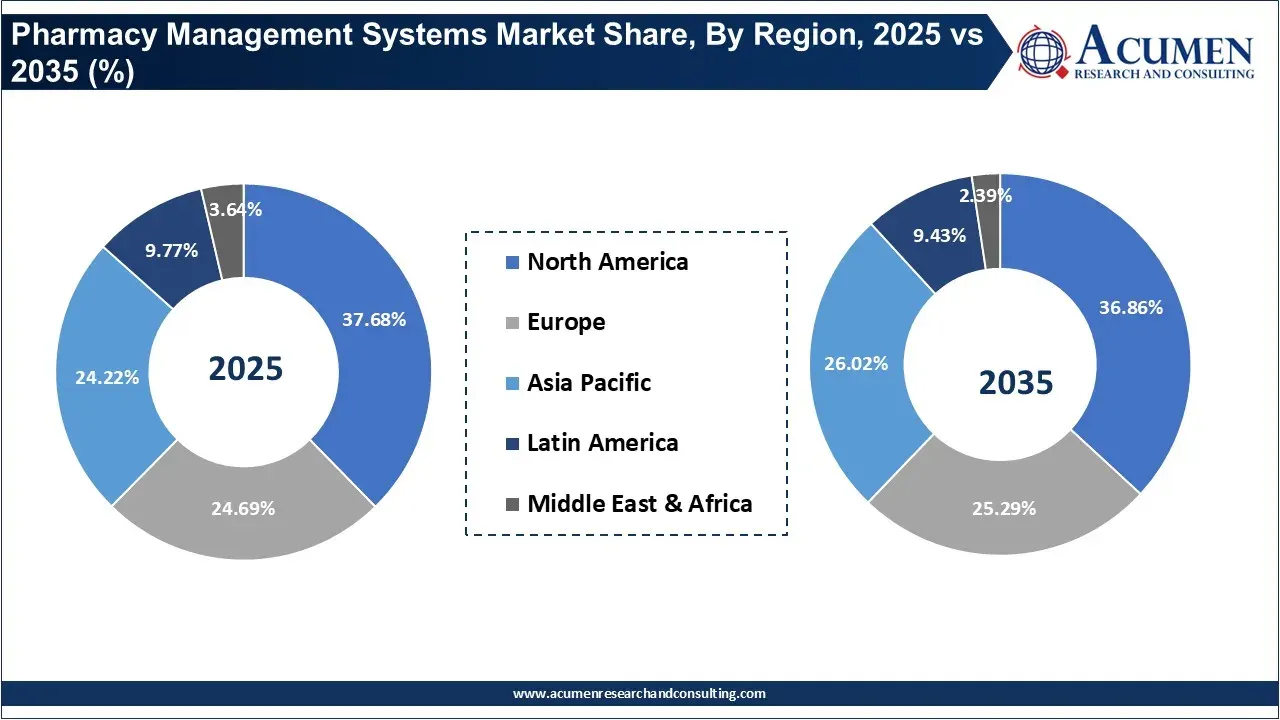
- By region: North America dominated the pharmacy management systems market with a 37.68% share in 2025, generating USD 12.44 billion in revenue. Asia-Pacific is the fastest-growing region, with a projected CAGR of 12.1% from 2026 to 2035, and is expected to reach USD 24.66 billion by 2035.
- By component: Solutions dominated the pharmacy management systems market with a 76.66% share in 2025, generating USD 25.32 billion in revenue. Inventory management was the largest solution subsegment, accounting for 30.79% of the solutions market and generating USD 7.79 billion in revenue.
- By deployment: On-premise deployment dominated the pharmacy management systems market with a 57.26% share in 2025, generating USD 18.91 billion in revenue. Cloud-based deployment accounted for the remaining 42.74%, generating USD 14.11 billion as pharmacies increasingly consider scalable platforms and simplified software maintenance.
- By organization size: Large pharmacies dominated the pharmacy management systems market with a 68.17% share in 2025, generating USD 22.51 billion in revenue. Small and medium-sized pharmacies accounted for 31.83%, generating USD 10.51 billion, with opportunities for vendors offering affordable, easy-to-use software and streamlined inventory management.
Industry Overview
Pharmacy management systems are typically used by retail pharmacies, hospital pharmacies, specialty pharmacies, long-term care pharmacies and others to assist pharmacies in processing and filling prescriptions, tracking inventory, billing and patient records, adhering to regulatory requirements and reporting activities, all of which is handled through software.
The industry is shifting from core dispensing and billing software to connected systems that enable automation, business analytics, electronic prescribing, clinical workflows, and interoperability between pharmacy and healthcare information systems. Cloud deployment and subscription-based pricing models are opening new avenues for standalone pharmacies and smaller operators, while larger pharmacy chains are emphasizing centralized management, system integration, and scalable automation solutions.
Major Trends
- AI-enabled pharmacy workflows: Vendors are incorporating AI into prescription data validation, workflow prioritization, inventory forecasting, and administrative task automation, with pharmacist oversight remaining essential for safety-sensitive decisions.
- Cloud-based deployment: Subscription-based and cloud-hosted systems are attracting pharmacies seeking scalable software, centralized updates, remote access, and lower upfront infrastructure requirements.
- Greater interoperability: Pharmacies increasingly need systems that exchange data with electronic health records, e-prescribing platforms, insurers, wholesalers, and patient engagement applications.
- Robotic dispensing and central fill: Pharmacy operators are exploring robotics and centralized fulfillment to process high prescription volumes, improve consistency, and reduce repetitive manual work.
- Real-time inventory intelligence: Demand forecasting, expiry tracking, stock alerts, and automated replenishment are becoming important tools for reducing waste and managing medicine shortages.
- Specialty pharmacy digitization: Complex therapies, patient assistance programs, medication adherence requirements, and coordination across care teams are increasing demand for specialized workflow capabilities.
- Cybersecurity and data governance: Strong access controls, encryption, audit trails, backup systems, and secure data exchange are becoming essential software selection criteria.
- Patient engagement integration: Refill reminders, digital prescription management, medication synchronization, and adherence communications are helping pharmacies improve service convenience and continuity of care.
Pharmacy Management Software Opportunity Matrix
Where Should Vendors Expand Next?
| Opportunity Area | Target Customers | Vendor Strategy |
|---|---|---|
| Independent and Community Pharmacies | Independent pharmacies and small pharmacy groups | Offer subscription pricing, guided onboarding, built-in billing, and inventory modules |
| Hospital Pharmacy Integration | Hospitals and multi-facility health systems | Develop interoperable platforms with centralized dashboards and robust audit trails |
| Specialty Pharmacy Management | Specialty drug providers, oncology pharmacies, and complex-care pharmacies | Build configurable specialty workflows and patient engagement capabilities |
| AI-Powered Inventory Optimization | Retail chains, hospital pharmacies, and wholesalers | Introduce demand forecasting, replenishment recommendations, and explainable alerts |
Pharmacy Management Systems Market Dynamics
Growth Drivers
- Increasing Adoption of Healthcare Automation: Hospitals, retail pharmacies, and healthcare networks are adopting pharmacy management systems to automate prescription processing, inventory tracking, billing, and dispensing workflows, improving operational efficiency and reducing manual errors.
- Growing Demand for Medication Safety: Rising emphasis on patient safety and accurate medication dispensing is driving demand for software that supports prescription validation, drug interaction alerts, dosage verification, and electronic medication records across healthcare settings.
- Expansion of Digital Healthcare Infrastructure: Increasing adoption of electronic health records, e-prescriptions, telehealth, and connected healthcare platforms is encouraging pharmacies to implement integrated management systems that improve information exchange and coordination between pharmacists, prescribers, and patients.
Restraints
- High Implementation and Maintenance Costs: Deploying pharmacy management systems can require software licensing, hardware upgrades, data migration, employee training, and ongoing technical support, creating financial barriers for independent pharmacies and smaller healthcare providers.
- Data Security and Privacy Concerns: Pharmacy systems process sensitive patient information, prescription histories, and payment data, making them potential targets for cyberattacks. Compliance with data protection requirements increases the need for security controls and continuous monitoring.
- Integration with Legacy Healthcare Systems: Compatibility issues between pharmacy software, hospital information systems, electronic health records, and insurance platforms can complicate implementation, increase customization costs, and disrupt existing workflows during migration.
Opportunities
- Cloud-Based Pharmacy Management Solutions: Growing demand for flexible and remotely accessible software creates opportunities for cloud-based platforms that reduce on-site infrastructure requirements, simplify updates, and support centralized management across multiple pharmacy locations.
- AI-Enabled Inventory and Prescription Management: Integrating artificial intelligence into pharmacy systems creates opportunities for demand forecasting, stock optimization, prescription anomaly detection, and workflow automation, helping pharmacies improve inventory availability and operational decision-making.
- Expansion of E-Pharmacy and Omnichannel Services: The growth of online medicine ordering, home delivery, and digital prescription services creates opportunities for pharmacy management providers to develop platforms that connect inventory, order fulfillment, payment processing, and customer communication.
Challenges
- Ensuring Regulatory Compliance: Pharmacy management software must accommodate changing prescription regulations, controlled medicine requirements, reimbursement procedures, and electronic recordkeeping standards across jurisdictions, increasing the complexity of software development and maintenance.
- Maintaining Data Accuracy and System Reliability: Incorrect inventory records, outdated drug information, system downtime, or prescription processing errors can affect dispensing operations and patient safety, requiring reliable data synchronization, validation controls, and disaster recovery procedures.
- Managing User Adoption and Workflow Changes: Pharmacists and pharmacy staff may require substantial training when transitioning from manual processes or older systems. Resistance to change and poorly configured workflows can reduce adoption and limit the operational benefits of new software.
Pharmacy Technology Policy Tracker, 2025–2028
| Country | Policy or Initiative | Timeline | Key Implications for Pharmacy Technology |
|---|---|---|---|
| United States | HTI-4 Final Rule and electronic prescribing standards | 2025–2028 |
|
| United Kingdom | NHS Community Pharmacy Digital Integration | 2025–2028 |
|
| Australia | Electronic Prescribing and National Healthcare Interoperability Plan | 2025–2028 |
|
| India | Ayushman Bharat Digital Mission (ABDM) and Digital Health Infrastructure | 2025–2028 |
|
Pharmacy Management Systems Market Segmentation Insights
Component Insights
Solutions: Solutions led the pharmacy management systems market in 2025, generating USD 25.32 billion in revenue and accounting for 76.66% of the market. The demand for solutions is driven by the need to track inventory, purchase orders, supply chains, regulatory data, and pharmacy performance through single, integrated software applications. Inventory management was the largest sub-segment in solutions.
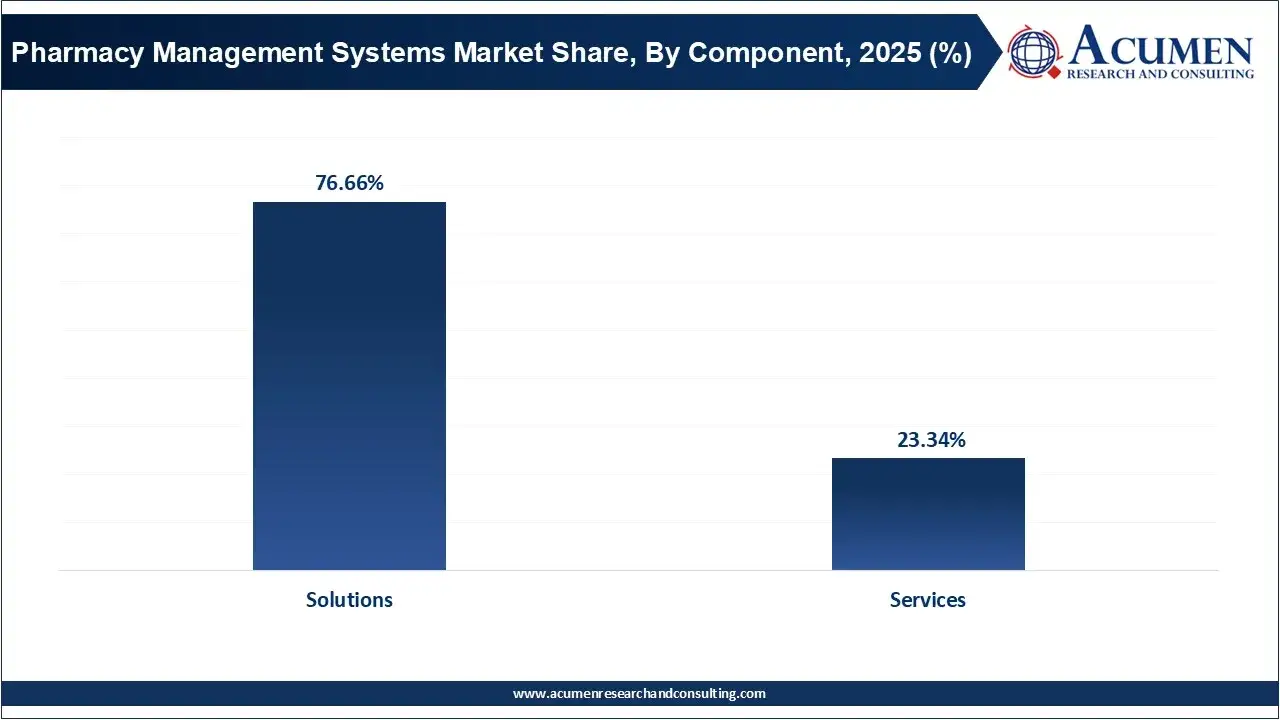
Services: Services represented 23.34% of the pharmacy management systems market in 2025, representing USD 7.71 billion in revenue. Implementation, integration, training, maintenance, technical support, and migration to new systems are all services within the segment. New pharmacy systems clients may need assistance with system implementation, customer data conversion, employee training, and integration with existing healthcare IT systems.
Deployment Insights
On-Premise: On-premise deployment dominated the pharmacy management systems market in 2025, accounting for 57.26% of the market and generating USD 18.91 billion in revenue. Pharmacies using on-premise systems retain greater direct control over their software environments, infrastructure, and data management processes. Established healthcare organizations may continue using these platforms because of existing IT investments, customized workflows, and integration requirements.
Cloud-Based: Cloud-based deployment accounted for 42.74% of the pharmacy management systems market in 2025, generating USD 14.11 billion in revenue. These platforms enable pharmacies to access software through internet-connected systems while reducing dependence on locally maintained infrastructure. Subscription-based pricing, remote access, centralized updates, and scalability make cloud solutions attractive to pharmacy groups and organizations seeking to modernize operations.
Organization Size Insights
Large Pharmacies: Large pharmacies dominated the pharmacy management systems market in 2025, accounting for 68.17% of the market and generating USD 22.51 billion in revenue. Large pharmacy chains, hospital networks, and multi-location operators require software that supports centralized inventory management, purchasing, reporting, compliance, and coordination across multiple facilities. Their complex operations and high transaction volumes increase the need for integrated platforms that improve visibility and standardize workflows.
Small and Medium-Sized Pharmacies: Small and medium-sized pharmacies accounted for 31.83% of the pharmacy management systems market in 2025, generating USD 10.51 billion in revenue. These businesses require affordable software that simplifies prescription processing, billing, stock tracking, purchasing, and regulatory recordkeeping without demanding extensive IT resources. Subscription-based pricing, easy implementation, and user-friendly interfaces can help vendors address their needs. Independent pharmacies may also benefit from automated replenishment alerts and straightforward reporting tools.
Pharmacy Management Systems Market Regional Insights
Which Region Dominates the Pharmacy Management Systems Market?
North America held the largest share of the global pharmacy management systems market in 2025 at 37.68% and is estimated to reach USD 34.94 billion by 2035 at a CAGR of 11.0% from 2026 to 2035. The North America market was driven due to overall healthcare IT system in healthcare, a significant prevalence of digital pharmacy workflow, and the need for software that enables prescription processing, inventory management, billing, and medication safety.
Pharmacies and healthcare systems continue to demand software solutions that link dispensing centers and information to electronic health records, electronic prescriptions, reimbursement workflows, and centralized reporting. These needs provide opportunities for vendors of interoperability, automation, analytics, and large-scale cloud computing solutions.
To stand out in North America, vendors will need to compete on integration functionality, security, ease of implementation, and quantifiable pharmacy productivity improvements. Independent pharmacies may seek low-cost solutions on a subscription basis; hospital networks and retail chains will probably be interested in an enterprise package.
Which Region Is Expected to Grow Fastest in the Pharmacy Management Systems Market?
Asia-Pacific is likely to emerge as the most rapidly growing regional market, growing at a CAGR of 12.1% from 2026 to 2035. The Asia-Pacific market is predicted to grow from USD 8.80 billion in 2026 to reach USD 24.66 billion by the end of 2035, increasing the revenue contribution to global market from 24.22% in 2025 to 26.02% in 2035. The market growth is anticipated to propel on account of pharmaceutical digitalization, rising pharmacy networks, upgraded hospital infrastructure, and increasing demand for effective prescription and inventory management.
The market in nations like India, China, Japan, and South Korea offer an unique range of adoption environments from budget pharmacy software for community pharmacies, to sophisticated hospital integration and to end-to-end automated dispensing systems.
Cloud-enabled platforms, built on modular products, are seen to meet the needs of smaller pharmacies, while large health systems could seek interoperability, consolidated inventory access and security. Partnerships at the local level, alongside implementation services and flexible pricing, are also observed to support market entry strategies.
Competitive Landscape
- McKesson Corporation (Texas, USA)
- Oracle Health (Texas, USA)
- Epic Systems Corporation (Wisconsin, USA)
- Becton, Dickinson and Company (New Jersey, USA)
- Omnicell, Inc. (USA)
- Swisslog Healthcare (Colorado, USA)
- ARxIUM Inc. (Canada)
- ScriptPro LLC (Kansas, USA)
- RedSail Technologies (South Carolina, USA)
- Micro Merchant Systems, Inc. (New York, USA)
- Computer-Rx (Oklahoma, USA)
- Liberty Software ( Texas, USA)
- Keycentrix (Kansas, USA)
- SoftWriters, Inc. (Pennsylvania, USA)
- RxSafe, LLC (California, USA)
Recent Developments
- January 2026: Uniphar announced the acquisition of TouchStore, an Irish provider of pharmacy dispensing and retail management software. The deal is intended to strengthen Uniphar's pharmacy technology and supply-chain offering.
- February 2026: RedSail Technologies acquired PrimeRx as an affiliate, expanding its network to approximately 16,000 pharmacies and strengthening its portfolio of pharmacy management software and connected services.
Segments Covered
By Component
- Solutions
- Inventory Management
- Purchase Orders Management
- Supply Chain Management
- Regulatory and Compliance Information
- Clinical and Administrative Performance
- Others, including SMS and Notifications and E-Prescription
- Services
By Deployment
- Cloud-Based
- On-Premise
By Organization Size
- Small and Medium-Sized Pharmacies
- Large Pharmacies
By Region
- North America
- Europe
- Asia-Pacific
- Latin America
- Middle East & Africa
Looking for discounts, bulk pricing, or custom solutions? Contact us today at sales@acumenresearchandconsulting.com
Frequently Asked Questions

Related Market Research Reports
June 2022
October 2026
October 2026
October 2026
October 2026
October 2026
September 2026
July 2026