
Predictive Analytics Market Size, Share, Trends, Forecast Report 2026 to 2035
Predictive Analytics Market (By Component: Software/Solutions, Services; By Deployment: On-Premise, Cloud; By Enterprise Size: Large Enterprises, Small & Medium Enterprises (SMEs); By Industry Vertical: BFSI, Healthcare & Life Sciences, Manufacturing, Retail & Consumer Goods, IT & Telecom, Energy & Utilities, Government & Public Sector, Others; By Application: Demand Forecasting & Planning, Predictive Maintenance & Asset Management, Risk, Fraud & Compliance, Customer & Churn Analytics, Revenue & Pricing, Sales & Marketing, Financial & Workforce Forecasting, Strategic & Operational Decision Support) - Global Industry Analysis, Size, Share, Regional Analysis, Trends and Forecast 2026 - 2035
- Last Updated: 28 Oct 2026
- Report Code: ARC1690
- Category: ICT
Predictive Analytics Market Size and Forecast 2026 to 2035
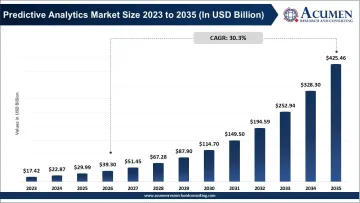
The global predictive analytics market size was valued at USD 29.99 billion in 2025 and is expected to reach at USD 425.46 billion by 2035, while growing at a promising CAGR of 30.3% during the forecast period of 2026-2035.
Report Highlights
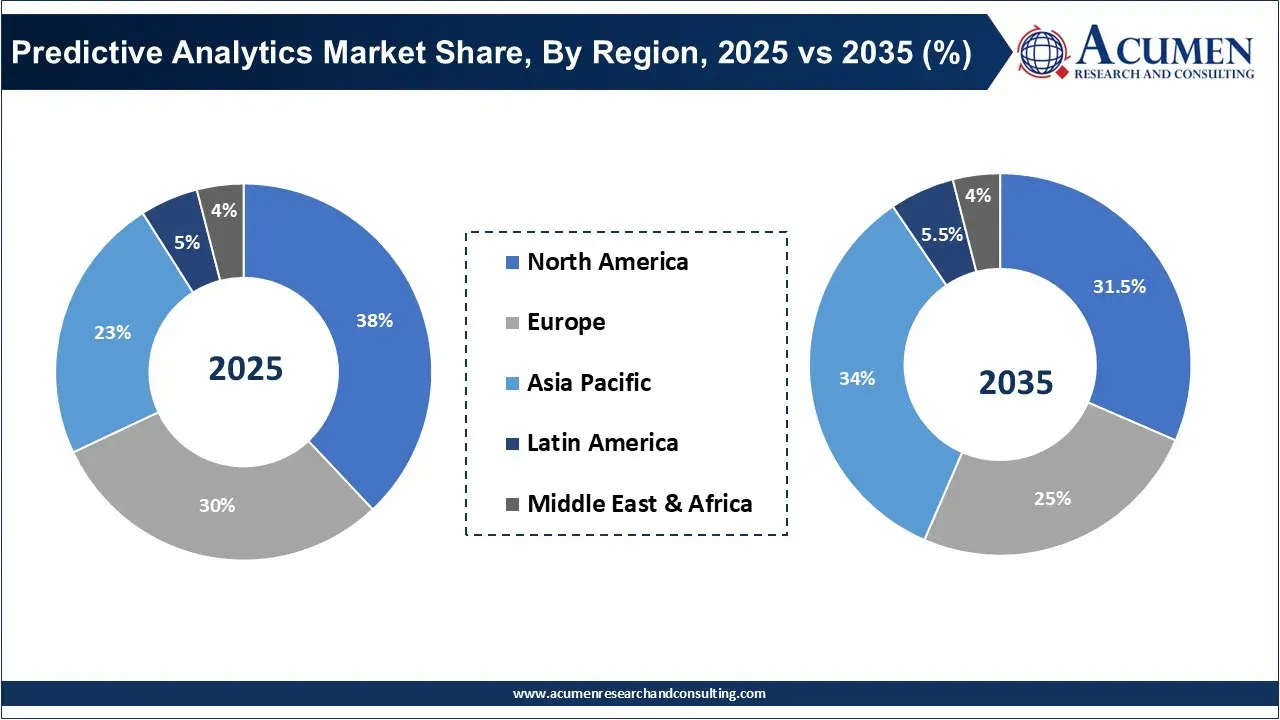
- By region, North America dominated with a 38% share in 2025, supported by advanced technology infrastructure, high cloud adoption, strong enterprise data availability, and early AI adoption.
- By region, Europe held the second-largest share at 30% in 2025, supported by strong predictive analytics adoption across BFSI, automotive, manufacturing, healthcare, retail, and telecommunications.
- By region, Asia-Pacific accounted for 23% of the market in 2025 but is projected to reach 34% by 2035, making it the fastest-growing major regional market.
- By component, software/solutions dominated the predictive analytics market with a 68% share in 2025, supported by growing adoption of cloud platforms, embedded analytics, and automated decision-making tools.
- By component, software/solutions are projected to increase their share to 72% by 2035, as enterprises increasingly integrate predictive capabilities into their existing technology infrastructure.
- By deployment, cloud accounted for the largest share at 62% in 2025, driven by its scalability, flexibility, lower infrastructure requirements, and ease of deployment.
- By deployment, cloud-based predictive analytics is projected to grow at a 33.1% CAGR from 2026 to 2035, as businesses increasingly shift analytics workloads to cloud environments.
- By deployment, on-premise solutions accounted for 38% of the market in 2025, supported by continued demand for greater control over data security, governance, and infrastructure.
- By enterprise size, large enterprises dominated with a 74% share in 2025, owing to their larger technology budgets, extensive datasets, established IT infrastructure, and dedicated analytics teams.
- By enterprise size, SMEs accounted for 26% of the market in 2025 but are projected to reach 40% by 2035, supported by the increasing availability of affordable cloud-based analytics platforms.
- By industry vertical, BFSI dominated with a 21% share in 2025, driven by the use of predictive analytics for fraud detection, credit scoring, risk assessment, customer analysis, and financial forecasting.
- By industry vertical, manufacturing held an 18% share in 2025, supported by industrial IoT, automation, connected equipment, predictive maintenance, and production optimization.
- By application, demand forecasting and planning dominated with a 20% share in 2025, as businesses use predictive models to anticipate demand, optimize inventory, and improve production planning.
- By application, risk, fraud, and compliance accounted for 17% of the market in 2025, driven by the need to identify financial risks, fraudulent activities, defaults, and potential compliance issues.
What Is Predictive Analytics Market and How Does It Work?
The predictive analytics market encompasses software, platforms, services, and technology that leverages historical and real-time data, statistical models, AI, and machine learning models to anticipate future events and business outcomes. Predictive analytics is currently being merged within various cloud platforms, as well as in the IoT, enterprise software, customer data platforms, and business intelligence systems to hasten the speed of decision-making.
In general, there are four steps that the predictive analytics system follow. Firstly, Collect historical and real time data. Secondly, detect patterns through historical data and Machine Learning algorithms. Thirdly, generate prediction or probability score from the pattern.
Lastly, translate probability score into effective business actions. For example, in manufacturing, equipment sensors could analyze abnormal running behaviour so to find a defect before equipment failure. With help of purchase histories, engagements with brand or company, behavioral patterns, and demographics of customer base the conversion probability, chances of churn of the customer, value he offers and predicted buying interests can be foreseen.
How Is Predictive Analytics Changing Marketing Decisions?
- Globally, 42% use real-time data to identify market trends, allowing marketing teams to adjust campaigns and product positioning based on emerging demand patterns.
- Predictive analytics is increasingly being combined with AI-generated insights and automated recommendations, enabling marketers to move from broad audience targeting toward customer-level personalization.
- In 2025, Westcon-Comstor's analytics-driven Intelligent Demand program supported more than 1,200 channel campaigns, compared with 540 in 2024, representing 132% year-over-year growth.
- In May 2026, U.S. consumers referred to retail websites through large language models generated 53% more revenue per visit than consumers arriving through non-AI sources, highlighting the increasing commercial value of AI-driven discovery and personalized digital journeys.
- Predictive models can help marketers prioritize high-probability leads, forecast customer churn, optimize campaign timing, estimate demand, and allocate advertising budgets toward audiences with higher expected conversion or lifetime value.
Expert Opinion
Can Predictive Analytics Reduce Manufacturing Downtime and Production Costs?
According to our experts, these machines-where there is tremendous opportunity to enhance efficiency in the manufacturing process-can be more reliable with the usage of predictive analytics that can pinpoint the abnormal patterns before a failure occurs-making their repair an expensive job to undertake. Manufacturers can combine the machine data, IoT sensors, maintenance history, production related information along with machine learning to ensure a shift in trends of corrective to condition-based to predictive maintenance.
An amount of substantial opportunity, a new report reveals manufacturers in U.K., U.S., Germany have a downtime cost of $1.27 million per hour on a global basis while the manufacturers in U.K and Germany individually can have downtime cost as high as $1.36 million per hour.
| Predictive analytics impact | Traditional approach | With predictive analytics / predictive maintenance |
|---|---|---|
| Unplanned downtime | Reactive repairs after equipment failure | Early failure detection using sensor and machine data |
| Maintenance costs | Fixed schedules or emergency repairs | Maintenance performed based on actual equipment condition |
| Equipment availability | Production interrupted by unexpected failures | Maintenance scheduled during planned production windows |
| Maintenance planning time | Manual inspection and fixed maintenance schedules | Automated monitoring and predictive alerts |
| Equipment defects | Failures identified after production disruption | Anomalies detected before critical failure |
| Production capacity | Capacity lost during unexpected shutdowns | Fewer interruptions and better maintenance scheduling |
Market Dynamics
Driver
Growing Adoption of AI, IoT, and Real-Time Data
With a high deployment rate in IoT devices, connecting machinery, cloud infrastructures, AI and ML, manufacturing systems produce masses amounts of data which can enable the manufacturing organizations to move towards predictive decision-making. Manufacturers are using predictive analytics to supervise equipment operations, find exceptions, forecast failures, adjust production plans and improve quality management processes.
In 2026, Cisco found that AI adoption in live industrial operations accounted for 61% of surveyed organizations, where the research also revealed that 83% of those organizations will increase spending on AI. In real terms, the data which is collected in a manufacturing system can support an extended deployment of predictive analytics across the different industries.
Restraint
Data Quality, Integration, and Workforce Gaps
Predictive analytics requires reliable, structured, and sufficiently large datasets, while many enterprises still operate with fragmented legacy systems and inconsistent data. Workforce capability is another challenge: recent industrial AI research found that roughly 78% of reported barriers were associated with workforce capability, skills, or organizational readiness rather than headcount alone. These limitations can delay implementation and reduce the realized return on predictive analytics investments.
Opportunity
Integration of Predictive Analytics with AI and Autonomous Decision-Making
Combining predictive analytics with generative AI, agents, digital twins, edge, automated workflows presents a shift in moving from future prediction to a more adaptive learning experience that anticipates issues rather than reporting on an outcome. Business can expect from predictive applications suggesting not only future predictions, but solutions; such as a suggested plan of action, automate prioritization of maintenance schedules, production settings, defects, or immediate real-time responses to demand fluctuations.
A report by IDC suggest that by 2026 more than 40% of manufacturers with production scheduling systems will deploy artificial intelligence in its platform, or upgrade present systems with AI-based capabilities, KPMG found 68% of industrial manufacturing executives were already seeing an opportunity to deploy artificial intelligence at scale within the next twelve months.
This presents an opportunity to vendors focused in the predictive analytics realm to enhance predictive solutions and bridge forecasting, recommendation and automated execution within one decision making framework.
Segmentation Insights
Component Insights
In 2025 software/solutions held a majority share in the predictive analytics market. This segment is expected to reinforce its hold to attain 72% by 2035 that explains that the growth of predictive analytics is growing to rest more upon on cloud based software solutions, predictive analysis embedded capabilities, data science models, and automated decision tools.
The software/solutions category holds this majority because of the urgent need from organizations to embed prediction capabilities into their current data & technical infrastructure. Current predictive analytics software allow the organization to merge existing data with current business data, statistical & data science model, business intelligence reports & data.
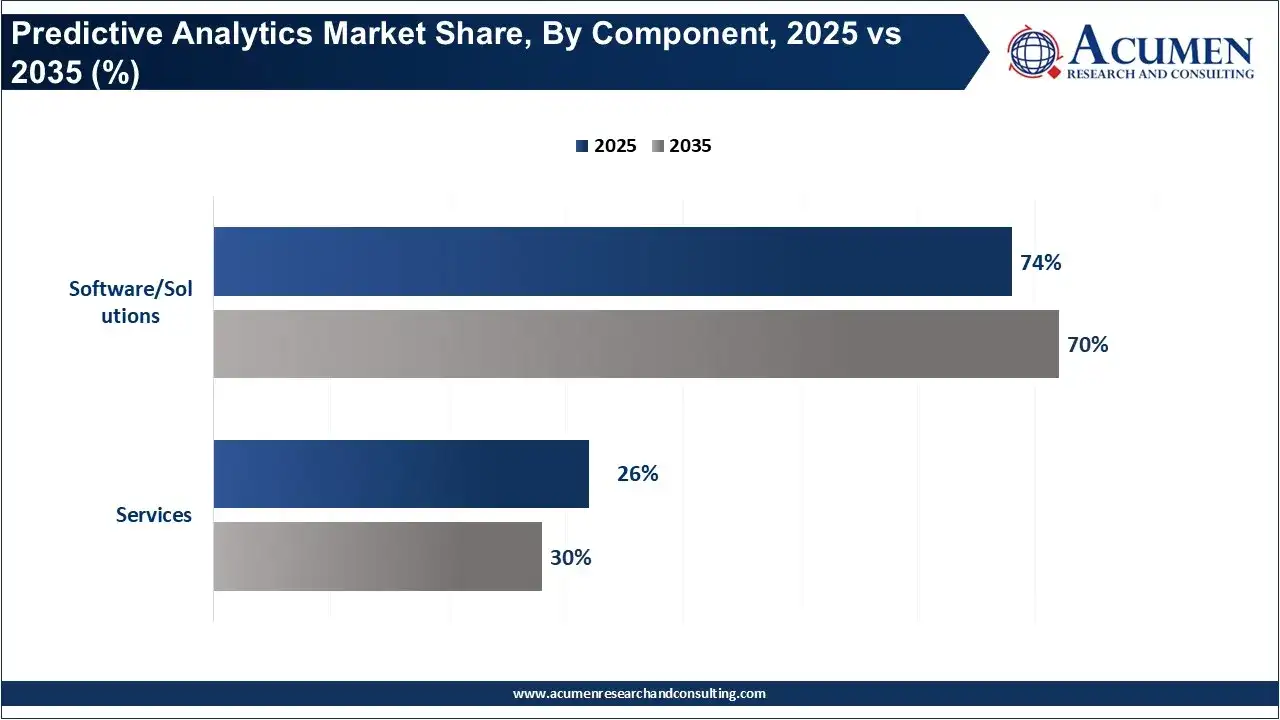
Services represented 32% of the market in 2025, making them the second-largest component category. Services remain important because successful predictive analytics deployment requires more than simply purchasing software. Organizations frequently require consulting, implementation, integration, data engineering, model development, customization, training, maintenance, and managed analytics services.
Service providers play a particularly important role for organizations that lack sufficient internal data science capabilities. They help enterprises identify high-value predictive use cases, prepare datasets, select appropriate algorithms, integrate analytical models with enterprise systems, and establish processes for monitoring model performance.
Deployment Insights
Cloud deployment segment captured the majority share in the predictive analytics market in 2025 with 62% share. Deployment in cloud segment is the highest growing segment as the source predict the cloud deployment in predictive analytics segment will grow with the CAGR of 33.1% from 2026 to 2035.
Cloud deployment is attributed to increase the growth in predictive analytics because of scale, agility, infrastructure less and easy to deploy on. Predictive analytic workload is a very inconsistent as and the load depends on data volume or complexity of the model. A cloud can scale the resources required in terms of computing storage without any increase in capital investment compared with hardware.
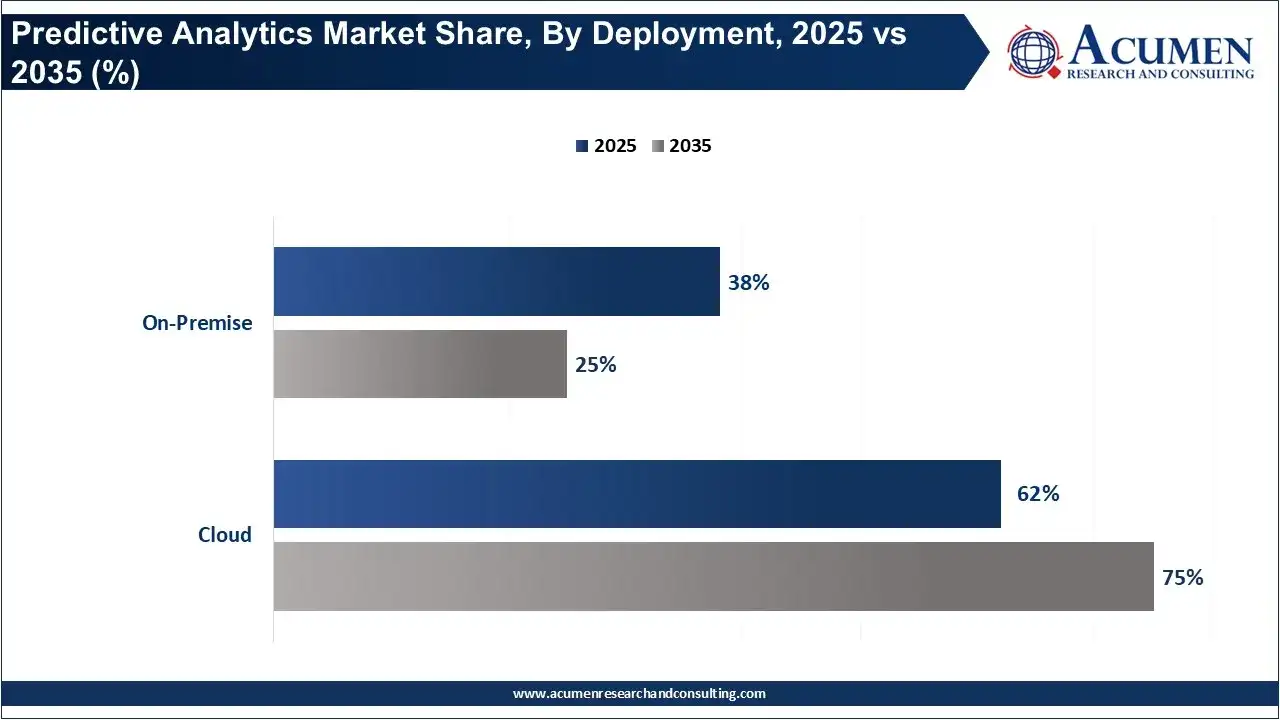
On-premise deployment accounted for 38% of the market in 2025, making it the second-largest deployment segment. However, its share is projected to fall to 25% by 2035. On-premise predictive analytics remains relevant where organizations require greater control over data infrastructure, security, governance, and system configuration. Large financial institutions, government organizations, defense-related entities, and enterprises with highly sensitive datasets may continue maintaining certain predictive analytics workloads within internal environments.
Enterprise Size Insights
The largest enterprises played dominant roles in the predictive analytics market in 2025, having captured a 74% market share. Largest enterprises maintained such a dominant position, as the organizations are more likely to have access to structured and unstructured data, larger technology budgets, established IT infrastructure, and dedicated analytics staff. Large organizations also tend to be comprised of multiple business units to which predictive analytics can provide clearly identifiable value.
One example is that of a large manufacturing company, the organization is likely to have predictive models in operation across equipment failures, demand and inventory levels, production forecasting, quality control and supply chain planning simultaneously.
SMEs represented 26% of the market in 2025, but their share is projected to reach 40% by 2035. Although the source does not provide a CAGR for SMEs, the substantial increase in market share makes SMEs the fastest-expanding enterprise-size category in terms of share gain within the supplied forecast.
The increasing availability of cloud-based predictive analytics is particularly important for SMEs because it eliminates the need for significant upfront infrastructure investment. Subscription-based analytical platforms allow smaller organizations to access capabilities that previously required large internal data science teams.
Industry Vertical Insights
In 2025, BFSI held dominant market share by industry vertical 21%, of the predictive analytics market. Predictive models can be used by banks, insurers, lending institutions and financial service firms to identify financial risks, fraud, assess creditability of individuals and firms, predict behavior of customers, and formulate financial products etc.
The risk management aspect can be greatly highlighted, where using predictive models of the past transaction and customer history, a user might be able to predict defaulting, or detecting of anomalies or emerging risks associated. While, systems aimed at detecting frauds in transactions might predict possible frauds based upon an analysis of the transaction behavior and deviation.
Manufacturing represented the second largest sector holding 18% of the market share. The major attribute to the strong showing of this sector has to do with the rise of industrial IOT, connected devices, automation, digital twins and smart manufacturing, leading to volumes of new data for analysis.
Manufacturing sector uses predictive models to forecast and predict failures of its equipment well in advance, plan production cycles efficiently, forecast demand, planning inventory, reduces maintenance times and cost. Quality anomalies might be better identified using predictive models to understand and foresee.
Application Insights
In 2025, demand forecasting & planning represented 20% of the predictive analytics market value, making it the largest segment within the application. The biggest share that demand forecasting represents within predictive analytics market is explained by the vital necessity of foreseeing and expecting the future demand in virtually every industry.
Predictive analytics aims to overcome the limitations of traditional approaches of forecasting with its ability to forecast future demand based on past behaviors combined with a wide range of variables (e.g., seasonality, pricing & promotion activities, business situation, customers' behavior, market trends and overall business condition and industry specifics).
Risk, fraud & compliance accounted for 17% of the market value, taking second position across applications. This market share comes predominantly from sectors like insurance & finance, health and fitness care, retail, e-commerce, telecommunications and other industries where operations are threatened on a massive scale by financial and operational, regulatory and cybersecurity risks.
With predictive models, it's possible to evaluate an investment risk's and assess the financial default and the risk of insurance. It is also useful to predict any further compliance concerns. Fraud analysis can be ideally suited for predictive modeling because they analyze massive amounts of information at high speed so one may develop sophisticated predictive analytics on the patterns which might otherwise remain hidden.
Predictive Analytics Market Regional Analysis
North America: Why Does the Region Still Lead the Predictive Analytics Market?
The largest predictive analytics market in 2025 was North America holding 38% of the global market followed by Europe at 30% and Asia-pacific with 23%. Their dominant position in the regional market was predominantly driven by its robust technological infrastructure, high cloud adoptions, availability of numerous tech companies and adoption to early adoption of AI and machine learning technologies.
In North America, readily available large data from various customer, financial, operational and industries also assists the organization to drive predicative analytics in predicting sales trends, recognizing risks, understanding customers and increasing overall business productivity.
Banking, financial services, and insurance (BFSI) sector is another major contributor to the predictable analytics market in the region. Banks and financial institutes utilize this technology in fraud detection, credit scoring, risk evaluation, predicting customer churn rates and financial forecasts. Manufacturers use it for equipment maintenance, supply-chain management, demand prediction and production plan.
Can Regulatory Complexity in Europe Become a Competitive Advantage for Predictive Analytics?
Europe was the second-largest predictive analytics market in 2025, with a 30% share. Strong demand comes from industries such as banking, automotive, manufacturing, healthcare, retail, and telecommunications.
European companies are using predictive analytics to reduce costs, improve efficiency, manage risks, and make better business decisions. For example, manufacturers use it to predict equipment failures and improve production, while banks use it for fraud detection, risk management, and customer analysis. Europe's large automotive and manufacturing industries also create strong demand for predictive maintenance, supply-chain forecasting, quality control, and production planning.
Is Asia Pacific Becoming the New Growth Engine of Predictive Analytics?
Asia-Pacific is predicted to become the rapidly rising predictive analytics market in the next few years. The region had a market share of 23% in 2025 and this figure is set to rise to 34% by 2035. The region's market is anticipated to rise at a CAGR of 36.1% between 2026-2035, this being higher than all the leading regions. The market size is projected to escalate from a size of $9.04 billion to $144.66 billion between 2026 to 2035 respectively.
Factors such as growing use of cloud, proliferation of digitalization, an increase in the scope of application of AI, proliferation of smartphones and internet usage and the huge growth in the volumes of data being produced and used both by consumers and companies contribute towards this accelerated growth in the predicted time.
Countries like China, India, Japan, South Korea, Singapore and Australia are all heavily investing into AI, digital infrastructure, automation and data-reliant technology. As businesses are moving their operations online and to digital platforms, predictive analytics are seeing tremendous market demand and use.
Hence, from being a lesser significant predictive analytics market, Asia-Pacific is set to emerge as the key driver to business growth in the predictive analytics arena; although it has a lesser developed market size than North America and Europe, a significantly faster rate of market increase in the predicted timeline, should make the regional market quite significant in the global scenario.
Predictive Analytics Patent & Innovation Landscape: Top 5 Countries & Their Insights
| Country | Innovation Insight |
|---|---|
| China | China is the leading source of AI/GenAI patent activity, with more than 43,000 GenAI patent families published by China-based inventors in 2024–2025. Its strong activity is supported by technology companies, universities, financial institutions, and infrastructure providers. |
| United States | The U.S. remains a major center for commercial AI innovation, with more than 4,380 GenAI patent families in 2025. Google, Microsoft, IBM and Nvidia are among the major U.S.-based companies driving AI-related innovation. |
| Japan | Japan has rapidly increased its AI patent activity, recording a 210% CAGR in GenAI patent families between 2023 and 2025. SoftBank's large patent portfolio has been a major contributor to this acceleration. |
| South Korea | South Korea remains a major AI innovation hub, ranking fourth among leading GenAI inventor locations. Its technology ecosystem, led by major electronics and technology companies, supports continued development of AI and predictive technologies. |
| India | India ranked fifth among major GenAI inventor locations and recorded a 63% CAGR in GenAI patent families between 2023 and 2025. Rising AI investment, software capabilities, and enterprise digitalization are supporting the country's growing innovation base. |
Leading Companies
- SAS (North Carolina, U.S.)
- IBM (New York, U.S.)
- Microsoft (Washington, U.S.)
- Oracle (Texas, U.S.)
- SAP (Germany)
- Salesforce (California, U.S.)
- Alteryx (California, U.S.)
- Altair Engineering (Michigan, U.S.)
- Dataiku (New York, U.S.)
- DataRobot (Boston, Massachusetts, U.S.)
Segments Covered in the Report
By Component
- Software/Solutions
- Services
By Deployment
- On-Premise
- Cloud
By Enterprise Size
- Large Enterprises
- Small & Medium Enterprises (SMEs)
By Industry Vertical
- BFSI
- Healthcare & Life Sciences
- Manufacturing
- Retail & Consumer Goods
- IT & Telecom
- Energy & Utilities
- Government & Public Sector
- Others
By Application
- Demand Forecasting & Planning
- Predictive Maintenance & Asset Management
- Risk, Fraud & Compliance
- Customer & Churn Analytics
- Revenue & Pricing
- Sales & Marketing
- Financial & Workforce Forecasting
- Strategic & Operational Decision Support
By Region
- North America
- Europe
- Asia-Pacific
- Latin America
- Middle East & Africa
Looking for discounts, bulk pricing, or custom solutions? Contact us today at sales@acumenresearchandconsulting.com
Frequently Asked Questions

Related Market Research Reports
July 2022
September 2026
June 2026
June 2026
December 2023
December 2023
June 2023
June 2023