November 2023

Predictive Maintenance Market (By Component: Solution, Services; By Deployment: On-premise, Cloud-based, Hybrid; By Enterprise Size: Large Enterprises, Small & Medium Enterprises; By End Use Industry: Manufacturing, Energy & Utilities, Oil & Gas, Automotive, Aerospace & Defense, Healthcare & Pharmaceutical, Transportation & Logistics, Construction, IT & Telecom, Others) - Global Industry Analysis, Size, Share, Regional Analysis, Trends and Forecast 2026 - 2035
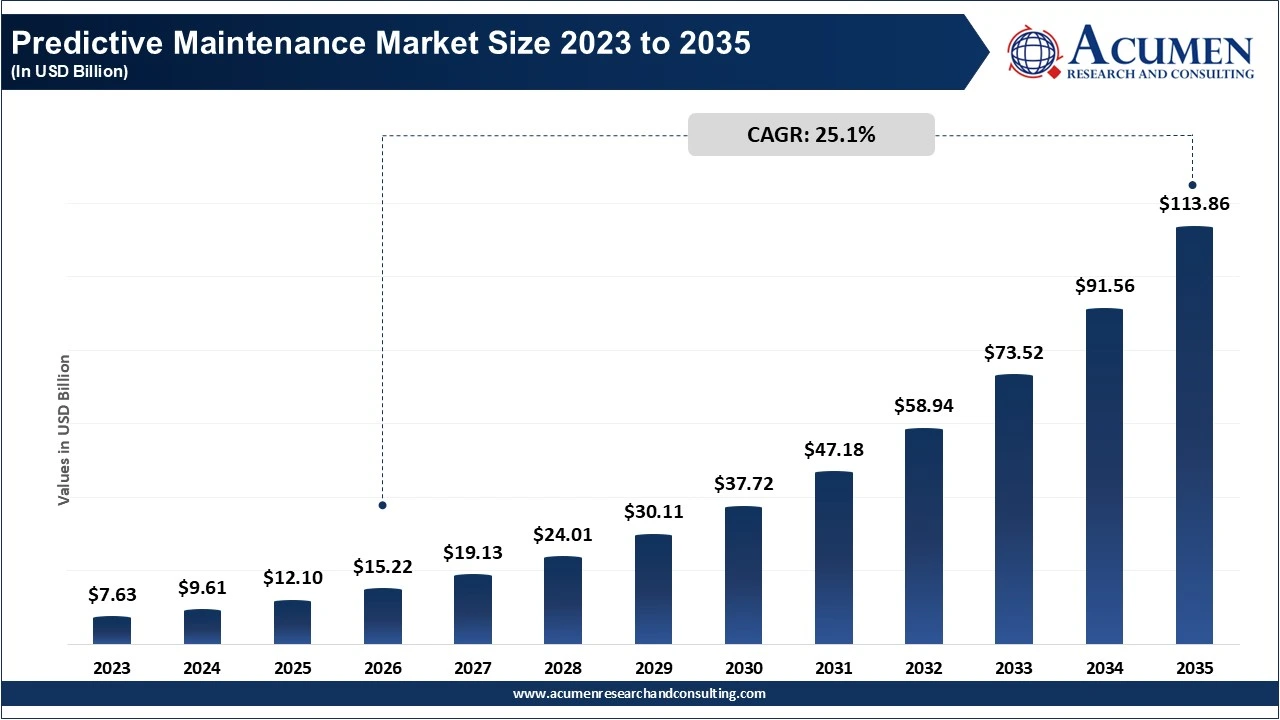
The global predictive maintenance market size was valued at USD 12.10 billion in 2025 and is estimated to surpass around USD 113.86 billion by 2035 growing at a CAGR of 25.1% from 2026 to 2035. The predictive maintenance market is seen to expand rapidly owing to the demand for IoT sensor-based operational systems in multiple industries including, healthcare, telecom, manufacturing and automotive. Additionally, the widespread adoption of smart manufacturing and automation creates a significant driver for the market to boom.
Predictive maintenance is an advanced maintenance strategy which employs technologies such as Artificial intelligence (AI), machine learning, IIoT, sensors, cloud computing and data analytics to monitor and assess the condition and performance of industrial assets and forecast the occurrence of possible breakdowns prior to the actual fault condition. As compared to reactive maintenance which is a scheduled repair of machine once it has failed and preventive maintenance which is performed at regular intervals based on a predefined schedule, predictive maintenance targets and forecasts the nascent indicators of potential failures to minimize downtime, maintenance costs and optimize operational efficiencies.
The market for predictive maintenance functions by means of sensors and monitoring systems which are connected and integrated to various industrial assets like motors, turbines, pumps, compressors, conveyors, manufacturing robots, and power systems. These sensors gather real-time operational data which consists of measures such as machine vibration levels, temperature, pressure, power consumption, oil/lubrication levels and conditions, acoustic signatures, and performance characteristics of the machine.
| Attribute | Details |
| Predictive Maintenance Market Size in 2026 | USD 15.22 Billion |
| Predictive Maintenance Market Size in 2035 | USD 113.86 Billion |
| Predictive Maintenance Market CAGR | 25.1% |
| Analysis Period | 2022 - 2035 |
| Base Year | 2025 |
| Forecast Data | 2026 - 2035 |
| Segments Covered | By Component, By Deployment, By Enterprise Size, By End-Use Industry, and By Geography |
| Regional Scope | North America, Europe, Asia Pacific, Latin America, and Middle East & Africa |
| Key Companies Profiled | IBM, Siemens, General Electric, Honeywell, Schneider Electric, Rockwell Automation, SAP, ABB, Microsoft, Amazon Web Services |
| Report Coverage | Market Trends, Drivers, Restraints, Competitive Analysis, Player Profiling, Covid-19 Analysis, Regulation Analysis |
Rising Adoption of Industry 4.0 and Industrial Automation Technologies
The expanding adoption of Industry 4.0 technologies such as smart factory automation is a leading catalyst of growth of the predictive maintenance market. Sectors including manufacturing, automotive, aerospace, oil & gas, energy, and logistics are increasingly embracing Industrial Internet of Things (IIoT), artificial intelligence, machine learning, and cloud computing technologies to streamline operations, minimize costly equipment downtime and improve overall equipment effectiveness.
Predictive maintenance solutions are helping companies to assess machinery condition in real time, identify imminent failures, and effectively schedule maintenance activities, leading to fewer unplanned downtimes and minimized production losses. Furthermore, investments in areas such as industrial robotics, connected sensors, digital twins, and intelligent manufacturing facilities are further propelling adoption of AI-based predictive maintenance solutions worldwide.
High Initial Implementation Costs and Complex Integration Challenges
High initial costs to deploy predictive maintenance are a key obstacle to market growth, particularly among SMEs. Deploying predictive maintenance involves enormous investment in areas like industrial sensors, IoT technology, AI analytics solutions, cloud infrastructure, workforce training and system integration services.
Many traditional manufacturing plants lack the capability to integrate the new predictive maintenance technologies into their old industrial equipment and outdated systems. Other factors, such as cybersecurity threats, management complexities in dealing with huge amounts of data, the lack of trained professionals who are able to work with industrial AI systems may hinder the large-scale deployment.
Expansion of AI, Edge Computing, and Smart Manufacturing Ecosystems
Increasingly rapid growth of the artificial intelligence, edge computing and smart manufacturing ecosystem have offered strong opportunities for the predictive maintenance market. Predictive analytics platforms integrated with AI technology can analyze huge amounts of industrial data in real time for the increasingly fast and precise prediction of machine failures.
Moreover, edge computing has revolutionized the prediction of maintenance through on-site analysis of industrial data thereby increasing efficiency of operational performance and shortening time delay. Moreover, rapid increase in the implementation of connected factories, 5G supported industrial network, autonomous production systems and digital twin technology across different sectors will accelerate the demand for the new generation of predictive maintenance solutions worldwide.
North America held the largest market share in the predictive maintenance market in 2025 accounting for a share of 33% and is predicted to have a CAGR of 23.7% from 2025 to 2035, attributed to the region's technologically robust infrastructure, widespread adoption of industrial automation, substantial investments made in Industry 4.0 ecosystems. The United States, as part of this region, is at the forefront globally in deploying industrial AI, smart manufacturing, industrial Internet of things (IIoT), cloud computing, and connected factory systems that aid in the accelerated deployment of predictive maintenance solutions. With one of the highest concentrations of advanced manufacturing facilities, hyperscale data centers, aerospace production, automobile manufacturing, and energy infrastructure, the demand for intelligent monitoring and maintenance systems in the North American region is huge.
U.S. Predictive Maintenance Market
The U.S. Predictive maintenance market is the world’s most technologically advanced market, largely driven by the nation's large manufacturing infrastructure, advanced industrial automation backbone, and quick implementation of AI and IIoT technologies. The manufacturing industry of the United States contributes more than USD 2.3 trillion each year, and that produces huge demand in predictive analytics, assets monitoring, and intelligent maintenance solutions across industries such as automotive, aerospace, oil & gas, utilities, pharmaceuticals, and electronics manufacturing.
Some of the biggest market players are General Electric, IBM, Microsoft, and Honeywell, that are currently investing heavily in AI-enabled predictive maintenance platforms, industrial edge computing solutions and real-time machine monitoring technologies. Moreover, increasing installations of connected sensors, 5G based industrial networking and cloud based industrial maintenance platforms are drastically boosting IIoT adoption across the manufacturing sites.
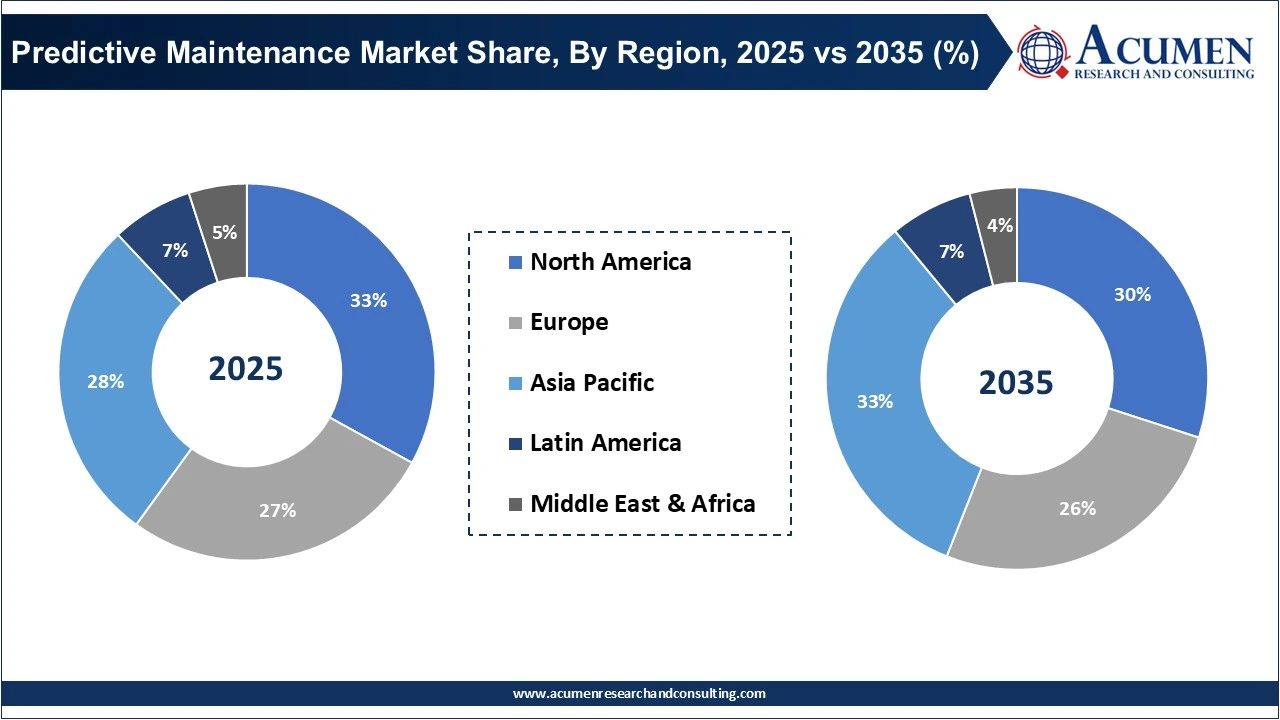
Asia Pacific is predicted to witness the fastest growth with a CAGR of 27.4% from 2025 to 2035, driven by industrial automation growth and the increase in use of industrial robotics. It is also attributed to government support of smart manufacturing and considerable investments in digital transformation across major industrial nations like China, India, Japan and South Korea. Being a global manufacturing center for various sectors including automotive, electronics, semiconductors, heavy machinery, pharmaceutical and consumer products the region accounts for significant demand of predictive maintenance technologies to help boost production efficiency and minimize expensive downtime.
In terms of the use of industrial robots, Asia Pacific is at the top with a considerable majority of robot installations worldwide, China, Japan and South Korea are considered to be the pioneers of automation across all manufacturing industries in this region. Industrial digitisation policies, subsidies for smart factory, AI investment programs and advanced manufacturing incentives across many nations of Asia Pacific encourage the use of smart technologies and assist in enhancing automation processes.
Japan Predictive Maintenance Market
The Japanese predictive maintenance market is rapidly evolving owing to the country's highly automated manufacturing sector, leading robotics industry, and huge investment in smart factory infrastructure. Japan is the one of the world's largest manufacturing industries particularly in the automobile, electronics, semiconductor, robotics and precision machinery, that consequently drive a considerable demand in intelligent maintenance and machinery monitoring technologies.
Japanese companies like Fanuc, Hitachi, and Mitsubishi Electric are extensively investing in industrial AI, machine monitoring solutions and predictive analytics platforms with integrated industrial robotics and factory automation solutions. Japan's Society 5.0 initiatives and smart factory strategy is also significantly fueling industrial IoT and intelligent maintenance infrastructure in the nation's factories.
The solution segment dominated the predictive maintenance market with 68% share in 2025 due to rapid uptake of AI-based industrial monitoring solutions, predictive analytics software, and smart factory technologies in global industrial verticals. Industry enterprises are investing in predictive maintenance solutions in order to reduce unscheduled downtime, maximize equipment effectiveness, and increase operational efficiency while cutting costs related to maintenance activities. Increased deployment of IIoT sensors, connected devices, cloud computing technology, and machine learning algorithm is propelling quick adoption of AI based predictive maintenance software solution across manufacturing industries, energy, logistics, and transportation industries.
Predictive Maintenance Market Revenue Share, By Component, 2025 (%)
| Component | Revenue Share, 2025 (%) | Revenue Share, 2035 (%) |
| Solution | 68% | 69% |
| Services | 32% | 31% |
The services segment accounted for 32% of the predictive maintenance market in 2025 due to increasing demand from clients for dedicated implementation support, professional services, and maintenance of long-term systems used in predictive maintenance implementation. Complex, data-intensive, and smart systems deployed under predictive maintenance projects require the help of professional service providers for their successful integration within industrial enterprises' operational environment. Strong demand for professional services also exists due to the need for system customization and process improvement and workforce training services related to implementation projects.
On-premise deployment segment held 46% share of the predictive maintenance market in 2025, attributed to strong preference of large industrial organizations towards high operational control, security and on-premises data management over critical industrial data. Highly sensitive industrial data and mission-critical assets, such as in the oil & gas, aerospace and defense, automotive manufacturing and utilities sectors tend to adopt on-premises systems due to data privacy and regulatory compliance needs.
Organizations choose the on-premises deployment models to allow them to integrate predictive maintenance solutions with existing IT and manufacturing execution systems in their plants or facilities. This deployment model provides higher customizability, faster on-premises data processing, and eliminates reliance on off-premises cloud infrastructure.
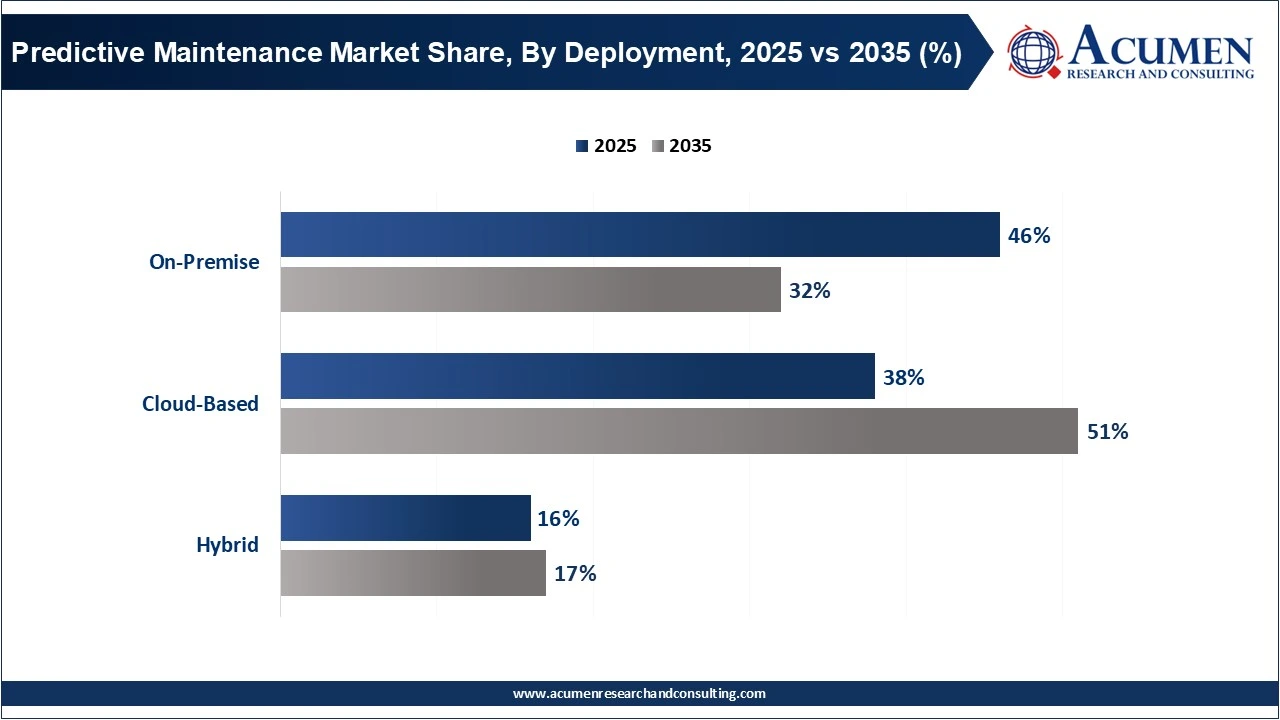
Cloud-based deployment segment captured 38% share of the predictive maintenance market in 2025, and is poised to grow at the highest CAGR of 29.2% during the forecast period, driven by rising adoption of scalable industrial cloud infrastructure, AI based analytical platform and remote asset monitoring solutions. The cloud-based predictive maintenance solutions enable organizations to process massive operational data on an real-time basis while reducing infrastructure management cost, and enhancing deployment flexibility.
Large enterprises captured the predictive maintenance market share of 78% in 2025 due to their strong financial background, industrial operations and early adoption of Industry 4.0 technologies. The growing investments by large-scale manufacturing industries, automotive, power & energy, aviation, oil & gas operators in predictive maintenance systems has enabled them to streamline their equipment's reliability, enhance production efficiencies and reduce operational downtime within the complex industrial environments.
Predictive Maintenance Market Revenue Share, By Enterprise Size, 2025 (%)
| Enterprise Size | Revenue Share, 2025 (%) | Revenue Share, 2035 (%) |
| Large Enterprises | 78% | 64% |
| Small & Medium Enterprises (SMEs) | 22% | 36% |
The small and medium enterprises (SMEs) segment held a market share of 22% in 2025 owing to the expanding availability of low cost predictive maintenance solutions and growing consciousness among users for industrial analytic systems benefits in operations. The adoption of predictive maintenance systems by SMEs is growing due to the cost reduction of repairing equipment, increased utilization of assets and improved manufacturing productivity in restricted operational conditions.
The manufacturing segment accounted for the largest market share of 28% in 2025 due to the growing prevalence of industrial automation, smart factory systems and connected manufacturing technologies across various manufacturing plants globally. Manufacturing companies are susceptible to immense monetary risks with the likelihood of machinery failure, production delays and operational breakdown, making predictive maintenance systems a crucial tool to maintain operational continuity.
Growing number of deployment of industrial robots, automated assembly line machinery, CNC machines and AI based manufacturing systems among manufacturing facilities is greatly fueling the demand for predictive maintenance platforms, which can continuously monitor machinery health. Industries such as automotive, electronics, heavy machinery, food and beverage and semiconductor manufacturing are investing extensively in predictive analytics solutions to increase OEE and minimize maintenance-related breakdown in their operations.
Predictive Maintenance Market Revenue Share, By End Use Industry, 2025 (%)
| End Use Industry | Revenue Share, 2025 (%) |
| Manufacturing | 28% |
| Energy & Utilities | 18% |
| Oil & Gas | 14% |
| Automotive | 10% |
| Aerospace & Defense | 7% |
| Healthcare & Pharmiaceuticals | 6% |
| Transportation & Logistics | 8% |
| Construction | 4% |
| IT & Telecom | 3% |
| Others | 2% |
The second largest share of 18% was held by energy & utilities segment in 2025 due to the ever-increasing need to continuously monitor crucial infrastructure like transformers, power grids, substations, turbines, and renewable energy systems. Failure of critical equipment in power generation and utility networks could result in major operational disruption and large-scale service outage and financial losses, significantly elevating the importance of predictive maintenance in this industry.
Utility organizations are implementing AI powered monitoring systems, digital twins and industrial analytics solutions to monitor asset performance and schedule maintenance activities effectively. Increasing adoption of predictive maintenance solutions is being driven by rapid development and deployment of renewable energy infrastructure such as smart grid, wind farms and solar plants.
| Company | Major Offerings |
| IBM | Provides AI-powered predictive maintenance solutions through IBM Maximo Application Suite, offering asset performance management, predictive analytics, condition monitoring, and industrial IoT integration capabilities. |
| Siemens | Offers predictive maintenance platforms integrated with Industrial IoT, digital twins, MindSphere industrial cloud, and smart manufacturing solutions for factories and industrial assets. |
| General Electric | Develops industrial predictive analytics and asset monitoring solutions for power generation, aviation, manufacturing, and energy infrastructure through its Proficy and APM platforms. |
| Honeywell | Provides connected plant solutions, predictive maintenance software, industrial automation systems, and AI-enabled operational performance platforms for manufacturing and energy sectors. |
| Schneider Electric | Offers EcoStruxure predictive maintenance solutions including industrial automation, energy monitoring, smart asset management, and AI-powered operational analytics. |
| Rockwell Automation | Specializes in FactoryTalk analytics platforms, industrial automation systems, machine condition monitoring, and predictive maintenance software for smart factories. |
| SAP | Provides predictive asset insights, enterprise asset management, cloud analytics, and AI-driven maintenance optimization solutions integrated with industrial ERP platforms. |
| ABB | Offers ABB Ability digital platforms featuring predictive maintenance, industrial robotics analytics, remote equipment monitoring, and smart manufacturing technologies. |
| Microsoft | Delivers Azure-based predictive maintenance solutions, industrial AI, cloud computing infrastructure, and IoT-enabled operational analytics platforms for connected industries. |
| Amazon Web Services | Provides industrial cloud infrastructure, IoT analytics, AI-powered monitoring tools, and predictive maintenance services through AWS IoT and machine learning platforms. |
By Component
By Deployment
By Enterprise Size
By End Use Industry
By Region
Looking for discounts, bulk pricing, or custom solutions? Contact us today at sales@acumenresearchandconsulting.com

November 2023
February 2023
March 2026
March 2025
Trusted Market Intelligence | 2026–2035 Insights | Designed to Support Faster, Smarter Decisions
Thank you! Our team will reach out to you soon.