
Recyclable Packaging Market Size, Share, Trends and Forecast 2026 to 2035
Recyclable Packaging Market (By Material Type: Paper & Paperboard, Plastics, Glass, Metals, Wood, Others; By Packaging Type: Paper and Cardboard Packaging, Bottles and Jars, Flexible Films, Wraps and Pouches, Cans and Other Metal Containers, Protective and Transit Packaging, Others; By End-Use Industry: Food & Beverages, E-commerce and Logistics, Healthcare and Pharmaceuticals, Personal Care and Cosmetics, Household and Home Care, Industrial and Chemicals, Others) - Global Industry Analysis, Size, Share, Regional Analysis, Trends and Forecast 2026 - 2035
- Last Updated: 30 Oct 2026
- Report Code: ARC3248
- Category: Packaging
Recyclable Packaging Market Size and Forecast to 2035
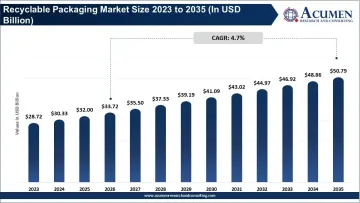
The global recyclable packaging market size was valued at USD 32 billion in 2025 and is expected to reach at USD 50.79 billion by 2035, while expanding at a promising CAGR of 4.7% during the forecast period 2026 to 2035. The recyclable packaging market is growing as businesses respond to stricter packaging waste regulations, rising consumer preference for sustainable products, corporate environmental commitments, and advancements in recyclable materials. Investments in recycling infrastructure and circular packaging solutions are further supporting market adoption.
Recyclable Packaging Market Key Metrics
- Base Year Market Size (2025): $32 billion
- Current Year Market Size (2026): $33.72 billion
- Estimated Year Market Size (2035): $50.79 billion
- Forecast Period CAGR (2026-2035): 4.7%
Key Takeaways
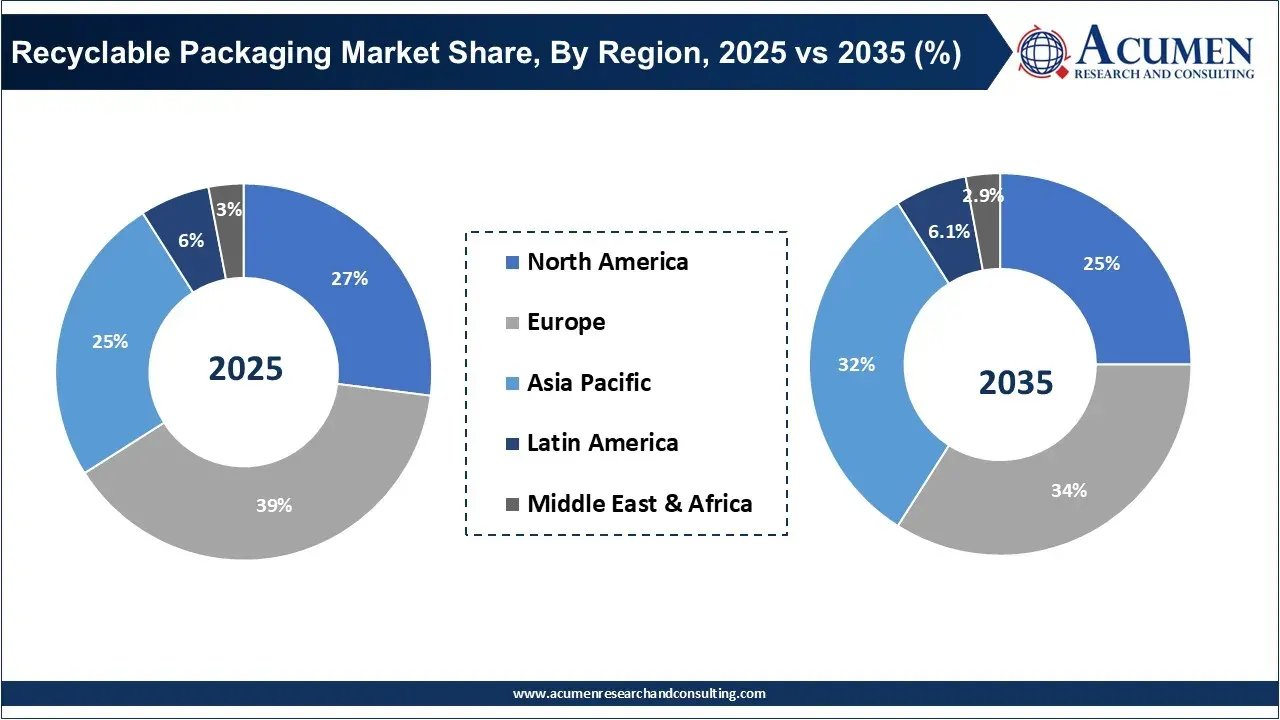
- By region: Europe dominated the Recyclable Packaging Market with a 39.0% share in 2025, generating USD 12.48 billion in revenue. Asia-Pacific is the fastest-growing region, with a projected CAGR of 7.6% from 2026 to 2035, and is expected to reach USD 16.25 billion by 2035.
- By material type: Paper and paperboard dominated the material type segment with a 37.0% share in 2025. Its share is projected to increase to 39.0% by 2035, supported by demand for fiber-based packaging, established recycling systems, and recyclable alternatives for consumer goods.
- By packaging type: Paper and cardboard packaging dominated the packaging type segment with a 32.0% share in 2025, generating USD 10.79 billion in 2026. The segment is projected to reach USD 17.27 billion by 2035, growing at a CAGR of 5.4% from 2026 to 2035, supported by demand from e-commerce, retail, and food packaging.
- By end-use industry: Food and beverages dominated the end-use industry segment with a 40.0% share in 2025. E-commerce and logistics ranked second with a 14.0% share, supported by growing demand for recyclable shipping cartons, corrugated boxes, and protective packaging as parcel deliveries expand.
What Is the Recyclable Packaging Market?
The recyclable packaging market comprises packaging materials and solutions designed to be collected, sorted, processed, and converted into materials for manufacturing new products or packaging. It includes paper and paperboard, glass, metals, and recyclable plastics used across food and beverages, healthcare, personal care, e-commerce, and industrial applications. Market development is influenced by environmental regulations, material innovation, recycling infrastructure, and growing efforts to reduce packaging waste and dependence on virgin raw materials.
Recent Trends Shaping
- Shift Toward Mono-Material Packaging: Manufacturers are developing packaging made from compatible single-material structures to simplify sorting and recycling while maintaining the functional properties required for product protection.
- Growing Use of Recycled Content: Brands are increasing the incorporation of recycled materials into packaging where technically feasible, supporting circular material flows and reducing reliance on virgin resources.
- Innovation in Recyclable Flexible Packaging: Advances in polymer films, barrier coatings, and sealant technologies are helping improve the recyclability of flexible packaging used in food, personal care, and household products.
- Expansion of Paper-Based Packaging: Businesses are adopting recyclable paperboard, molded fiber, and corrugated packaging for retail and e-commerce applications as alternatives to selected plastic packaging formats.
Regulatory Landscape for Recyclable Packaging
| Country or Region | Regulation or Policy | Key Requirements |
|---|---|---|
| European Union | Packaging and Packaging Waste Regulation (PPWR), Regulation (EU) 2025/40 | Establishes requirements covering packaging sustainability, recyclability, recycled content, packaging waste prevention, and producer responsibility. The regulation generally applies from August 12, 2026, with requirements phased in according to specific provisions. |
| United States | State-level Extended Producer Responsibility (EPR) laws | States including California, Oregon, Colorado, and Maine have enacted packaging EPR frameworks. Requirements vary but can include producer registration, reporting, fees, and financing or supporting packaging waste management programs. |
| United Kingdom | Packaging Extended Producer Responsibility (pEPR) | Requires obligated businesses to report relevant packaging data and contribute toward packaging waste management costs under applicable rules. Modulated fees can create incentives to improve packaging recyclability. |
| India | Plastic Waste Management Rules, 2016, and subsequent amendments | Establishes responsibilities for plastic waste management, including EPR obligations for applicable producers, importers, and brand owners. Businesses must comply with relevant registration, reporting, and recycling requirements. |
| Canada | Provincial and Territorial EPR Frameworks | Packaging producer responsibility requirements are implemented through provincial and territorial systems. Obligations vary by jurisdiction and may cover financing, collection, recovery, and reporting for designated packaging materials. |
| Australia | National Packaging Targets and the Australian Packaging Covenant framework | Policy initiatives and industry commitments encourage packaging to be recyclable, reusable, or compostable and increase recycled content. Applicable obligations depend on the relevant framework and jurisdiction. |
| Japan | Act on the Promotion of Sorted Collection and Recycling of Containers and Packaging | Establishes a framework for sorting, collection, and recycling specified packaging materials, with responsibilities allocated among municipalities, businesses, and consumers. |
Adoption & Potential Statistics
- The United States produced 66.3 million tons of paper and paperboard in 2025, while packaging paper production increased 1.7% year over year.
- UK recycled 4.069 million tonnes of paper and cardboard packaging in 2024, achieving an 84.1% recycling rate.
- The UK generated 2.156 million tonnes of plastic packaging waste in 2024, of which 1.154 million tonnes were recycled, representing a 53.5% recycling rate.
- The UK recycled 1.759 million tonnes of glass packaging in 2024 from 2.223 million tonnes generated, achieving a 79.1% recycling rate.
- The UK recycled 157,000 tonnes of aluminum packaging in 2024 from 238,000 tonnes generated, achieving a 65.9% recycling rate.
- The UK recycled 379,000 tonnes of steel packaging in 2024 from 444,000 tonnes generated, achieving an 85.5% recycling rate.
- The UK recycled 8.154 million tonnes of packaging waste in 2024, representing a 73.2% recycling rate.
- An estimated 42.8 million tonnes of consumer packaging were placed on the market in 2024 across 19 EU member states, including 32.3 million tonnes of glass-based packaging and 5.9 million tonnes of plastic packaging.
- An estimated USD 36.5 billion to USD 43.4 billion was needed to modernize U.S. recycling infrastructure, including collection, sorting, and material-processing facilities.
Recyclable Packaging Market Dynamics
Growth Drivers
- Stringent Packaging Waste Regulations: Governments are introducing extended producer responsibility requirements, recycling targets, and restrictions on certain single-use plastics, encouraging manufacturers to adopt recyclable packaging materials and redesign packaging formats to improve end-of-life recovery.
- Growing Consumer Preference for Sustainable Packaging: Increasing environmental awareness is influencing purchasing decisions, encouraging brands across food and beverages, personal care, and household products to replace difficult-to-recycle packaging with recyclable alternatives that support sustainability commitments.
- Corporate Sustainability Commitments: Consumer goods companies and retailers are incorporating packaging recyclability into environmental targets and procurement strategies, increasing demand for recyclable paper, cardboard, glass, metals, and compatible plastic packaging solutions.
Restraints
- Limited Recycling Infrastructure: Uneven collection systems, sorting capabilities, and recycling facilities can prevent recyclable packaging from being recovered efficiently, particularly in regions where waste management infrastructure is underdeveloped.
- Higher Costs of Material Transition: Switching to recyclable packaging may require new equipment, packaging redesign, material testing, and supply chain adjustments, increasing initial costs for manufacturers operating with established production processes.
- Performance Limitations of Recyclable Materials: Some recyclable alternatives may offer lower moisture resistance, oxygen barriers, heat tolerance, or mechanical strength than conventional multilayer packaging, limiting their suitability for products with demanding protection requirements.
Key Opportunities
- Innovation in Mono-Material Packaging: Developing packaging made from compatible single-polymer structures creates opportunities to improve recyclability while maintaining product protection, supporting applications in flexible packaging, personal care, food, and household products.
- Expansion of Recycled Material Integration: Improvements in sorting, processing, and material recovery create opportunities to incorporate recycled content into packaging where technically and legally appropriate, strengthening circular material supply chains and reducing reliance on virgin resources.
- Growth in Recyclable Flexible Packaging: Advances in recyclable films, barrier coatings, and flexible packaging structures create opportunities to replace selected difficult-to-recycle formats while retaining lightweight designs and efficient product distribution.
Challenges
- Maintaining Packaging Functionality: Manufacturers must ensure that recyclable packaging provides adequate shelf life, product safety, durability, and barrier performance, particularly for food, pharmaceuticals, and other products sensitive to moisture, oxygen, or contamination.
- Inconsistent Recycling Standards: Differences in recyclability definitions, labeling requirements, collection systems, and processing capabilities across countries complicate packaging design and make it difficult for global brands to implement consistent solutions.
- Scaling Recycling and Recovery Systems: Increasing recyclable packaging adoption requires coordinated investment in collection, sorting, recycling capacity, and end-market demand for recovered materials. Without sufficient infrastructure and material offtake, recyclable packaging may not be effectively recycled in practice.
Recyclable Packaging Market Segmentation Insights
Material Type Insights
Paper & Paperboard: Paper and paperboard dominated the recyclable packaging market by material type in 2025, accounting for 37.0% of the market. Their share is projected to increase to 39.0% by 2035. Established collection systems, established converting capabilities, printability, and widespread use in cartons, corrugated boxes, and paper-based containers support adoption. Continued development of recyclable barrier coatings and fiber-based alternatives is expanding their potential across food, retail, and e-commerce packaging.
Plastics: Plastics accounted for 24.0% of the recyclable packaging market in 2025, making them the second-largest material category. Their lightweight construction, durability, flexibility, and sealing performance support their use in bottles, films, pouches, and containers. Adoption increasingly depends on the development of mono-material structures, improved sorting and recycling compatibility, and the availability of suitable collection infrastructure. The projected 23.0% share in 2035 indicates a modest decline in relative market position.
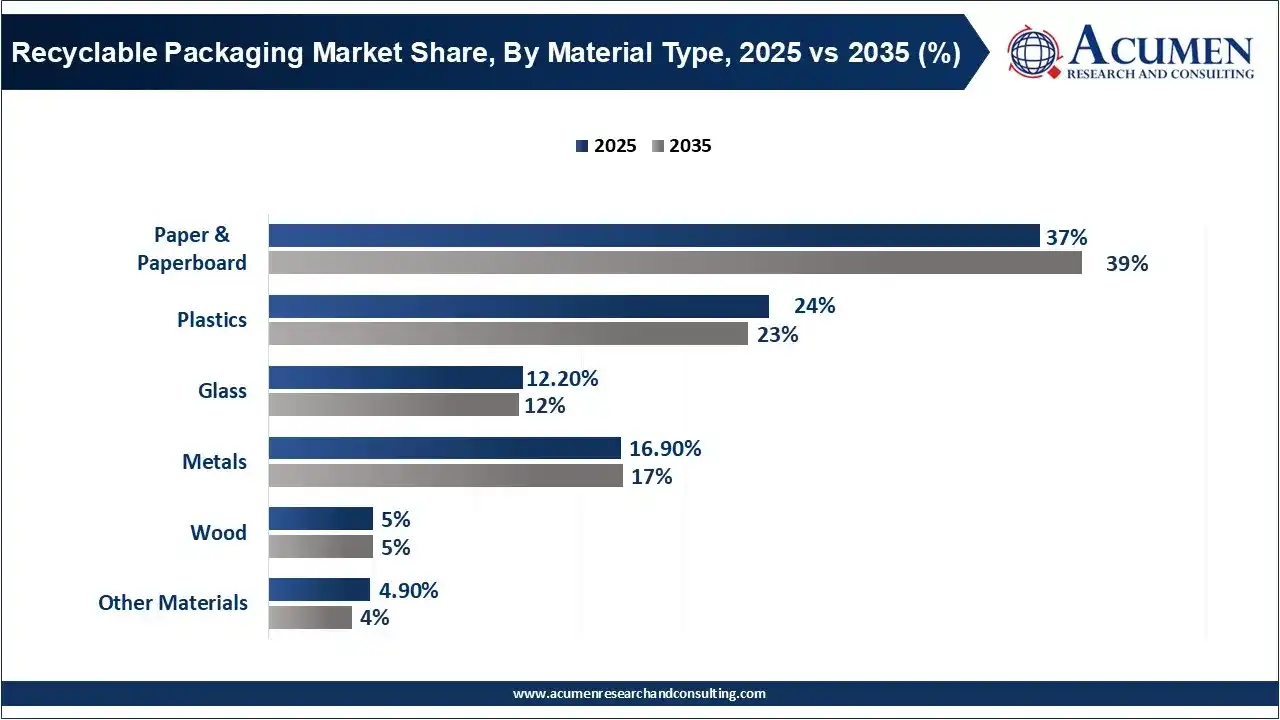
Metals: Metals represented 16.9% of the market in 2025, ranking third among the listed material categories. Their durability, barrier properties, and established recovery pathways support applications in beverage cans, food containers, and industrial packaging. Aluminum and steel can be recycled repeatedly when collected and processed appropriately, making them relevant to circular packaging strategies. The segment's share is projected to increase slightly to 17.0% by 2035.
Packaging Type Insights
Paper and Cardboard Packaging: Paper and cardboard packaging dominated the market in 2025, accounting for 32.0% of total revenue. The segment is projected to reach USD 17.27 billion by 2035, growing at a CAGR of 5.4% from 2026 to 2035. Demand from e-commerce, retail distribution, and consumer goods supports its adoption, while manufacturers are developing paper-based formats with improved moisture resistance and protective performance.
Bottles and Jars: Bottles and jars held a 24.0% market share in 2025, making them the second-largest packaging category. The segment is projected to reach USD 11.68 billion by 2035, expanding at a CAGR of 4.2% from 2026 to 2035. Glass bottles and recyclable plastic containers serve food, beverage, personal care, and household applications. Lightweighting, recycled-content integration, and packaging designs compatible with established recovery systems support continued development.
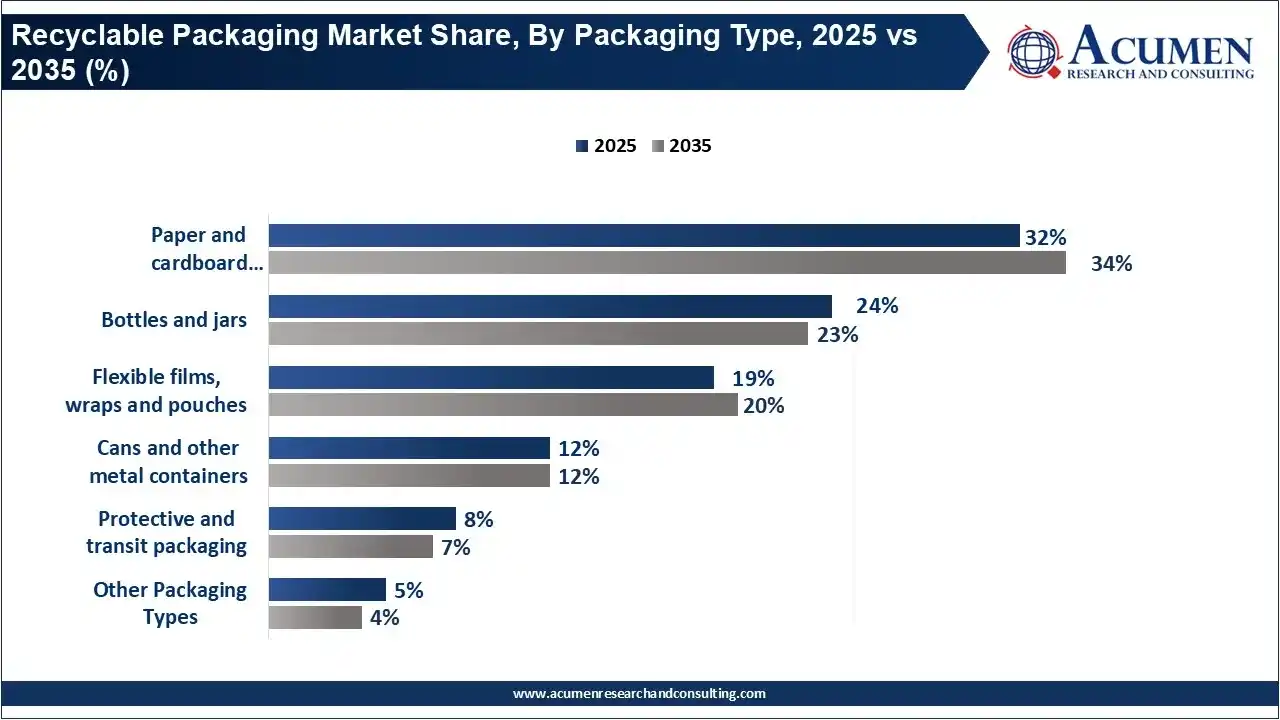
Flexible Films, Wraps and Pouches: Flexible films, wraps, and pouches accounted for 19.0% of the market in 2025, ranking third among packaging types. The segment is expected to grow at a CAGR of 5.3% from 2026 to 2035, reaching USD 10.16 billion by 2035. Innovations in mono-material films, recyclable barrier structures, and flexible packaging designs are helping manufacturers address product protection requirements while improving compatibility with recycling systems.
End-Use Industry Insights
Food & Beverages: Food and beverages dominated the recyclable packaging market by end-use industry in 2025, accounting for 40.0% of the market. The sector's extensive use of cartons, bottles, cans, trays, and flexible packaging supports demand. Manufacturers must balance recyclability with food safety, moisture and oxygen barriers, shelf life, and transport protection, encouraging the development of improved paper-based packaging and recyclable plastic structures.
E-commerce and Logistics: E-commerce and logistics represented 14.0% of the market in 2025, making it the second-largest end-use industry. Demand for shipping cartons, corrugated boxes, protective paper packaging, and transit materials supports adoption. Growth in parcel deliveries and efforts to reduce unnecessary packaging are encouraging businesses to improve package sizing, replace difficult-to-recycle protective materials, and increase the use of recyclable shipping formats.
Healthcare and Pharmaceuticals: Healthcare and pharmaceuticals accounted for 11.0% of the market in 2025, ranking third among end-use industries. Adoption is supported by demand for medicine cartons, bottles, secondary packaging, and selected recyclable pharmaceutical containers. However, packaging used for sterile products and sensitive medicines must meet strict requirements for product integrity, contamination control, barrier performance, and regulatory compliance, limiting material substitution in some applications.
Recyclable Packaging Market Regional Analysis
Europe: Largest Regional Recyclable Packaging Market
Europe led the global market for recyclable packaging in 2025 with USD 12.48 billion, 39.0% of global revenues. The market is estimated to reach USD 17.27 billion by 2035 with a market share of 34.0%. The demand is being driven by packaging waste legislation, well-developed collection and recycling systems and corporate commitments to circular packaging.
But recycling rates vary by material and country, largely depending on sorting capacity and end-market demand for recovered materials. Opportunities for expansion include recyclable paperboard, mono-material flexible packaging and recycled content solutions.
- Germany: Germany is an important European packaging market with well-established waste collection and recycling infrastructure, extended producer responsibility rules and market for recyclable packaging in food, beverage, industrial and consumer goods sectors.
Asia-Pacific: Fastest-Growing Regional Recyclable Packaging Market
Asia-Pacific is expected to be the fastest-growing regional market with a 7.6% CAGR between 2026 and 2035. Revenue will be driven from USD 8.43 billion in 2026 to USD 16.25 billion by 2035. The region is also set to see an increase in market share from 25.0% in 2025 to 32.0% in 2035, owing to the growing manufacturing capacity, urbanization, and ecommerce activity.
Demand for packaged food and consumer goods, investments in recycling infrastructure, and redesigning of packaging materials will create some opportunities, though coverage of collection, waste management systems, and enforcement varies across regional markets.
- China: is one of the leading markets in the region for plastic, paperboard and consumer packaging manufacturing. China's significant packaging manufacturing base, growing e-commerce market and policies to combat plastic pollution contribute to the growth of recyclable packaging and packaging innovation.
North America: Mature Packaging & Recycling Sector
North America was 27.0% of the total recyclable packaging market in 2025 at USD 8.64 billion. This regional market is expected to reach USD 12.70 billion by 2035, accounting for 25.0% of market share. Access to packaging via mature and still expanding packaging and consumer goods manufacturers as well as extensive use of the segments' primary, semi-rigid forms such as corrugated boxes, metal cans, glass containers and plastic bottles, make this region attractive to consumers.
Regional companies are redirecting packaging materials that use recycled materials, aiming to achieve a higher level of recyclability. Availability of recycling infrastructure, collection economics and packaging legislations within states and provinces affect investment decisions and the rate of material adoption.
- United States: With the region's largest food and beverage processing, e-commerce fulfilment, packaging manufacturing, and investment in recycled-content material and recycling infrastructure, the U.S. is region's largest packaging market.
Recyclable Packaging Market Competitive Landscape
- Amcor: Develops recyclable rigid and flexible packaging solutions for food, beverage, healthcare, and personal care applications, with a focus on packaging redesign and circularity.
- Mondi: Strengthens the market through mono-material flexible packaging, recyclable paper-based solutions, and high-barrier packaging innovations.
- Berry Global: Offers recyclable plastic bottles, containers, cups, and films, including packaging incorporating post-consumer recycled materials.
- Huhtamaki: Develops fiber-based food packaging, including recyclable paper cups designed to reduce plastic content while maintaining product protection.
- Tetra Pak: Advances carton packaging circularity through packaging design, certified recycled polymers, and investments in collection and recycling infrastructure.
- Sealed Air: Contributes through protective food packaging and material innovations that aim to reduce packaging waste while maintaining product integrity.
- Smurfit Westrock: Focuses on paper-based and corrugated packaging solutions that support recyclable transport, e-commerce, and consumer packaging applications.
- Sonoco: Serves the market through paper-based, rigid, and flexible packaging formats, including solutions designed around material recovery and packaging efficiency.
- International Paper: Supports recyclable packaging adoption through fiber-based packaging materials, corrugated products, and renewable-fiber packaging solutions.
- Crown Holdings: Contributes through metal packaging, including aluminum and steel beverage and food containers that can be recovered through established metal recycling systems.
Development Outlook
- May 2026 – Amcor: Launched PP Revolution, a range of recycle-ready polypropylene dip cups and lidding solutions for sauces, dressings, and condiments, designed to support packaging recyclability while maintaining product protection.
- June 2026 – Mondi: Introduced re/loop FlowWrap, a mono-polypropylene wet wipes packaging solution containing 35% post-consumer recycled content and designed for compatibility with polypropylene mechanical recycling.
Segments Covered
By Material Type
- Paper & Paperboard
- Plastics
- Glass
- Metals
- Wood
- Other Materials
By Packaging Type
- Paper and Cardboard Packaging
- Bottles and Jars
- Flexible Films, Wraps and Pouches
- Cans and Other Metal Containers
- Protective and Transit Packaging
- Other Packaging Types
By End-Use Industry
- Food & Beverages
- E-commerce and Logistics
- Healthcare and Pharmaceuticals
- Personal Care and Cosmetics
- Household and Home Care
- Industrial and Chemicals
- Others
By Region
- North America
- Europe
- Asia-Pacific
- Latin America
- Middle East & Africa
Looking for discounts, bulk pricing, or custom solutions? Contact us today at sales@acumenresearchandconsulting.com
Frequently Asked Questions

Related Market Research Reports
October 2026
October 2026
July 2026
May 2026
December 2025
November 2025
May 2025
April 2025